

Published: · Updated:
Air Brake Valves on a Semi Truck: Types and Functions
A plain guide to every valve in a semi truck air brake system: what each one does, the symptom it gives when it fails, and which VADEN post to read next.
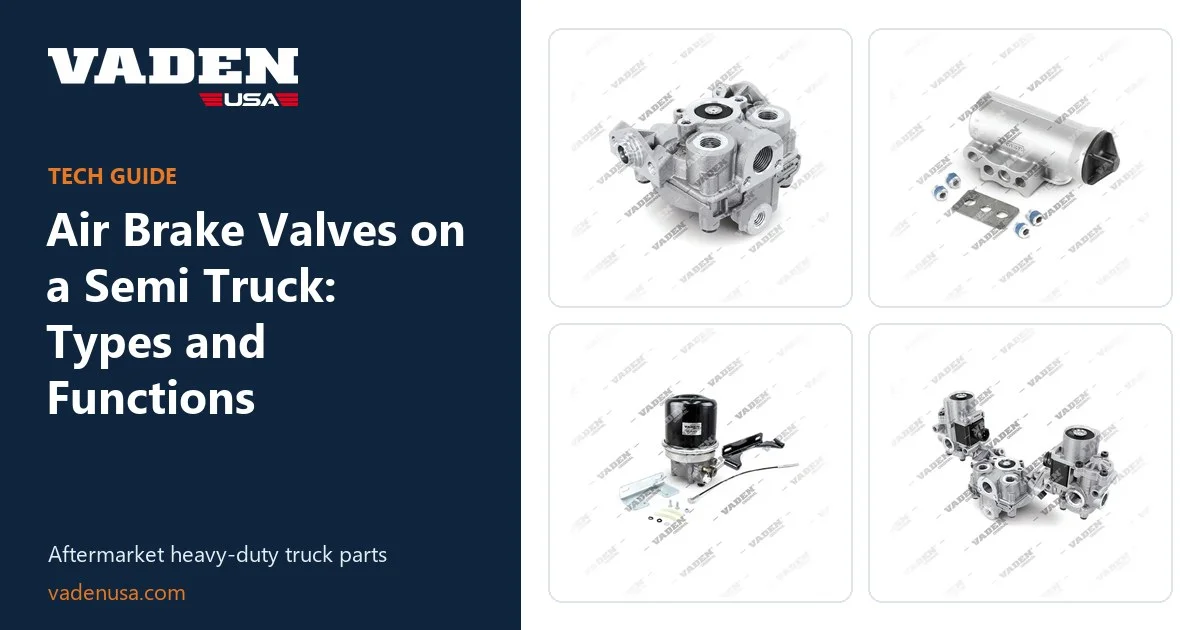
The air brake valves on a semi truck control where compressed air goes, how much pressure it holds and how fast it is applied or released. Valves fall into four jobs: supply and protection (governor, safety, check, pressure protection), air treatment (dryer and purge), driver control (treadle, parking and trailer supply) and delivery (relay, quick release, ABS modulator).
How the valves fit together
Air starts at the compressor, passes through the air dryer and fills the supply tanks. From there it feeds the service brakes through the treadle valve and relay valves, and it holds the spring brakes released through the parking control. Every valve below sits somewhere on that path. For the full flow, read our guide on how air brakes work on a semi truck.
Federal rules require a low air pressure warning that is active at 55 psi or half the governor cut-out pressure, whichever is less, and state CDL manuals describe the other pressures drivers are tested on (see 49 CFR 393.51 at FMCSA and the New York CDL Manual, Section 5 (air brakes)). Exact pressures vary by manufacturer, so always confirm against the service manual for your truck.
Air brake valves at a glance
| Valve | System | What it does | Common symptom |
|---|---|---|---|
| Governor | Supply | Tells the compressor and dryer when to build or stop building pressure | Pressure builds too high or too low, or the compressor never unloads |
| Safety (pop-off) valve | Supply | Vents air if pressure goes too high | Hissing and venting near the compressor or first tank |
| Air dryer purge valve | Air treatment | Releases water and contaminants when the compressor unloads | Constant air leak at the dryer, or water in the tanks |
| Check valve (one-way) | Supply | Lets air flow one way so a leak upstream does not drain a tank | Tank pressure drops after shutdown while the line upstream is fine |
| Pressure protection valve | Supply | Closes a circuit if its pressure falls too low so the others stay charged | One circuit will not charge, or a leak drains the whole system |
| Drain valve | Tanks | Removes water and oil from the tank | Water at the drain, slow leak at the valve, freezing in winter |
| Treadle valve | Service brakes | Meters air to the brakes in proportion to pedal travel | Soft or slow pedal, air leak at the pedal, brakes that hang on |
| Relay valve | Service brakes | Sends a large air volume to the rear brakes when it gets a small control signal | Slow apply or release at the rear axle |
| Quick release valve | Service brakes | Dumps air from a chamber fast when the pedal is released | Slow brake release, air leak at the exhaust port |
| Spring brake control valve | Parking | Applies and releases the spring brakes through the dash knob | Spring brakes will not release, or apply while driving |
| Trailer supply (red) and parking (yellow) valves | Parking and trailer | Charge the trailer and control the tractor parking brake | Knob will not stay in, trailer will not charge |
| Tractor protection valve | Trailer | Shuts off tractor air if the trailer line breaks away | Trailer will not charge, or air loss when a trailer hose fails |
| ABS modulator valve | ABS | Holds, releases or reapplies air to a wheel to prevent lockup | ABS light on, dragging or uneven brakes on one wheel end |
Supply and protection valves
Governor
The governor senses system pressure and signals the compressor to stop pumping (cut-out) and start again (cut-in). CDL manuals describe a cut-out around 125 psi and a cut-in around 100 psi, but the real settings depend on the truck. It also triggers the air dryer purge. See the air governor guide, and browse compressor governor valves.
Safety valve
The safety valve is a spring-loaded pop-off that opens if pressure climbs too high, well above the governor cut-out. The exact opening pressure depends on the system, so check the service manual. A valve that pops regularly usually points to a stuck governor or unloader, not a bad valve. Read truck air compressor safety valve: location and pop-off causes, and see compressor safety valves.
Air brake check valve
An air brake check valve is a one-way valve. It lets air in but not back out, so the tanks stay charged if a line upstream leaks. Check valves are built into many dryers, compressor discharge fittings and wet tank ports, and they are also part of pressure protection valves. We do not have a stand-alone post on them; the air brake flow guide shows where they sit.
Pressure protection valve
An air brake pressure protection valve opens only above a set pressure and closes again if that circuit falls below it. This keeps the primary and secondary circuits from draining each other, and it protects the main system from a failure in an accessory or trailer circuit. The same valve type is sometimes called a trailer pressure protection valve when it guards the trailer supply circuit. Full detail is in pressure protection valve: how it works and fails.
Air treatment valves
Air dryer and purge valve
The air dryer removes moisture and oil vapor from the air, and its purge valve discharges the collected contaminants each time the governor unloads the compressor. A purge valve that never seals shows up as a constant leak at the dryer exhaust. See air dryer purge valve: symptoms, location, replacement and the overview semi truck air dryer guide. If the truck has an air processing unit, read air dryer vs APU.
Tank drain valve
Drain valves let you remove water and oil from each tank, either by hand or automatically. They are small, but a leaking or frozen one can pull system pressure down or let moisture reach the brakes. Compare types in the air tank drain valve guide. For cold-weather icing, see air line antifreeze and frozen air brakes.
Driver control and service brake valves
Treadle (foot brake) valve
The treadle valve is under the brake pedal. It sends air to the service brake circuits in proportion to how far you press, and it exhausts that air when you lift. Worn plungers or seals cause a spongy pedal or a leak at the pedal. See treadle valve: how it works and fails.
Relay valve
A relay valve is a remote-mounted valve that takes a small control signal from the treadle valve and passes a large volume of air from the tank straight to the brake chambers, so rear brakes apply and release quickly without a long air line to the pedal. Learn the differences in air brake relay valve guide: R-12 vs R-14, and see VADEN relay valves.
Quick release valve
Placed near the brake chambers, the quick release valve exhausts chamber air locally instead of sending it back to the treadle valve. That speeds up release. A quick release valve that leaks or sticks gives slow release or a steady hiss at the exhaust. Read air brake quick release valve: how it works and fails.
ABS modulator valve
The ABS modulator is an electrically controlled valve at each controlled wheel end or axle. On a signal from the ABS controller it holds, releases or reapplies brake pressure to stop wheel lockup. See ABS modulator valve: symptoms and replacement and the wider ABS brake system guide.
Parking and trailer valves
Spring brake control valve
The spring brake valve (also called the spring brake control valve) is the dash-controlled valve that exhausts air from the spring brake chambers to apply the parking brake and charges them to release it. A truck that will not release, or applies spring brakes unexpectedly, may have low system pressure rather than a failed valve. Read what spring brakes are and how to cage them safely.
Parking (yellow) and trailer supply (red) valves
The yellow diamond knob controls the tractor parking brake and the red octagon knob supplies air to the trailer. Both are push-pull valves. The red knob pops out and closes the trailer supply when system pressure falls into the range described in CDL manuals (roughly 20 to 45 psi), and the yellow knob pops out as the spring brakes apply. Our CDL air brakes study guide covers the numbers drivers are tested on.
Tractor protection valve
The tractor protection valve is operated by the red trailer supply knob. If a trailer line breaks away or leaks badly, it closes so the tractor keeps its air. Test it during the pre-trip as described in tractor protection valve: what it does and how to test it, and see the connection side in glad hands and trailer air lines.
Other valves you may meet
Trucks with air suspension and air-ride cabs use a leveling valve to hold ride height; see the cab leveling valve guide. Air over hydraulic systems use air to apply hydraulic brakes; see air over hydraulic brakes.
How to find a bad valve
- Chock the wheels, build full pressure and shut the engine off. Note the pressure.
- Listen and use soapy water to find leaks at each valve, exhaust port and fitting.
- Do the standard leakage test with the brakes released, then applied, as in your pre-trip routine. See the CDL pre-trip checklist and the DOT air brake inspection checklist.
- Check the governor cut-in and cut-out, and the low air warning, against the service manual.
- Replace the valve that matches the leak and recheck. Do not guess at several at once.
Parts by system
VADEN lists parts for several of these valves. Browse the categories below, then match your OE number with our cross-reference guide.
- Supply: compressor governor valves, compressor safety valves and unloader valves.
- Air treatment: air dryer valves and air processing units.
- Delivery: relay valves and ABS solenoid modulator valves.
- Cab: cab suspension leveling valves.
We do not list every valve in this guide, such as treadle, quick release or stand-alone pressure protection valves. Ask us if you need one. OEM brand names such as Bendix, WABCO and Haldex are trademarks of their owners and are used only for reference when you cross-reference a part. VADEN parts are aftermarket replacements and are not made or approved by those companies.
FAQ
What is a pressure protection valve?
It is a valve that stays closed until a circuit reaches a set pressure, then closes again if that circuit falls below it. It keeps a leak in one circuit from draining the rest of the brake system. See our pressure protection valve post.
What does an air brake check valve do?
It allows air to flow in one direction only. If the supply line leaks, the check valve traps the air already in the tank so brake pressure is not lost back through the leak.
What is the difference between a relay valve and a quick release valve?
A relay valve takes a small control signal and delivers a large volume of air from a tank to the brake chambers. A quick release valve only speeds up exhaust from the chambers when you release the brakes.
What is a spring brake valve?
It is the control valve that exhausts air from the spring brake chambers to apply the parking brake and supplies air to release it. On a tractor it is operated from the dash by the yellow parking knob.
Where is the safety valve on a truck air system?
It is usually on the first tank the compressor fills (the supply or wet tank). Locations vary, so check your service manual.
Why does my air brake system lose pressure when the engine is off?
Common causes are a leaking check valve, drain valve, treadle valve, relay valve, quick release valve or chamber. Use the leak test above to isolate it.
Need a valve or a cross-reference?
Send your OE number or truck model to info@vadenusa.com or use the contact page to request a quote or open an account.
Blog
3 2026-11-19
Air Brake Troubleshooting Guide: Symptoms, Causes, Fixes
Symptom-by-symptom air brake troubleshooting for semi trucks: slow build-up, pressure loss, constant dryer purge, locked brakes and ABS faults, with first checks.
 2026-11-19
Trailer ABS Light: Causes, Reset and DOT Violation Rules
Why the ABS light stays on a semi trailer, what the power-up check should look like, common causes, blink codes, resetting and what DOT rules say.
 2026-11-19
WABCO Air Compressor: ID, Rebuild Kits and Replacement
How to identify a WABCO air brake compressor by its 10-digit number, tell single from twin cylinder, and decide between a repair kit and a replacement unit.