

Published: · Updated:
Air Brake Quick Release Valve: How It Works and Fails
How an air brake quick release valve works, how to spot leaks and slow release, how to test and replace it, and how it differs from a relay valve.
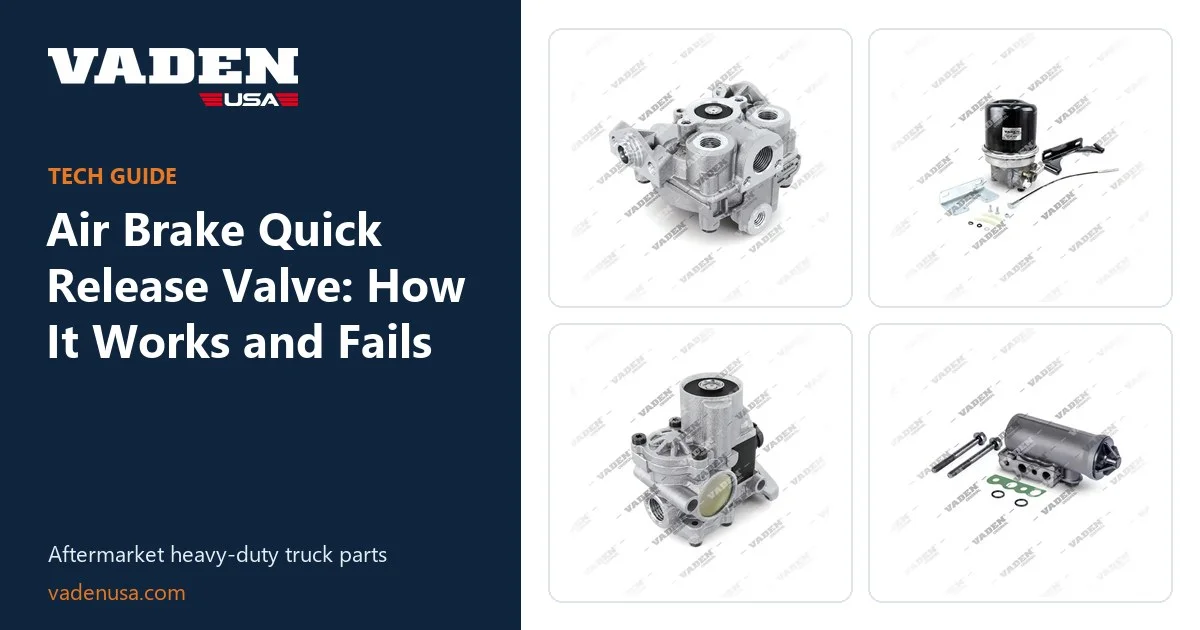
An air brake quick release valve lets air leave a brake chamber through its own exhaust port instead of traveling back to the brake pedal valve, so the brakes release faster. It is a small diaphragm valve with supply, delivery and exhaust ports. If it hisses, drags or releases slowly, test it and replace it.
This guide is written for mechanics and fleet managers. It covers what the valve does, where it is used, how to tell it from a relay valve, how to find a leak, and how to replace it. One honest note up front: VADEN does not sell quick release valves. The nearest parts we make are relay valves, covered in the VADEN parts section below.
How an air brake quick release valve works
The valve has three ports and one moving part, a flexible diaphragm that acts as both inlet and exhaust seal.
- Supply port: air arrives from the brake valve or an upstream valve when the driver applies the brakes.
- Delivery ports: air leaves toward the brake chambers.
- Exhaust port: open to the atmosphere, usually covered by a rubber flap or screen.
When the driver presses the pedal, supply pressure pushes the diaphragm against the exhaust seat. The exhaust closes and air flows around the diaphragm edge to the delivery ports and on to the chambers. When the driver lets off the pedal, supply pressure drops. The higher pressure on the delivery side then lifts the diaphragm off the supply seat, and the chamber air vents out of the exhaust port right at the valve. That short path is what makes release fast. Without the valve, the same air would have to flow back through long lines and the pedal valve.
For the bigger picture of how these parts work together, see our guide on how air brakes work on a semi truck.
Quick release valve vs relay valve
The two are often confused because both sit between the brake valve and the chambers and both exhaust locally. The key difference is where the air comes from.
| Feature | Quick release valve | Relay valve |
|---|---|---|
| Main job | Speeds up release of chamber air | Speeds up both application and release |
| Air source on application | Same line that feeds the supply port | Separate supply port fed from a reservoir |
| Control signal | None, the supply air itself moves the diaphragm | Small control (service) signal moves the piston |
| Typical size and cost | Small, simple, low cost | Larger, more ports, higher cost |
| Helps apply time | No | Yes, on long lines to rear axles and trailers |
In short, a quick release valve only improves release, while a relay valve improves both apply and release. If you are not sure which one is on your truck, read the cast or stamped identification on the body and compare it with the manufacturer catalog. Our air brake relay valve guide explains the relay valve side in detail.
Where quick release valves are used
Exact layouts depend on the make, model and year, so always confirm against the service manual for your vehicle. In general you will find quick release valves in these places:
- Steer axle brake lines: a valve near the front chambers so front brakes release quickly after a stop.
- Trailers: trailer systems use quick release and relay valves close to the axle groups to shorten response time on long trailers.
- Inline positions: some valves are installed directly in a line with fittings on each port, while others bolt to a bracket near the chamber.
Some spring brake circuits also include a quick release function. Confirm it in the service manual before assuming one is there.
On many tractors the valve is easy to spot: a small body with one large exhaust opening pointing down and two delivery lines running to the left and right chambers.
Symptoms of a bad quick release valve
A failing valve usually shows up in one of a few ways. Use the table to match what you see to the likely cause.
| Symptom | Likely cause | What to check |
|---|---|---|
| Constant hiss from the exhaust port with brakes released | Dirt or damage on the supply seat, worn or cut diaphragm, or leakage from the valve that feeds the supply port | Soap test at the exhaust port with brakes released; also check the upstream brake valve or relay valve that feeds the supply port |
| Hiss from the exhaust port only while braking | Exhaust seat not sealing | Soap test with the brakes held applied |
| Brake drags or releases slowly on one axle | Diaphragm sticking, blocked exhaust, ice or debris | Inspect the exhaust opening, then compare release time left to right |
| Brakes slow to release in cold weather | Moisture frozen in the valve | Check the air dryer and drain the tanks |
| Air loss with brakes applied (pressure drops on the gauge with the pedal held) | Leak at the valve body, fittings, diaphragm edge or exhaust seat | Soap all ports and fittings with the pedal held |
| Uneven brake feel or pull to one side | One side slow to release or apply | Check both delivery lines and chambers |
Moisture and oil are common causes of sticking. If you find water or oil in the valve, look upstream too. Our guides on the truck air dryer and the air tank drain valve cover the most common sources.
How to test a quick release valve
You need soapy water in a spray bottle, wheel chocks, and a second person in the cab. Work on level ground.
- Chock the wheels, set the parking brake and build normal system pressure.
- With the brakes released, spray soapy water on the exhaust port, the cover and the body seams. Look for bubbles that keep growing or listen for a steady hiss.
- Have your helper apply the service brakes and hold them. Spray the same areas again. A leak while applied points to the exhaust seat or diaphragm edge.
- Spray each fitting and delivery line connection. Bubbles at a fitting mean a loose or damaged fitting, not necessarily a bad valve.
- Have your helper release the pedal and listen. Air should exhaust from the valve in one short burst. A slow, drawn out release suggests a sticking diaphragm or a restricted exhaust.
- Compare the left and right brakes, watching the chamber pushrods. Both should return at about the same time.
Inspect the exhaust opening for mud, ice, paper or insects, which can block it. Clean the opening first. If the symptom stays, replace the valve. Quick release valves are normally replaced as a unit instead of rebuilt, but if your model has a service kit, follow the manufacturer instructions.
Air leaks are an inspection item. For how inspectors look at brake leaks and release problems, see our DOT air brake inspection checklist, the CVSA North American Standard Out-of-Service Criteria, 49 CFR Part 393, Subpart C (brakes) and 49 CFR 393.48, which requires that brakes be capable of operating at all times.
How to replace a quick release valve
- Park on level ground, chock the wheels and drain the air system until the gauges read zero. Spring brakes will apply when the pressure is gone, so do not cage or release them while the valve is off the vehicle. Follow the manufacturer lockout steps.
- Mark or photograph the three lines so supply and delivery go back to the right ports. Most valves have port numbers cast into the body.
- Disconnect the lines and remove the mounting bolts, or unscrew the valve if it is installed inline.
- Compare the new valve with the old one: port sizes, thread type, port count and mounting style. Do not assume a part with the same shape has the same port layout.
- Clean the line ends. Replace damaged fittings, and use thread sealant approved for air systems, keeping it away from the first thread so no sealant enters the valve.
- Install the new valve with the exhaust opening pointing down, then connect the lines to the correct ports and tighten to the manufacturer torque.
- Build pressure and soap test every connection. Make several full brake applications and releases, and confirm both sides release together.
- Do a road test at low speed before returning the truck to service.
If the valve you are replacing carries a Bendix, WABCO or other brand marking, use our Bendix cross reference and the guide on how to cross reference an OE part number to match numbers carefully.
VADEN parts
VADEN does not currently list quick release valves. The nearest parts in our brake system range are relay valves, which also exhaust chamber air at the valve. The table below lists the relay valve we currently offer, which replaces a WABCO part; it is not a quick release valve. Browse the relay valve category or the full brake system category. Do not substitute a relay valve for a quick release valve unless the manufacturer specifies it, because the port layout and function are different. VADEN parts are aftermarket replacements, and brand names such as WABCO are used only for reference.
| VADEN part | Description | Replaces / fits |
|---|---|---|
| VADEN 303.01.0053 | Relay Valve, Replaces WABCO 9730110240 | Wabco 9730110240 |
FAQ
What does a quick release valve do in an air brake system?
It exhausts air from the brake chambers at the valve itself when the driver releases the pedal. Air does not have to flow back through the lines and the brake valve, so the brakes release faster.
What is the difference between a quick release valve and a relay valve?
A quick release valve only speeds up release and uses the same air that feeds its supply port. A relay valve is fed by a separate reservoir supply and a small control signal, so it speeds up both application and release.
How do I know if a quick release valve is bad?
Common signs are a steady hiss from the exhaust port, brakes that drag or release slowly, uneven release left to right, and air loss with the brakes applied. Confirm with a soap test at the exhaust port and fittings before replacing it.
Where is the quick release valve on a semi trailer?
Placement varies by trailer design. They are commonly mounted on or near the brake lines close to an axle group or chamber, with the exhaust pointing down. Check the trailer plumbing diagram or the manufacturer manual for your model.
Can a quick release valve be installed inline?
Yes, some valves are made to be installed directly in an air line with fittings on each port. Others bolt to a bracket. Match the port layout, thread and mounting style to the original, and keep the exhaust pointing down.
Can I drive with a leaking quick release valve?
A small leak may not stop the truck, but it can drain the system, cause slow release and fail an inspection. Repair it before the next trip.
Need help matching a brake valve or a nearby part? Request a quote or e-mail info@vadenusa.com with the part number or a photo, and our team will help you find the right VADEN replacement.
Blog
3 2026-11-19
Air Brake Troubleshooting Guide: Symptoms, Causes, Fixes
Symptom-by-symptom air brake troubleshooting for semi trucks: slow build-up, pressure loss, constant dryer purge, locked brakes and ABS faults, with first checks.
 2026-11-19
Trailer ABS Light: Causes, Reset and DOT Violation Rules
Why the ABS light stays on a semi trailer, what the power-up check should look like, common causes, blink codes, resetting and what DOT rules say.
 2026-11-19
WABCO Air Compressor: ID, Rebuild Kits and Replacement
How to identify a WABCO air brake compressor by its 10-digit number, tell single from twin cylinder, and decide between a repair kit and a replacement unit.