

Published: · Updated:
Tractor Protection Valve: What It Does and How to Test It
The tractor protection valve closes the trailer air lines to protect the tractor. Learn how it works, how it relates to the red knob and how to test it.
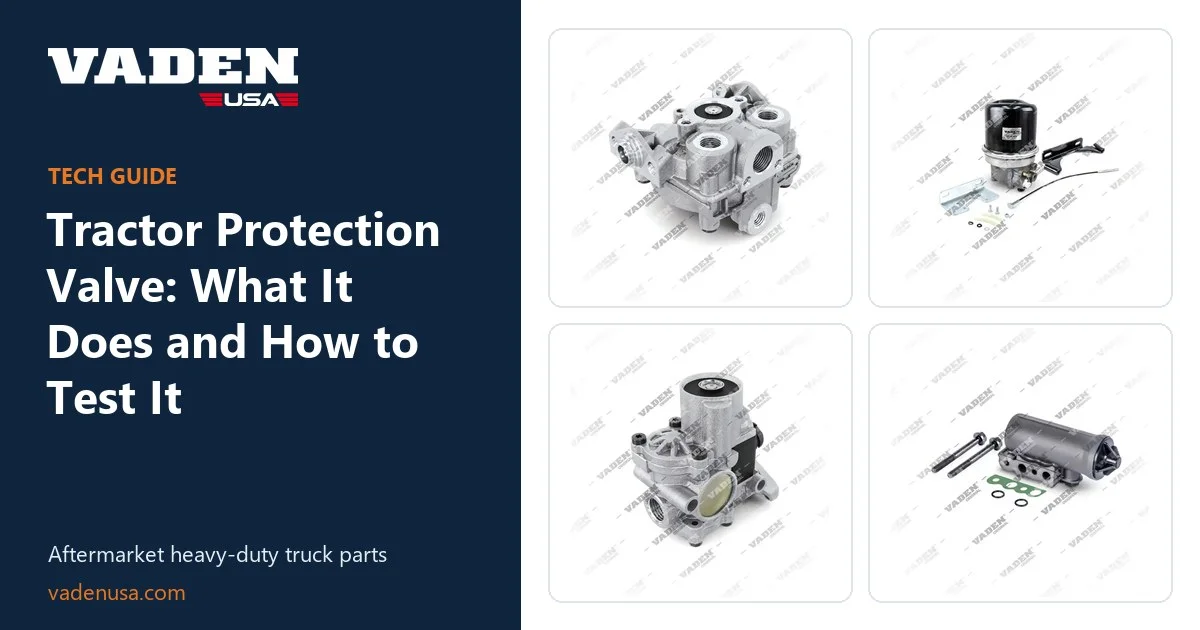
The tractor protection valve is an air valve that closes the tractor's supply and service lines to the trailer when pressure falls or the trailer breaks away, so a trailer leak cannot drain the tractor's brakes. It works with the red octagon trailer air supply valve on the dash, which pops out when pressure drops to the cut-out range.
What the tractor protection valve does
A tractor pulling an air-braked trailer shares one compressed air system with it. Without protection, a burst hose, a broken glad hand or a trailer that separates on the road would vent the tractor's tanks too, and the tractor would lose the air it needs to stop. The tractor protection valve prevents that. It sits between the tractor and the trailer lines and closes them off when it has to.
In practice it protects the tractor in three situations:
- Trailer breakaway. The lines part, the valve closes and the tractor keeps its air. The trailer's own emergency system applies the trailer brakes.
- Heavy trailer leak. If the trailer leaks faster than the compressor can replace the air, the valve closes automatically before the tractor's pressure falls too low.
- Tractor running without a trailer. With the valve closed, the open glad hands on a bobtail tractor do not bleed air to the atmosphere.
The requirement comes from federal rules. 49 CFR 393.43 requires a tractor towing an air-braked trailer to have a tractor protection valve, or an equivalent device, that operates automatically when the tractor's air pressure drops into a range the rule sets, and it requires trailer emergency braking in a breakaway. FMVSS 121 (49 CFR 571.121) sets the design requirements for the air brake system itself.
Tractor protection valve vs trailer air supply valve
These two names cause most of the confusion. The trailer air supply valve is the red octagon knob on the dash. It is the driver's control. The tractor protection valve is the separate valve in the trailer air lines that it works with. At the cut-out pressure the supply valve pops out and the tractor protection valve closes, which is the automatic operation 49 CFR 393.43 requires.
- Push the red knob in: the trailer supply line is open, and air flows to charge the trailer reservoirs and release the trailer spring brakes.
- Pull the red knob out: the trailer supply line is vented, which applies the trailer's spring brakes, and the trailer lines are closed off from the tractor. You do this when you uncouple.
- Knob pops out by itself: system pressure has fallen to the cut-out range. The supply valve has exhausted the trailer supply line and the tractor protection valve has closed to protect the tractor.
The yellow diamond knob next to it is the tractor parking brake valve. It is a separate circuit and controls the tractor's own spring brakes. In many cabs the two knobs sit side by side, so check the shape and color before you pull one. For how the whole system fits together, see how air brakes work on a semi truck.
Where the tractor protection valve is located
There is no single location, and layouts differ by make, model and year. Two arrangements are common:
- Integrated in the dash control valve. The red knob and the valve that does the work are one assembly behind the dash. Air lines run from it to the trailer connections at the back of the cab.
- Frame-mounted or cab-rear unit. The dash knob is a pilot control, and a separate valve near the rear of the cab or on the frame crossmember does the switching. Air lines from the supply and service circuits go into it, and lines to the glad hands come out.
To find yours on a Freightliner, Peterbilt, Volvo or any other make, trace the air lines back from the glad hands. The valve sits where the supply and service lines from the tractor meet the lines going to the trailer. Use the manufacturer's service manual for the exact position and port layout, and note any numbers cast or stamped on the body. Our guide to glad hands and trailer air lines shows the connections the valve feeds, and how to cross-reference an OE part number explains how to match a replacement.
How to test the tractor protection valve
This is the check taught in state CDL air brake manuals and used in the pre-trip inspection; see, for example, the air brake section of the Georgia CDL manual. Your own state's manual and the vehicle manufacturer are the authority for the exact pressure at which the knob should pop out, so read them before a test. The steps below follow the common version.
- Park on level ground, set the parking brake and chock the wheels if needed. Couple the trailer and connect both air lines.
- Start the engine and build full system pressure. Push in the red trailer air supply knob and the yellow parking knob.
- Shut the engine off. Leave the key on if your truck needs it for the gauges.
- Press and release the brake pedal repeatedly to lower air pressure while watching the gauges.
- As pressure falls, the red trailer air supply knob should pop out at the pressure specified by the manufacturer and your state manual. The yellow parking knob should pop out at the same time or after the red knob.
- If the red knob does not pop out, or only pops out when pressure is very low, the tractor protection valve or its control is faulty. Do not drive the unit.
For the full routine see our CDL Class A pre-trip checklist, the CDL air brakes study guide and the DOT air brake inspection checklist.
Symptoms of a failing tractor protection valve
| Symptom | Likely cause | What to check |
|---|---|---|
| Air hissing from the dash or knob exhaust | Worn seals or O-rings in the control valve | Soap-test the knob area and exhaust port with the knob in and out |
| Tractor pressure drops with the trailer disconnected | Valve not sealing, or a leak at an open glad hand | Pull the red knob out, disconnect, and watch the gauges |
| Red knob will not stay in | Low system pressure, a leaking trailer, or a damaged valve | Build full pressure, check the trailer lines, then retest |
| Red knob does not pop out during the test | Valve stuck open or control worn | Repeat the pop-out test and compare with the manual |
| Trailer brakes will not release | No air reaching the trailer supply line, a blocked line or a faulty valve | Check air at the supply glad hand and the line for kinks or restrictions |
Fix simple causes first: a cracked hose, a worn glad hand seal or a dirty fitting. If the tractor valve is the cause, replace it as an assembly with the correct port layout for your truck, following the manufacturer's service manual. Oil and moisture from a worn dryer or compressor can shorten the life of air valves, so check the air dryer as well.
Tractor protection valve vs other air brake valves
| Valve | Function | Typical location | Failure sign |
|---|---|---|---|
| Tractor protection valve | Closes the trailer lines to protect the tractor's air | Dash or rear of cab, between tractor and trailer lines | Tractor loses air when trailer is disconnected or leaks |
| Trailer air supply valve (red octagon) | Driver control that charges or vents the trailer supply line and pops out at the cut-out pressure | Dash | Knob will not stay in or will not pop out |
| Relay valve | Speeds up application and release at the axle by relaying brake air | Near the rear axles or trailer | Slow application, slow release, air leak at exhaust. See the relay valve guide |
| Quick release valve | Exhausts chamber air quickly when the brakes are released | Near brake chambers | Brakes drag or release slowly. See the quick release valve guide |
| Treadle valve | Meters air to the service brakes in proportion to pedal travel | Cab floor | Poor modulation or leak at the pedal. See the treadle valve guide |
VADEN parts for the air brake system
VADEN does not list a standalone tractor protection valve in this catalog, and we do not sell the dash control valve. What we do supply for the same system are relay valves, relay valve parts and other air brake system parts. VADEN parts are aftermarket replacements. Freightliner, Peterbilt, Volvo and other names in this article are trademarks of their owners and are used only to identify parts and cross-references.
FAQ
What does a tractor protection valve do?
It closes the air lines between the tractor and the trailer when system pressure drops or the trailer breaks away. That keeps the tractor's air in its own tanks so the tractor can still stop, and it lets the trailer's emergency system apply the trailer brakes.
What is a tractor protection valve?
It is an air valve in the tractor's brake system that connects to the trailer supply and service lines. It works with the red octagon trailer air supply valve on the dash, and it closes automatically when air pressure falls to the cut-out range.
How can you test the tractor protection valve?
Build full air pressure with the trailer coupled and the red knob in, shut off the engine, and press and release the brake pedal repeatedly. The red knob should pop out at the pressure your manufacturer and state CDL manual specify. If it does not, the valve or its control needs service.
Where is the tractor protection valve located?
It is either built into the dash control valve assembly or mounted as a separate unit near the back of the cab or on the frame. Trace the air lines from the glad hands back toward the tractor, and use the service manual for your model.
What is the difference between the tractor protection valve and the trailer air supply valve?
The trailer air supply valve is the red octagon knob, the driver's control. The tractor protection valve is the separate valve that opens and closes the lines to the trailer. At the cut-out pressure the supply valve pops out and the tractor protection valve closes automatically.
How do I know if the tractor protection valve is bad?
Typical signs are air leaking at the knob or its exhaust, tractor pressure falling when the trailer is disconnected, a red knob that will not stay in or will not pop out during the test, and trailer brakes that will not charge. Confirm with a soap test and the pop-out test.
Need air brake parts?
Send us the OE number, truck make and model, and we will check the matching air brake parts and relay valves. Request a quote or write to info@vadenusa.com.
Blog
3 2026-11-19
Air Brake Troubleshooting Guide: Symptoms, Causes, Fixes
Symptom-by-symptom air brake troubleshooting for semi trucks: slow build-up, pressure loss, constant dryer purge, locked brakes and ABS faults, with first checks.
 2026-11-19
Trailer ABS Light: Causes, Reset and DOT Violation Rules
Why the ABS light stays on a semi trailer, what the power-up check should look like, common causes, blink codes, resetting and what DOT rules say.
 2026-11-19
WABCO Air Compressor: ID, Rebuild Kits and Replacement
How to identify a WABCO air brake compressor by its 10-digit number, tell single from twin cylinder, and decide between a repair kit and a replacement unit.