

Published: · Updated:
Pressure Protection Valve: Air Brake Function, Testing
What a truck air brake pressure protection valve does, where it sits, how to spot a failing one, and how to test it with two gauges before you replace it.
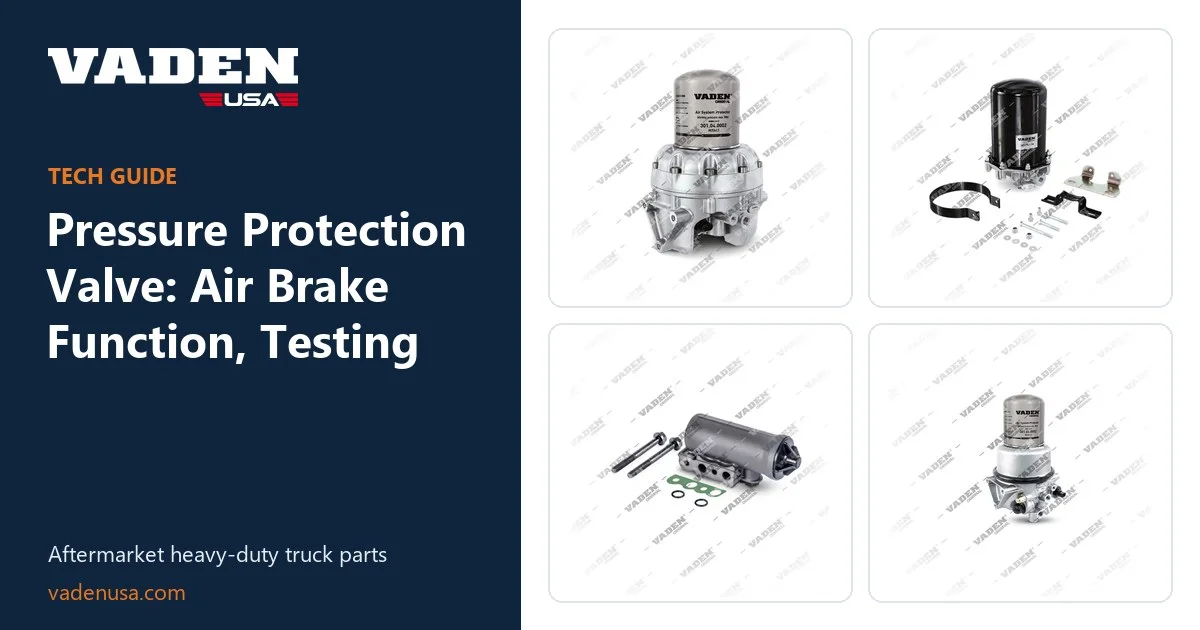
A pressure protection valve (PPV) is a normally closed air valve that feeds a secondary circuit, such as trailer air suspension or an accessory line, only while supply pressure stays above its closing pressure. If that circuit leaks, the valve shuts and keeps the brake reservoirs from draining. Bendix PR-2, PR-3 and PR-4 are common examples.
Note: this guide is about truck air brakes. A "pressure reducing valve" or "pressure relief valve" in a fire sprinkler or fire protection water system is a different device and is not covered here.
What a pressure protection valve does
Air brake systems must keep enough pressure in the service reservoirs to stop the vehicle. Anything else that draws air from the same supply, such as air suspension, a cab air seat, a horn or other accessories, is a possible leak path. The PPV sits between the main supply and that secondary circuit. As long as pressure at the supply port stays above the closing pressure, the valve stays open and air flows to the accessory side. When supply pressure drops below the closing pressure, the valve closes and isolates the delivery side, so a broken accessory line cannot pull the brake supply down with it.
The valve opens again at a higher pressure than it closes at: about 10 psi higher on the PR-3 and PR-4 and 15 to 20 psi higher on the PR-2, per the Bendix service data sheet SD-03-2010. This gap keeps the valve from chattering, and Bendix notes the valve can also delay filling of auxiliary tanks so the brake system builds pressure fast. For the exact numbers on your valve, use the manufacturer's data sheet, not a general rule.
Where pressure protection valves are used
- Trailer air suspension supply. Bendix describes the PR-3 pressure protection valve as normally used to supply the air suspension system on the trailer. It comes in several pressure settings, so it can feed other trailer accessories too.
- Accessory feeds on the tractor. Air seats, cab suspension, air horns and similar loads are often fed through a protection valve so a leak there is not a brake problem.
- Air processing and dryer circuits. Many modern air processing units combine the dryer, governor and protection valves in one housing. Read our guide on the air dryer vs air processing unit to see what is built in.
PR-2, PR-3 and PR-4 in short
| Valve | What to know |
|---|---|
| PR-2 | Adjustable pressure setting, per Bendix literature. Opens 15 to 20 psi above closing pressure. |
| PR-3 | Trailer air suspension and accessory supply; several pressure settings available. Not adjustable. |
| PR-4 | Fixed setting; not adjustable. The closing pressure is printed on the label on the valve. |
Closing pressure differs by part number. Bendix notes that the closing pressure is shown on the label affixed to the PR-2 and PR-4, and the data sheet says the valve should close within about plus or minus 5 psi of the pressure on that label or in the vehicle manual. Always match the replacement to the label, the vehicle manual or the OE number.
Symptoms of a failing pressure protection valve
| Symptom | Likely cause |
|---|---|
| Air suspension or accessory does not fill, while brake tanks build normally | Valve stuck closed, or closing pressure set or worn too high |
| Brake tanks build slowly or lose air when an accessory line leaks | Valve not closing, stuck open or leaking past its seat |
| Constant hiss at the valve body or cap | Leaking seals or inlet seat (check against the soap-test limits below) |
| Trailer suspension drops overnight but brakes hold pressure | Leak downstream of the valve; the valve may be working correctly |
Before you blame the valve, check the compressor and the rest of the system. Our guides on testing a truck air compressor and the air governor help rule those out first.
How to test a pressure protection valve
The Bendix service data sheet describes an operating check with a gauge and bleed valve on each side of the valve. Follow the data sheet for your model; the general idea is below.
- Block the vehicle. Install a test gauge with a bleed valve at the supply side and another at the delivery side, or use accurate gauges at the nearest test port on each side.
- Charge the system to full pressure and shut off the engine.
- Slowly bleed pressure from the delivery side. Both gauges fall until the valve closes. The supply gauge should stop at the closing pressure, within about 5 psi of the label or vehicle manual, while the delivery gauge keeps falling.
- PR-3 only: build air again, shut off the engine and slowly bleed the supply side. The PR-3 has a check valve, so the delivery gauge should stay at the highest pressure reached.
- Leak check: with the system pressurized, apply soap solution around the cap. Per the data sheet, a 1 inch bubble in 3 seconds or longer is acceptable, and the PR-3 should show no leakage at the lower part of the valve. Then bleed the delivery side, disconnect the delivery line and check the port as the data sheet describes.
- If the valve fails the operating test or leakage is excessive, replace it, or service it with genuine manufacturer parts.
Wear eye protection and never loosen fittings on a pressurized line. A careful walk-around is also part of the DOT air brake inspection.
Replacing a pressure protection valve
- Block the vehicle, drain all air from the system and confirm the gauges read zero.
- Label or photograph the supply and delivery lines. The ports are not interchangeable.
- Remove the mounting bolts and the old valve, and compare its label, port layout and pressure setting with the new one.
- Mount the new valve securely with the mounting bolts and reconnect the lines to the correctly identified supply and delivery ports. Check the lines and fittings for wear; see our notes on air brake hose and fittings.
- Rebuild air and repeat the two-gauge test and the soap leak check.
Only the PR-2 is adjustable; PR-3 and PR-4 cannot be adjusted, so choose the right setting when you buy.
Related valves people confuse with the PPV
- Tractor protection valve. It shuts off the trailer air supply if the trailer breaks away or leaks badly. See the tractor protection valve guide.
- Compressor safety valve. It vents when system pressure is too high. See truck air compressor safety valve.
- Air governor. It controls when the compressor loads and unloads. See the air governor guide.
For the full map of valves in the system, see our air brake valves guide and how air brakes work on a semi truck.
VADEN parts for the air processing side
VADEN does not currently sell stand-alone pressure protection valves. If your problem turns out to be in the air supply circuit, we do make air dryer valves and air processing units. VADEN parts are aftermarket replacements; Bendix, PR-2, PR-3 and PR-4 are trademarks of their owners and are used here only to identify parts for reference. For help matching an OE number, read how to cross-reference an OE part number.
FAQ
What is a pressure protection valve on a truck?
It is a normally closed valve that feeds a secondary air circuit and closes if supply pressure falls below its set closing pressure, protecting the brake reservoirs from a leak in that circuit.
What is an air brake pressure protection valve used for?
It keeps brake air safe when a non-brake circuit fails. Typical uses are trailer air suspension, air seats and other accessory lines.
Where is the trailer pressure protection valve located?
Usually in the trailer air line that feeds the suspension. Bendix describes the PR-3 as normally used for this job. Check the trailer plumbing diagram for the exact location.
What is the closing pressure of a Bendix pressure protection valve?
It depends on the part number. The PR-4 has a fixed setting printed on its label, the PR-2 is adjustable and also labeled, and the PR-3 comes in several settings. For the PR-3, check the part number and the vehicle manual or service data.
Is a pressure protection valve the same as a fire protection pressure reducing valve?
No. Fire protection pressure reducing and relief valves control water pressure in sprinkler systems. A truck PPV protects compressed air in a brake system.
How do I know if my pressure protection valve is bad?
Look for an accessory circuit that will not fill, brake tanks that lose air when an accessory leaks, or a steady hiss at the valve. Confirm with a two-gauge test.
Can I repair a pressure protection valve?
Bendix says to replace the valve or repair it with genuine manufacturer parts if it fails the tests or leaks excessively. Many shops simply replace it. Retest after any repair.
Need help with the air supply circuit?
Send your OE number or truck model to info@vadenusa.com or use our contact page to request a quote.
Blog
3 2026-11-19
Air Brake Troubleshooting Guide: Symptoms, Causes, Fixes
Symptom-by-symptom air brake troubleshooting for semi trucks: slow build-up, pressure loss, constant dryer purge, locked brakes and ABS faults, with first checks.
 2026-11-19
Trailer ABS Light: Causes, Reset and DOT Violation Rules
Why the ABS light stays on a semi trailer, what the power-up check should look like, common causes, blink codes, resetting and what DOT rules say.
 2026-11-19
WABCO Air Compressor: ID, Rebuild Kits and Replacement
How to identify a WABCO air brake compressor by its 10-digit number, tell single from twin cylinder, and decide between a repair kit and a replacement unit.