

Published: · Updated:
Air Brake Relay Valve Guide: R-12 vs R-14, Symptoms
How an air brake relay valve works, how R-12 and R-14 style valves differ, the symptoms of a bad one, and how to test and replace it safely.
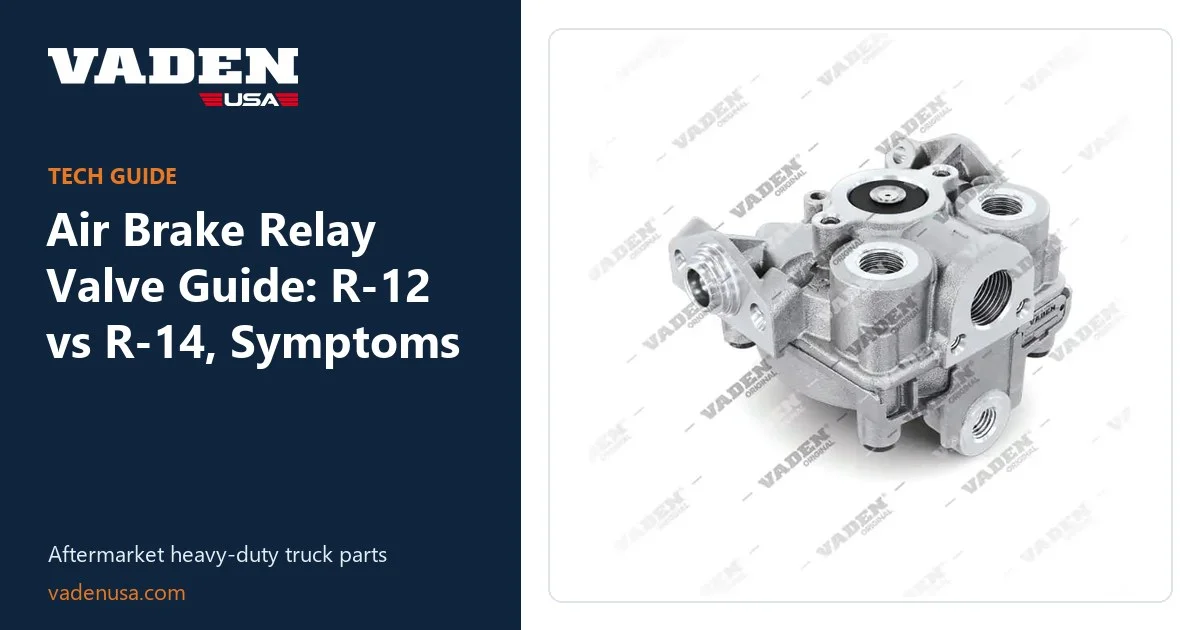
An air brake relay valve speeds up brake application and release at the axles. The foot valve sends only a small control signal, and the relay valve answers by sending a large flow of tank air to the brake chambers. A failing air brake relay valve shows up as slow release or a constant hiss at the exhaust.
How a relay valve works
Without a relay valve, every drop of air for the rear brakes would have to travel from the foot valve at the cab, through long lines, to the chambers at the axle. That is slow, especially on a tractor-trailer combination. A relay valve solves this by sitting close to the chambers and acting as a local air switch.
It has four basic connections:
- Supply: full-pressure air from a service reservoir (tank).
- Control: the small signal line from the foot valve, or from another control valve. It only moves a piston and does not carry the air that fills the chambers.
- Delivery: the lines to the brake chambers.
- Exhaust: the opening where chamber air is vented when you release the pedal.
When you press the pedal, control air pushes the piston down. The piston closes the exhaust and opens the supply to delivery, so tank air flows to the chambers right at the axle. When you release the pedal, control pressure drops, the supply closes, and the exhaust opens so the chamber air leaves quickly through the valve and not back through the whole line. For a wider view of the system, see our guide on how air brakes work on a semi truck.
Relay valve types: R-12, R-14 and others
"R-12" is a Bendix designation for a service relay valve. According to Bendix service data (SD-03-1064), the R-14 differs from the R-12 by adding a quick release and an anti-compounding feature (a balance port). Bendix lists them as interchangeable in many applications, but always confirm the exact valve from the label or casting number and the manufacturer's data sheet, not from looks alone. Our article on reading a Bendix casting number helps with that.
| Type | Main job | Typical place |
|---|---|---|
| Service relay valve (R-12 style) | Speeds up service brake apply and release | Rear tractor axle, trailer axles |
| Service relay with quick release and anti-compounding (R-14 style) | Same as above, and helps prevent service and spring brake forces adding together when the anti-compound line is connected | Axles with spring brake chambers |
| Spring brake / parking relay valve | Controls supply and exhaust of the spring brake chambers when you set or release the parking brake | Near the spring brake chambers, tractor and trailer |
| Quick-release valve | Dumps chamber air fast on release; has no supply from a tank | Front axle lines, some trailers |
| ABS relay or modulator style | Adds ABS pressure control to the relay function | Axles with ABS control, see ABS modulator valve guide |
The exact port count, mounting and port sizes vary by model and by vehicle maker. Check them against the original valve and the maker's data before ordering a replacement.
Spring brake and parking brake relay valves
A spring brake relay valve (also called a parking brake relay valve) has a different job from the service relay. It supplies air to hold the spring brakes released while driving, and it exhausts that air quickly when the parking brake is set or when system pressure is lost. It must work fast, because slow exhaust means the parking brakes apply late, and slow filling means they release late. When a spring brake control valve or relay valve leaks, you may see a parking brake that creeps on, drops off after you push the knob in, or a low-pressure warning that will not clear.
Where relay valves sit on a tractor and trailer
- Tractor: usually mounted on the frame rail or crossmember close to the rear drive axles, near the service reservoir that feeds it.
- Trailer: usually on the trailer frame or crossmember near the axles, often combined with the trailer emergency and relay function. A trailer relay valve takes its control signal from the service gladhand line.
Layouts differ by maker and model year, so trace the lines on your unit: tank to supply, signal line to control, chamber lines to delivery.
Bad air brake relay valve symptoms
Most relay valve failures come from worn seals, a stuck piston, dirt, or moisture and oil carried over from a poorly kept air system. Check your tank drain valves and dryer if you find contamination inside a valve.
| Symptom | Likely cause | What to check |
|---|---|---|
| Slow brake release, wheels drag after you let off the pedal | Sticking piston or blocked exhaust | Look for debris or ice at the exhaust port; listen for the exhaust when you release |
| Constant hiss at the exhaust port | Worn supply or exhaust seat, or torn diaphragm | Soap test the exhaust with brakes released and applied |
| Hiss only while the pedal is held | Leaking inlet/exhaust valve in applied position | Hold a full service application and check the exhaust |
| Delayed or weak application on one axle | Restricted control line or worn piston seal | Check control line and gauge pressure at the delivery port |
| Uneven braking, hot hubs on one side | Valve not delivering equal pressure, or a line fault | Compare delivery pressures; inspect chambers and lines |
| Pressure drop with engine off | Leak through the valve or its lines | Do a leakage check and soap all connections |
Do not guess from one symptom. A leaking chamber diaphragm, a bad quick-release valve or a worn slack adjuster can look the same. For inspection criteria that matter at roadside, see our DOT air brake inspection checklist and the CVSA out-of-service criteria.
How to test a relay valve
- Park on level ground, chock the wheels, and build system air to governor cut-out pressure. Do not work under the truck with the engine running.
- Release the parking brakes and check that the exhaust port is clean and free of ice or mud.
- Apply the service brake fully and soap the exhaust port, the cover and the body seams. A steady stream of bubbles at the exhaust with the pedal down or released points to a leaking valve.
- Release the pedal and watch or listen for how quickly the chambers exhaust. A slow or uneven release suggests a sticking piston or a restricted exhaust.
- Where a test gauge is fitted at the control and delivery ports, compare the two. Delivery should rise quickly and follow the control pressure as the manufacturer specifies; do not compare against a number from memory.
- Check the supply line and the control line for kinks, leaks and loose fittings before you blame the valve.
Replace or rebuild?
Some relay valves have service kits, but many shops find that a replacement valve saves time and avoids repeat comebacks when the body is corroded or the bore is worn. Rebuilding makes sense only when the body is in good condition and you have the correct kit for the exact valve type. If the valve is old, contaminated or has had a previous rebuild, replace it.
- Chock the wheels and drain the system air. Note that draining air applies the spring brakes, so never rely on them alone to hold the vehicle.
- Label every line to the old valve (supply, control, delivery) and take a photo.
- Remove the lines and the mounting bolts, and remove the valve.
- Compare the new valve to the old one: port positions, port sizes, mounting and type markings.
- Clean the fitting threads, use fresh sealant only as the manufacturer allows, and keep sealant out of the ports.
- Mount the valve in the same position and orientation, with the exhaust pointing down as originally installed.
- Reconnect each line to its labeled port, build air, and soap test every connection.
- Do a brake application and release test, then a road test at low speed in a safe area.
Brake rules and inspections
Brake system requirements for commercial vehicles are set out in 49 CFR Part 393 Subpart C, and air brake performance is covered by FMVSS No. 121 (49 CFR 571.121). In roadside inspections, CVSA out-of-service criteria address brake defects and air loss. A leaking relay valve can contribute to both, so fix it before the next inspection, not after.
VADEN parts
VADEN makes aftermarket replacement relay valves for heavy-duty brake systems. Browse our relay valves and relay valve categories, or the wider brake system range. Brand and OE names are used only for reference and cross-reference, and VADEN parts are aftermarket replacements, not original-equipment parts. Use our WABCO and Bendix cross-reference articles, or read how to cross-reference an OE part number.
| VADEN part | Description | Replaces / fits |
|---|---|---|
| VADEN 303.01.0053 | Relay Valve, Replaces WABCO 9730110240 | Wabco 9730110240 |
FAQ
What does a relay valve do on a truck air brake system?
It uses a small control signal from the foot valve to open a large flow of tank air to the brake chambers at the axle, and it exhausts the chambers quickly on release. This gives faster brake apply and release than lines from the cab alone.
What are the symptoms of a bad air brake relay valve?
Common signs are slow brake release, dragging wheels, a steady hiss from the exhaust port, delayed application on one axle, uneven braking and unexplained air loss. Confirm with a soap test before replacing the valve.
What is the difference between an R-12 and an R-14 relay valve?
Per Bendix service data, the R-14 adds a quick release and an anti-compounding feature (a balance port) to the R-12 design. Bendix lists them as interchangeable in many applications, so confirm the exact type and part number from the valve label before ordering.
Where is the relay valve located on a semi trailer?
Usually on the trailer frame or crossmember near the axles it serves. Trace the supply line from the reservoir and the control line from the gladhand to find it on your trailer.
Can a relay valve be rebuilt or should it be replaced?
It can be rebuilt if the body is clean and undamaged and you have the correct kit for that exact valve. If it is corroded, contaminated or already rebuilt once, replacement is the safer choice.
What is a spring brake relay valve?
It controls air to the spring brake chambers, holding the parking brakes released while driving and exhausting quickly when the parking brake is set or pressure is lost.
Need help matching a relay valve to your unit? Send the OE number or a photo of the label to info@vadenusa.com or use our contact page to request a quote.
Blog
3 2026-11-19
Air Brake Troubleshooting Guide: Symptoms, Causes, Fixes
Symptom-by-symptom air brake troubleshooting for semi trucks: slow build-up, pressure loss, constant dryer purge, locked brakes and ABS faults, with first checks.
 2026-11-19
Trailer ABS Light: Causes, Reset and DOT Violation Rules
Why the ABS light stays on a semi trailer, what the power-up check should look like, common causes, blink codes, resetting and what DOT rules say.
 2026-11-19
WABCO Air Compressor: ID, Rebuild Kits and Replacement
How to identify a WABCO air brake compressor by its 10-digit number, tell single from twin cylinder, and decide between a repair kit and a replacement unit.