

Published: · Updated:
Truck Air Compressor Safety Valve: Location and Pop-Off Causes
Where the safety valve sits on a truck air brake system, why it pops off, how to diagnose the real cause and when to replace the valve itself.
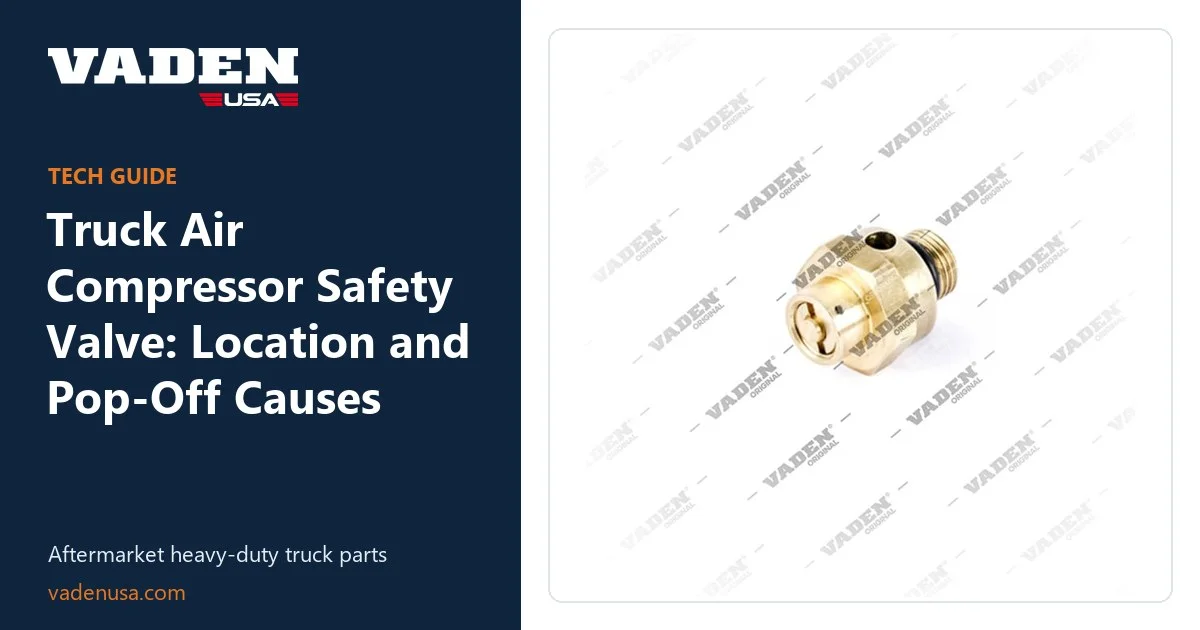
A truck air compressor safety valve is a spring-loaded pop-off valve that vents air when brake system pressure rises above a safe limit. It is a backup, not a regulator. Repeated pop-offs usually come from a governor or unloader that fails to stop the compressor, or a restricted discharge line, so find the cause before replacing the valve.
This guide covers the safety valve on a heavy-duty truck or tractor air brake system, not the tank compressors found in shops and garages. If you run a Class 8 truck, bus or vocational truck and hear air blasting from the wet tank or the compressor area, you are in the right place.
What the truck air compressor safety valve does
The air brake compressor builds pressure whenever the governor lets it. Once the system reaches the governor cut-out pressure, the governor signals the compressor to unload and stop adding air. The safety valve sits behind that control as insurance. Its spring holds a seat closed during normal operation, and it only lifts if pressure climbs above its own setting, which must always be above the governor cut-out (see the Bendix Air Brake Handbook).
When it opens, air escapes through the valve exhaust until pressure falls back and the spring reseats it. A pop-off therefore tells you that normal pressure control did not do its job, or that air could not leave the compressor and dryer freely. The valve protects the air system from over-pressure. Federal rules cover the brake system as a whole (49 CFR Part 393 for vehicles in service, FMVSS 121 for new air brake vehicles). Never disable or tamper with a safety device.
Where the safety valve is located
Location depends on the truck and the air system design. Check the service documentation for your exact unit rather than assuming.
- Wet tank (supply reservoir). The usual location is a valve threaded into the first reservoir that receives air from the compressor and dryer. This is where you will find it on most trucks.
- Dryer reservoir module. Some air dryers and air processing units integrate a reservoir module that carries a safety valve. Check the unit's service data. Do not confuse the dryer purge exhaust with a safety valve pop-off. See our guides to the semi truck air dryer and the air dryer purge valve.
- Near the compressor. A few designs may add a pop-off close to the compressor. Confirm against the service manual for your truck before assuming one is there.
To trace it, follow the line from the compressor outlet to the dryer and the first tank, then look for a small brass valve with a spring cage and a vent port. The air brake flow overview shows how air moves from compressor to tanks.
Why a truck compressor safety valve pops off
The valve is rarely the root problem. These are common causes, and several can occur together.
- Governor not unloading the compressor. If the governor does not send its signal at cut-out pressure, the compressor keeps pumping and pressure rises until the safety valve lifts. Read our air governor guide for ports and adjustment.
- Stuck or worn compressor unloader. The governor may signal correctly, but the unloader pistons or valves do not respond. See the compressor valve and unloader fault guide.
- Restricted discharge line. Oil carryover and heat can bake carbon deposits inside the discharge line or the dryer inlet. A restricted line lets pressure stay high at the compressor and dryer and can push the system toward a pop-off. Hoses and fittings in this area are covered in the compressor fittings and adapters guide.
- Frozen or clogged air dryer. A dryer that cannot pass air can create the same back pressure as a blocked line. Winter ice and saturated desiccant are typical triggers.
- Worn or contaminated safety valve. Dirt on the seat or a fatigued spring can make the valve leak or open early. A valve that weeps at normal pressure is itself faulty.
An oil-fouled system points to compressor wear or a dryer problem. The air compressor failure symptoms guide explains the signs.
Symptom and cause table
| What you see | Likely cause | What to check |
|---|---|---|
| Valve vents when gauges pass normal cut-out and keep climbing | Governor or unloader not stopping the compressor | Gauge pressure at cut-out, governor signal line, unloader response |
| Pop-off opens while pressure stays high at the compressor and dryer | Restricted discharge line or dryer inlet | Carbon in the line, dryer inlet flow, line temperature |
| Pop-off in freezing weather | Frozen dryer or line | Dryer heater, purge function, ice in the lines |
| Valve hisses steadily at normal pressure | Dirty seat or weak spring | Soap-test the vent port, then replace the valve |
| Valve pops and oil is present at the vent | Compressor oil passing, plus a pressure fault | Compressor wear, dryer cartridge, discharge line carbon |
How to diagnose it step by step
- Park on level ground, chock the wheels and keep the parking brakes applied. Never work on air system components while the truck is unattended on a slope.
- Run the engine and watch the dash gauges as the system builds pressure. Note the pressure at which the compressor stops (cut-out) and whether the safety valve opens before or after that point.
- Compare cut-out and cut-in pressures with the specifications from the truck or governor manufacturer. The safety valve setting must be above the governor cut-out, so confirm the valve's rating from its markings or the service data. Our step by step compressor test covers build-up and leakage checks.
- If pressure keeps rising past cut-out, suspect the governor or unloader. Check the governor signal line and the unloader before touching the safety valve.
- If the pop-off opens while pressure stays high at the compressor or dryer, shut the engine off and drain the system. Check the discharge line and dryer inlet for restriction, carbon, heat damage or ice.
- Soap-test the safety valve vent at normal pressure. A steady leak means the valve itself needs replacement.
- Fix the upstream cause, then retest the full build-up cycle before returning the truck to service.
Never plug, tighten or adjust the safety valve
Do not plug the vent, over-tighten the spring cage or swap in a valve with a higher rating to stop the noise. A safety valve that cannot open leaves the tanks and lines exposed to over-pressure. Do not attempt to adjust a safety valve or change its setting; use a valve with the rating specified for your system. If the valve needs work, replace it with a unit of the correct rating and thread.
How to replace the safety valve
- Depressurize the whole air system. Drain the wet tank and the other tanks until the gauges read zero, and wear eye protection.
- Identify the valve location and note its position and the direction of the vent port.
- Remove the old valve with the correct wrench. Inspect the port threads and clean them.
- Compare the new valve with the old one: thread size, pressure rating and body style must match the specification for your system, and the rating must be above the governor cut-out. Do not guess.
- Apply thread sealant suited to air systems as the valve maker directs, and install the valve to the specified torque. Do not over-tighten the body.
- Close the drains, build pressure and soap-test the joint and the vent port.
- Complete a full governor cut-out and cut-in cycle and confirm the new valve stays closed.
If the compressor shows wear, oil carryover or repeated unloading faults, a valve change alone will not hold. Our rebuild or replace guide helps you decide.
VADEN parts
VADEN lists an air brake reservoir safety valve that replaces Bendix 801116 (see table). For related repairs, see our compressor categories for the safety valve, governor, unloader parts and air brake compressors. VADEN parts are aftermarket replacements; Bendix and other brand names are used for reference only.
| VADEN part | Description | Replaces / fits |
|---|---|---|
| VADEN 7700 920 006 | Air Compressor Safety Valve, Replaces Bendix 801116 | Bendix 801116 |
FAQ
Where is the safety valve on a truck air compressor?
On most trucks it is threaded into the first (wet) tank after the compressor and dryer, or into a dryer reservoir module. A few designs may add one near the compressor. Check the service documentation for your truck and engine.
Why does the safety valve on my truck keep opening?
Common causes include a governor or unloader that does not stop the compressor, a restricted discharge line, a frozen dryer, or a worn valve. Find the pressure cause first, since a new valve will pop the same way.
What is the purpose of a safety relief valve on an air compressor system?
It is a last-resort protection that vents air if pressure exceeds a safe limit, so lines and tanks are not over-pressurized when normal pressure control fails.
Can I replace a compressor safety valve myself?
A trained technician with the correct tools can, after fully depressurizing the system. Use a valve with the right rating and thread, never plug or adjust it, and test the system afterward. If unsure, use a qualified shop.
What causes a blocked compressor discharge line?
Oil carryover and heat can build carbon inside the line and dryer inlet over time. Ice in cold weather can also restrict flow. Both raise pressure at the compressor.
How is this different from a shop compressor safety valve?
A shop tank compressor has its own relief valve sized for that tank. A truck brake compressor system uses a governor and unloader, with the safety valve set above the governor cut-out. Do not interchange them.
Need a safety valve or related compressor parts? Request a quote or email info@vadenusa.com with the OE number you are replacing.
Blog
3 2026-11-19
Air Brake Troubleshooting Guide: Symptoms, Causes, Fixes
Symptom-by-symptom air brake troubleshooting for semi trucks: slow build-up, pressure loss, constant dryer purge, locked brakes and ABS faults, with first checks.
 2026-11-19
Trailer ABS Light: Causes, Reset and DOT Violation Rules
Why the ABS light stays on a semi trailer, what the power-up check should look like, common causes, blink codes, resetting and what DOT rules say.
 2026-11-19
WABCO Air Compressor: ID, Rebuild Kits and Replacement
How to identify a WABCO air brake compressor by its 10-digit number, tell single from twin cylinder, and decide between a repair kit and a replacement unit.