

Published: · Updated:
ABS Modulator Valve on Semi Trucks: Symptoms & Replacement
How an ABS modulator valve works on a semi truck, what leaks and fault codes mean, how to test it, and how to replace and match it by OE number.
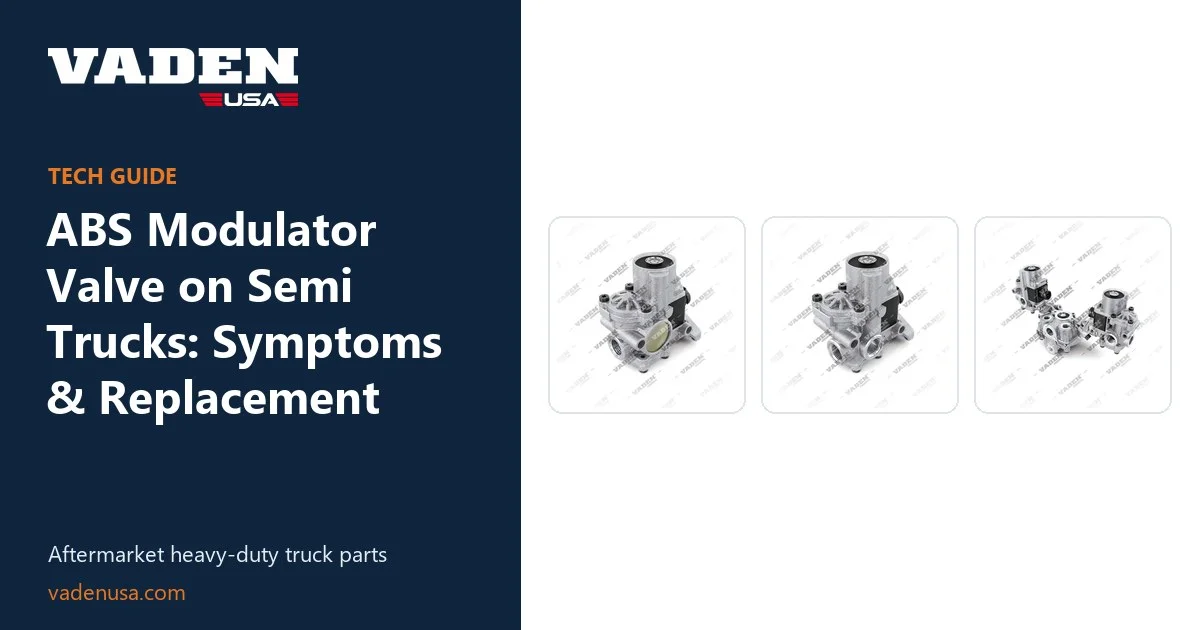
An ABS modulator valve is the air valve in the line to a brake chamber that the ABS controller uses to hold, release and reapply brake pressure when a wheel starts to lock. When the valve leaks, sticks or sets a fault code, the ABS lamp comes on and that wheel position loses antilock control.
What the ABS modulator valve does
Air-braked tractors and trailers use a simple control loop. A wheel speed sensor reports how fast each monitored wheel is turning. The ABS electronic control unit (ECU) compares those signals. If a wheel slows much faster than the others while braking, the ECU commands the modulator valve at that position to act on the brake air going to the chamber.
The modulator is an electrically controlled valve (solenoids) sitting between the service brake air supply, usually through a relay valve or the foot valve circuit, and the brake chamber. It has three jobs:
- Pass air during normal braking, so the brake works as the driver expects.
- Hold pressure in the chamber when the wheel is close to locking, so it does not rise further.
- Release and reapply pressure in quick pulses until the wheel recovers traction.
The sequence is sensor, ECU, modulator, chamber. Because the modulator moves air constantly during an ABS event, its seals and internal diaphragms wear, and contamination from the air system (oil, moisture, dirt) shortens its life. A wet or oily air supply is a common root cause, so a failed modulator is often a reason to inspect the air dryer as well. For the bigger picture of the brake circuit, see how air brakes work on a semi truck.
Tractor and trailer modulators
Tractors and trailers both use modulator valves, but they are not automatically interchangeable. On tractors, modulators are commonly fitted at the steer and drive axle wheel ends, and many are mounted in the air line close to the brake chamber or combined with a relay valve. Trailers usually have one or more modulators controlled by the trailer ABS ECU, fed from the trailer air supply. The number of controlled wheel ends depends on the axle layout and the ABS configuration, which is usually described by the number of sensors (S) and modulators (M).
The right replacement depends on the original part, not only on the vehicle. Connector type, port layout, mounting, voltage and whether the valve is a stand-alone modulator or part of a relay assembly all matter. That is why you match by the OE number stamped on the valve body, covered below. Fitment varies by model year and axle configuration, so check the number on the valve rather than the truck model alone.
ABS wheel speed sensors
The wheel speed sensor tells the ABS ECU how fast each monitored wheel turns. A sensor fault code, a damaged cable or tone ring, or a wrong sensor gap can turn on the ABS lamp or make a wheel lock in a hard stop, which looks like a stuck modulator. Do not replace the valve on a sensor code; check the sensor, its clip, the cable and the tone ring first. Resistance, output and gap values vary by maker, so use the maker's service literature and do not guess a number. The full sensor section is in our ABS brake system guide. VADEN lists ABS modulator valves; wheel speed sensors are outside the range shown here.
Symptoms of a bad ABS modulator valve
Failures usually show up in one of these ways. The table links each symptom to the likely cause and the first thing to check.
| Symptom | Likely cause | First check |
|---|---|---|
| Air leaking from the valve exhaust with brakes released | Worn or contaminated seat or diaphragm, or a stuck solenoid | Soap test at the exhaust; check supply air for oil or water |
| Air leaking from the valve exhaust only when brakes are applied | Internal seal leak in the apply path, or a leaking chamber diaphragm nearby | Compare against the brake chamber and fittings with a soap test |
| ABS lamp on, code on one wheel position | Open or shorted solenoid, damaged connector, or wiring fault | Inspect the connector and harness, then measure the coil resistance to the spec of the valve maker |
| Wheel locks up or brakes feel uneven in a hard stop | Valve not releasing, or a sensor fault hiding as a valve problem | Check the sensor and tone ring before replacing the valve |
| No brief movement or sound from the valve at key-on | Valve not responding to the ECU, or a power or wiring problem at the connector | Verify power, ground and codes |
The last row refers to the key-on self check. On many systems the ECU briefly cycles the modulators at power-up or at low speed, and you can hear a short burst of air from each valve. This is normal. Behavior differs by system, so follow the maker's service literature for what the check should sound like.
How to diagnose an ABS modulator valve
- Read the fault codes. Use a diagnostic tool or the lamp blink-code method if the system supports it. Blink codes and code lists are specific to the ECU maker, so use the ECU maker's tables. Note the wheel position and the fault type (solenoid circuit, sensor, power).
- Check the basics. Inspect the connector for corrosion, bent pins and water. Wiggle the harness while watching live data. A large share of "bad valve" codes are connector or harness faults.
- Rule out the sensor. If the code points to the sensor circuit or the wheel locks up, inspect the sensor, its clip, the cable and the tone ring first.
- Check for air leaks. Build full system pressure, chock the wheels and release the parking brake as your procedure requires, then apply a soap solution to the valve exhaust and ports with brakes released and again with the pedal applied.
- Measure the solenoid. With the connector unplugged and key off, measure resistance across the coil terminals and compare to the valve maker's specification. Do not guess a value. An open or very low reading confirms a failed coil.
- Decide. A confirmed internal leak or a failed solenoid means the valve needs replacement. A good valve with a bad harness needs the harness fixed, not a new valve.
How to replace an ABS modulator valve
- Park on level ground, chock the wheels and turn the ignition off. Follow your shop's lockout practice.
- Drain the air system or isolate the circuit so the valve is not under pressure.
- Record the OE number from the old valve. Photograph the connector, the port markings and the air line routing before removing anything.
- Unplug the electrical connector. Mark each air line to its port (supply, delivery to chamber), then disconnect them.
- Remove the mounting fasteners and take off the valve.
- Compare the new valve to the old one: same ports, same connector, same mounting. Clean the mounting surface and inspect the air lines and fittings. Replace damaged fittings.
- Install the new valve and tighten the fasteners to the torque specified by the vehicle or valve maker. Reconnect the air lines to the marked ports and plug in the connector until it locks.
- Build air pressure, then soap test every connection with the brakes released and applied.
- Clear the codes, cycle the key and confirm the ABS lamp behaves normally: it should light at power-up and go out. Take a short road test and check that no new codes set.
If the original valve failed because of contaminated air, correct that first, or the new valve will fail the same way. Look at the air dryer, the compressor and the tank drains. Our guides on air dryer cartridge intervals and air tank drain valves help here.
Can you drive with a bad ABS modulator valve?
The truck usually still brakes on a failed modulator, because the base air brakes work without ABS. But you lose antilock control at that wheel position, and a leaking valve also wastes air and can slow pressure build-up. Under 49 CFR 393.55, air-braked tractors built on or after March 1, 1997, and air-braked trucks, buses, semitrailers and trailers built on or after March 1, 1998, must have ABS with a malfunction indicator system (49 CFR 393.55 at Cornell LII). Trailers built on or after March 1, 1998 must also have an external ABS malfunction lamp. The ABS lamp should light briefly at power-up and then go out; a lamp that stays on or never lights indicates an ABS fault that can be flagged at inspection (see the CVSA anti-lock braking systems page). Repair it promptly. Our DOT air brake inspection checklist shows what inspectors look at, and the ABS brake system guide covers warning lamp diagnosis in more detail.
Match the replacement by OE number
The most reliable way to buy the right modulator is the number on the old valve. Write it without spaces, dashes or dots, for example WABCO 4721950780. Then compare ports, connector and mounting against the replacement. Our guides on cross-referencing an OE part number and the WABCO cross reference explain the process. If a relay valve is part of the assembly, see the air brake relay valve guide.
VADEN ABS modulator valves
VADEN lists ABS modulator valves cross-referenced to WABCO numbers. Browse the full ABS modulator valve category, the ABS solenoid modulator valves page, or the wider brake system range. VADEN parts are aftermarket replacements. WABCO and other names are trademarks of their owners and appear here only for reference.
| VADEN part | Description | Replaces / fits |
|---|---|---|
| VADEN 303.14.0039 | ABS Modulator Valve, Replaces WABCO 4721950780 | Wabco 4721950780 |
| VADEN 303.14.0040 | ABS Modulator Valve, Replaces WABCO 4721950790 | Wabco 4721950790 |
| VADEN 303.14.0100 | ABS Modulator Valve, Replaces WABCO 4725004250 | Wabco 4725004250 |
FAQ
What does an ABS modulator valve do?
It controls the air going to a brake chamber under ABS command. When the ECU sees a wheel about to lock, the modulator holds, releases and reapplies pressure so the wheel keeps turning and the driver keeps steering control.
Why is my ABS modulator valve leaking air?
Usually because an internal seat, seal or diaphragm is worn or contaminated by oil, moisture or dirt from the air system. Leaks at the exhaust with brakes released point to the valve itself. Check the air dryer and supply quality, and soap test the nearby fittings and chamber before replacing the valve.
How do I test an ABS modulator valve on a semi truck?
Read the fault codes, inspect the connector and harness, and listen for the key-on cycle if your system performs one. Measure the solenoid resistance against the valve maker's specification and soap test the exhaust and ports at full pressure, brakes released and applied.
Can I drive with a bad ABS modulator valve?
The base air brakes normally still work, but antilock control is lost at that wheel and the ABS lamp will be on. A leaking valve also drains air. ABS is required equipment on these vehicles, so have it repaired promptly; an ABS fault can be flagged at inspection.
Is a tractor ABS modulator the same as a trailer ABS modulator?
Not necessarily. Both modulate brake air, but connectors, ports, mounting and control electronics can differ. Always match the replacement to the OE number on the original valve, not to the vehicle type alone.
Can a bad wheel speed sensor look like a bad modulator valve?
Yes. A weak or dropped sensor signal can turn on the ABS lamp or cause a wheel to lock, which resembles a stuck modulator. The fault code tells you which circuit is at fault, so check the sensor, cable and tone ring before replacing the valve.
Need a modulator valve matched to an OE number? Request a quote or email info@vadenusa.com with the number from your old valve, and our team will help you confirm the match.
Blog
3 2026-11-19
Air Brake Troubleshooting Guide: Symptoms, Causes, Fixes
Symptom-by-symptom air brake troubleshooting for semi trucks: slow build-up, pressure loss, constant dryer purge, locked brakes and ABS faults, with first checks.
 2026-11-19
Trailer ABS Light: Causes, Reset and DOT Violation Rules
Why the ABS light stays on a semi trailer, what the power-up check should look like, common causes, blink codes, resetting and what DOT rules say.
 2026-11-19
WABCO Air Compressor: ID, Rebuild Kits and Replacement
How to identify a WABCO air brake compressor by its 10-digit number, tell single from twin cylinder, and decide between a repair kit and a replacement unit.