

Published: · Updated:
Semi Truck Air Dryer: How It Works, Location, Failure Signs
What a semi truck air dryer does, how the charge and purge cycle works, where it is located, the types, failure signs and service intervals for US fleets.
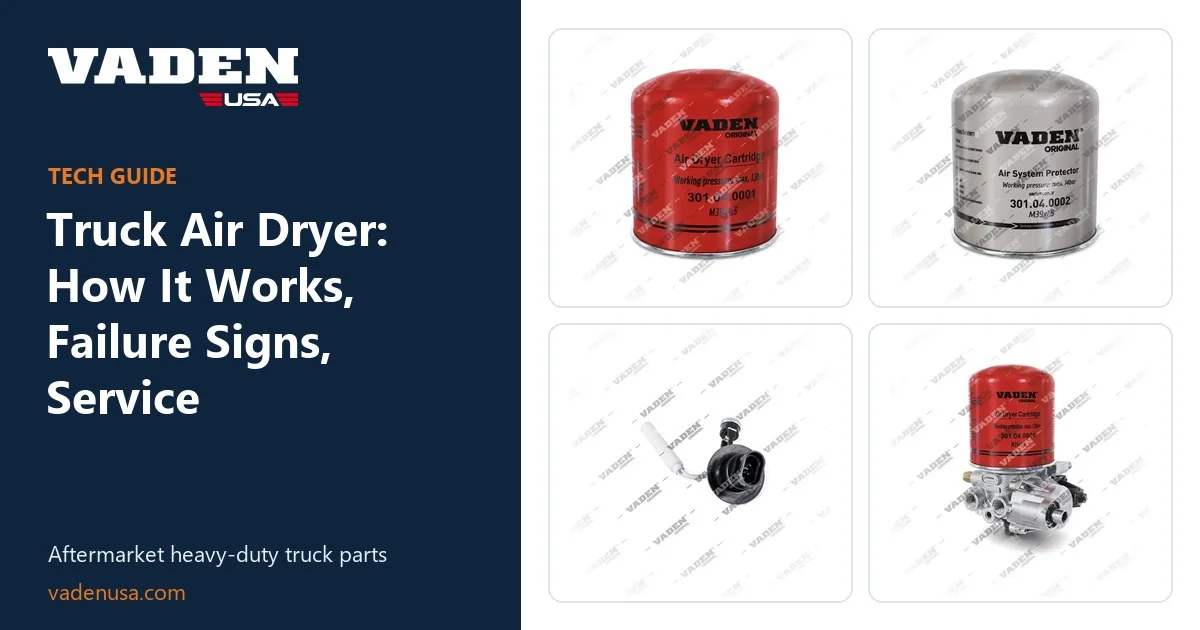
A semi truck air dryer removes water and oil vapor from the compressed air before it reaches the brake tanks. It is plumbed into the compressor discharge line, usually on the frame, and uses a desiccant cartridge that is purged each time the governor unloads the compressor. A failing dryer causes wet tanks, frozen lines and early valve wear.
How does an air dryer work?
An air dryer works in two repeating modes. While the compressor is loaded, the dryer separates oil and the desiccant adsorbs water vapor from the air. When the governor unloads the compressor, it signals the dryer to open its purge valve and send dry air back through the desiccant, expelling the collected water. In short, an air dryer is the brake system's filter and moisture trap.
Air leaving a compressor is hot, wet and carries a small amount of oil vapor. As it cools in the lines and tanks, water condenses, which means corrosion and freezing in a brake system. Bendix puts it this way: keeping moisture, oil aerosols and other contaminants out of the air system is rule number one, because oil can deteriorate seals, cause leaks and damage valves and brake chamber diaphragms (Bendix Tech Tips). Compressed air also feeds emissions controls, automated manual transmissions and driver assistance systems, so clean, dry air matters beyond the service brakes.
Charge cycle
While the compressor is loaded, discharge air enters the dryer. Oil and other contaminants are separated, and the air moves through the desiccant, which adsorbs water vapor. Dry air passes the delivery check valve and continues to the reservoirs. The check valve keeps system air from flowing back into the dryer.
Purge cycle
When system pressure reaches the governor cut-out, the governor unloads the compressor and sends a control signal to the dryer. That signal opens the purge valve to atmosphere and lets a controlled volume of dry air flow back through the desiccant and out of the exhaust. The desiccant is regenerated and the collected water and oil are expelled. The short blast of air you hear at the dryer is normal; a continuous leak is not.
For reference, FMVSS 121 requires the governor cut-in pressure on a truck to be 100 psi or greater (49 CFR 571.121). The cut-out value is set by the system and the OEM, so check the manual for the truck you are working on.
Where is the air dryer located on a semi truck?
The air dryer is installed in the discharge line between the air compressor and the first reservoir, so it sits downstream of the compressor. Most are mounted vertically on the frame, but the exact spot, the discharge line length and the unit itself vary by make, engine and model year. We do not list a location for each truck make here, because it changes by build; the dryer's service data sheet and the truck manufacturer's information are the reference.
- Follow the compressor discharge line to find the dryer; it runs from the compressor to the dryer inlet.
- The line should slope continuously downward to the dryer inlet, with no droops or loops that act as water traps (Bendix).
- If you cannot find the unit, look for the cartridge canister and the exhaust (purge) port; the OE number is cast or stamped on the housing.
Types of truck air dryers
| Type | What it is | Typical use |
|---|---|---|
| Standalone cartridge dryer | Housing with a replaceable desiccant cartridge, purge valve and check valve | The common setup on tractors and straight trucks |
| Dryer with oil-coalescing cartridge | Same dryer, with a cartridge that also captures oil aerosol | High or sensitive air demand, such as automated manual transmissions |
| Heated dryer | Dryer with a heater and thermostat at the purge and drain path | Often specified for cold climates; check the service data sheet |
| Air processing unit | Dryer, filtration and pressure protection combined in one housing | Trucks built with an integrated unit |
Dryers from different makers follow the same principle with different housings, port layouts and cartridge threads. Always match the dryer by the OE number cast or stamped on it. If you are unsure how to read the markings, see the Bendix cross reference. For Bendix model differences, read our Bendix air dryer models guide, and for the combined units see our air processing units.
Main parts of a dryer
- Desiccant cartridge: the consumable that holds moisture. Some are standard desiccant; others are oil-coalescing designs.
- Purge valve and end cover: the exhaust path that opens on the governor signal.
- Delivery check valve: blocks reverse flow from the reservoirs.
- Heater and thermostat: on dryers that have them, they keep the purge valve and drain path from freezing in cold weather.
- Turbo cut-off valve (some models): keeps engine turbocharger boost from being lost during the purge cycle; a leak here can cause that loss.
Signs the air dryer needs attention
| Symptom | Likely cause | First check |
|---|---|---|
| Water at reservoir drains | Saturated cartridge, wrong dryer location, long or looping discharge line, or outside air added to the system | Drain all tanks, review discharge line routing, then re-check after a week of normal service |
| Oil mixed with water in tanks | Oil carryover from a worn compressor or a cartridge past its life | Inspect the discharge line for carbon and oil; test the compressor |
| Slow pressure build-up | Leaking purge valve or sticking delivery check valve | Listen for continuous exhaust leakage while the compressor is loaded |
| Compressor cycles too often | Leak in purge valve, check valve or lines | Check for loss of pressure during the purge cycle |
| Frozen exhaust or drain in winter | On a heated dryer, a heater or thermostat problem; otherwise moisture reaching the purge path | Check the heater circuit and connector, if the dryer has a heater |
| Purge valve pops or sticks | Intermittent sticking or worn purge seal | Replace the purge valve assembly |
Bendix notes that a system that takes three or four minutes to charge when it normally takes one or two may be leaking, and that more frequent compressor cycling also shortens cartridge life. Temperature swings can mislead you: ambient shifts of more than 30 °F can cause a temporary accumulation of moisture, which Bendix says is reabsorbed once the truck is in operation, so re-check after about a week before condemning a dryer.
Service: cartridge, purge valve and check valve
Bendix suggests replacing the desiccant cartridge every 12 to 24 months for standard air demand such as line haul, and every 6 to 12 months for high or sensitive air demand such as city buses, off-road vehicles or trucks with an automated manual transmission. The truck manufacturer's schedule may be stricter, and compressor condition, vehicle age and operating environment can shorten the interval. For a deeper look, see our guide to air dryer cartridge replacement intervals.
- Open the reservoir drain valves regularly, at the interval your maintenance program sets, and look at what comes out. Excessive water, or oil mixed with water, means the cartridge likely needs replacement.
- Replace the purge valve assembly whenever the cartridge is changed. Bendix describes this as a best practice because it addresses purge seal leakage, valve popping and turbo cut-off leakage.
- Replace the delivery check valve with every other cartridge change.
- Replace an oil-coalescing cartridge with another oil-coalescing cartridge. A standard cartridge may be swapped for an oil-coalescing one, but not the reverse.
- Check mounting bolt torque against the dryer's service data sheet, and inspect air lines for chafing.
If oil keeps returning after a new cartridge, the dryer may be the victim rather than the cause. Read our Cummins ISX15 air compressor guide for compressor-side causes, and note that heavy air users such as lift axles, central tire inflation or bulk unloading push the compressor and dryer harder. For the wider picture of the brake circuit, see how air brakes work on a semi truck.
Dryer parts and when to replace them
Most dryer problems are traced to consumable or wear parts rather than the whole housing. Look at the cartridge first, then the purge valve and heater. VADEN lists air dryer cartridges and air dryer heaters, along with dryer assemblies and repair kits. VADEN parts are aftermarket replacements. Always compare the OE number on your old part before ordering, because the same truck model can have different dryers by year and build.
VADEN parts
| VADEN part | Description | Replaces / fits |
|---|---|---|
| VADEN 301.04.0001 | Air Dryer Cartridge, Replaces WABCO 4324100202 | Daewoo 3454402330, DAF 0699387 |
| VADEN 301.04.0002 | Air Dryer Cartridge, Replaces Meritor R950068 | Alexander Dennis 660724, DAF 0699387 |
| VADEN 301.02.0103.20 | Air Dryer Heater, Replaces WABCO 8942600462 | Wabco 8942600462 |
| VADEN 301.02.0104 | Air Dryer, Replaces WABCO 4324130010 | Wabco 4324130010 |
| VADEN 301.02.0127 | Air Dryer, Replaces WABCO 4324801450 | Wabco 4324801450, Wabco 4324803410 |
| VADEN 301.03.0144 | Air Dryer, Replaces Bendix 065225 | Bendix 065225, Bendix 065377 |
| VADEN 301.03.0144.01 | Air Dryer Repair Kit, Replaces Bendix 5004479 | Bendix 5004479 |
| VADEN 301.04.0014 | Air Dryer Cartridge, Replaces Bendix 5008414 | Bendix 5008414 |
| VADEN 301.04.0015 | Air Dryer Cartridge, Replaces Bendix 107796 | Bendix 107796 |
| VADEN 301.04.0016 | Air Dryer Cartridge, Replaces Bendix 065624 | Bendix 065624 |
Prices and availability are not published online. To get a quote or open an account, contact VADEN USA with the OE number.
FAQ
Where is the air dryer located on a semi truck?
It is installed in the compressor discharge line, ahead of the reservoirs, and is usually mounted vertically on the frame. Follow the line from the compressor, and use the dryer's service data sheet for your exact truck.
What does an air dryer do on a semi truck?
It removes water and oil vapor from compressed air using a desiccant cartridge, then purges the collected moisture when the governor unloads the compressor, protecting valves, seals and brake chambers.
How much does a truck air dryer cost?
Cost depends on the dryer type, OE number and whether you need the assembly, a cartridge or a repair kit. We do not publish prices; send the OE number through our contact page for a quote.
What are the types of truck air dryers?
Common types are standalone cartridge dryers, units with oil-coalescing cartridges, heated dryers and combined air processing units. Match by OE number.
How do I know my truck air dryer is failing?
Water or oil at the reservoir drains, slow pressure build-up, a compressor that cycles too often, continuous exhaust leakage or a frozen purge port in winter are the usual signs. Re-check after a week if temperatures swung widely.
How often should a truck air dryer cartridge be changed?
Bendix suggests every 12 to 24 months for standard air demand and every 6 to 12 months for high or sensitive demand, and says to follow the truck maker's schedule if it is stricter.
Can I put a standard cartridge where an oil-coalescing cartridge was?
Bendix says standard cartridges may be replaced with oil-coalescing ones, but oil-coalescing cartridges should be replaced with like parts.
Sources
- Bendix Tech Tips: Air Dryer System Inspection and Upkeep (2024)
- 49 CFR 571.121, FMVSS 121 Air brake systems (eCFR)
Bendix, WABCO, Meritor, Freightliner, Kenworth, Peterbilt, International, Mack, Volvo and other brand names are used only to identify compatible applications and OE reference numbers. VADEN is not affiliated with or endorsed by these companies.
Blog
3 2026-11-19
Air Brake Troubleshooting Guide: Symptoms, Causes, Fixes
Symptom-by-symptom air brake troubleshooting for semi trucks: slow build-up, pressure loss, constant dryer purge, locked brakes and ABS faults, with first checks.
 2026-11-19
Trailer ABS Light: Causes, Reset and DOT Violation Rules
Why the ABS light stays on a semi trailer, what the power-up check should look like, common causes, blink codes, resetting and what DOT rules say.
 2026-11-19
WABCO Air Compressor: ID, Rebuild Kits and Replacement
How to identify a WABCO air brake compressor by its 10-digit number, tell single from twin cylinder, and decide between a repair kit and a replacement unit.