

Published: · Updated:
Treadle (Foot Brake) Valve: How It Works and Fails
The treadle valve meters air from two service circuits to the brakes. Learn how it works, the symptoms of a failing one, how to leak-test it and when to replace it.
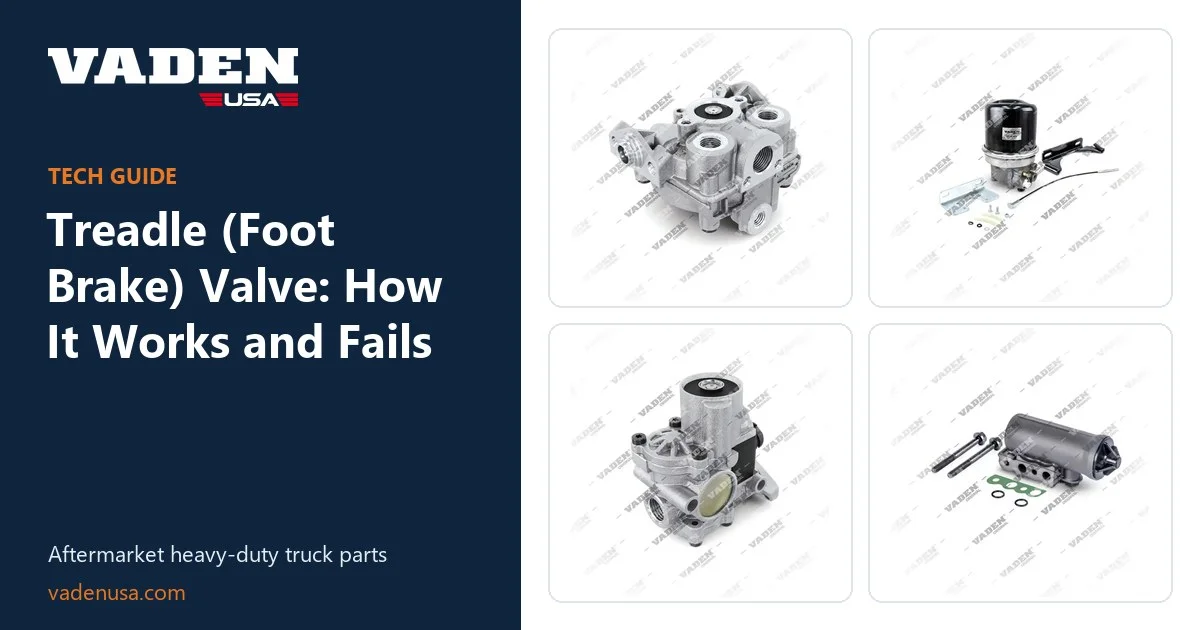
The treadle valve, also called the foot brake valve, is the pedal-operated valve that meters compressed air from the service reservoirs to the brake circuits. The harder you press, the more air it delivers, up to system pressure. A dual treadle valve has two sections, so if one circuit loses air the other can still apply brakes.
What the treadle valve does
On an air brake truck the driver never moves air directly. Pressing the pedal moves a plunger and spring inside the valve, which opens an inlet seat and lets reservoir air flow to the delivery ports. Because the spring and the valve piston balance against each other, the delivered pressure rises in proportion to pedal travel. This is called graduated, or "following," control. Release the pedal and the inlet closes, the exhaust seat opens, and the air in the brake lines vents out of the valve exhaust. Some shops call it the air brake foot valve; it is the same part.
That is why the treadle valve is the starting point for the whole service brake system. For the big picture of tanks, relay valves, chambers and slack adjusters, see our guide on how air brakes work on a semi truck.
Primary and secondary circuits
Federal Motor Vehicle Safety Standard 121 sets braking performance requirements for air-braked vehicles, including after a single service brake circuit failure (see 49 CFR 571.121). The split design of the dual treadle valve is how the pedal feeds two independent circuits. It is built as two valve sections stacked in one body, each fed by its own reservoir:
- Primary section. Fed by the primary service reservoir (often the one that feeds the rear brakes). On most tractors it supplies the drive axle circuit, usually through one or more relay valves.
- Secondary section. Fed by the secondary service reservoir. On most tractors it supplies the front axle circuit.
The pedal pushes the primary piston mechanically, and the primary delivery pressure then helps push the secondary piston. If the primary circuit leaks, the pedal still moves the secondary section directly. If the secondary circuit leaks, the primary section still works. In either case the pedal feels longer or lower and braking is weaker, so the truck should be taken out of service, not driven on.
The exact split of axles between circuits depends on the truck and trailer setup, so confirm it in the manufacturer's brake schematic before you diagnose.
Where it sits and what it feeds
The valve is mounted on the cab floor or firewall and operated by the pedal plate. Its delivery ports connect to the rest of the service brake system:
- The drive axle circuit usually goes to the control port of a relay valve, which then sends full reservoir air to the chambers close to the axle. That cuts brake application time.
- The front axle circuit usually goes toward the front brake chambers through the ABS modulator valves.
- A quick release valve may sit near a chamber to dump air fast when you let off the pedal.
- A pressure signal from the treadle circuits also goes to the trailer through the trailer control valve and the tractor protection system, and to the brake light switches.
Treadle valve vs relay, quick release and modulator
| Valve | Main job | Where it is | Controlled by |
|---|---|---|---|
| Treadle valve | Meters air in proportion to pedal travel, two circuits | Cab floor or firewall | Driver's foot |
| Relay valve | Uses a small control signal to pass large reservoir air volume to chambers | Near the axle or chambers | Treadle valve air signal |
| Quick release valve | Vents chamber air quickly on release | Close to the chambers | Pressure in the line |
| ABS modulator valve | Holds, releases or reapplies pressure at a wheel to prevent lock-up | Near the wheel end or frame | ABS electronic control unit |
Symptoms of a failing treadle valve
Treadle valves are simple and long-lived, but the seals, springs and plungers wear, and moisture or oil in the air system speeds that up. Typical signs:
| Symptom | Likely cause | First check |
|---|---|---|
| Hissing from the pedal area while the pedal is pressed | Worn or damaged inlet or exhaust seals, a cracked body | Soapy water at the exhaust and body joints with the pedal held |
| Air pressure drops when the brake is held | Leak in the valve or downstream line, hose or chamber | Static and applied leakage test (steps below) |
| Pedal sticks down or returns slowly | Dirty or corroded plunger, a broken return spring, a binding pedal pivot | Lubricate the pivot, then check the valve plunger travel |
| Weak or uneven braking, long pedal | One section not delivering, a restricted line, a failed relay valve or a worn brake | Compare delivery gauge readings for the two circuits |
| Air leaking from the exhaust when the pedal is released | Inlet seat not sealing, contamination | Check the supply pressure line and the exhaust port by hand and with soap solution |
| Low air warning when braking, compressor cycling often | Leakage in one circuit | Find the circuit by watching the primary and secondary gauge needles separately |
Before blaming the valve, rule out the parts downstream and upstream: a stuck relay valve, a leaking quick release valve, a bad hose or fitting, or a poorly adjusted brake can all produce the same complaint. A slow or uneven application can also come from the brakes themselves; see our notes on brake fade and brake lag and the slack adjuster guide.
Basic leak check for the treadle valve
This follows the usual air brake leakage checks mechanics use. Always use the vehicle manufacturer's service data for pressure limits and allowed leakage, and chock the wheels first.
- Park on level ground, chock the wheels and build system pressure to governor cut-out. Shut the engine off.
- With the wheels chocked, release the parking brakes so the spring brakes do not mask a service-circuit leak, and note both gauge readings.
- With the pedal released, watch the gauges for about a minute. A drop here points to a leak upstream of the treadle valve or in the supply side. Listen at the valve exhaust for a constant hiss.
- Press the pedal fully and hold it. Watch both gauges and listen at the cab floor, the valve exhaust and the line connections. Spray a soap solution on the exhaust port and body joints. Bubbles that keep growing mean a leaking seat or body.
- Compare the allowed pressure loss in the manufacturer's data. The CDL and inspection standards apply limits per minute for a held application; see our DOT air brake inspection checklist and pre-trip checklist.
- If the leak is only at a fitting or hose, repair that. If the valve body, exhaust or the delivery pressure itself is wrong, plan to replace the valve.
Repair or replace
Replacing the valve as an assembly is common practice because it is a safety component and a failed section takes one whole brake circuit out of action, but follow the manufacturer's service data on whether a rebuild is allowed. If a rebuild is permitted, verify the valve's delivery pressure and leakage afterward. In general:
- Drain the air system and block the vehicle so it cannot roll.
- Tag and photograph every air line. Treadle valve ports are marked for supply and delivery on each circuit, and crossing them can leave one circuit not working or the pedal unable to apply the brakes correctly.
- Disconnect the lines, remove the mounting bolts and the valve. Inspect the lines, fittings and the pedal pivot while it is out.
- Mount the new valve with the correct bolts and torque, reconnect each line to the marked port, and check that the pedal moves freely through its full travel and returns fully.
- Build air, run the leak check above, and road test at low speed before returning the truck to service. Check brake lights and trailer brake application as well.
Treadle valves are made in several body styles and port layouts, and the brand names and part numbers you find on the casting identify the valve only. Match the OE number from the casting or the valve label, not a similar looking valve. Our guide to cross-referencing an OE part number shows how to do that.
Related VADEN parts
VADEN does not list treadle valves in its catalog at this time. We do supply related air brake parts, including these categories:
VADEN parts are aftermarket replacements. Brand names and part numbers mentioned in this article are trademarks of their owners and are used only for reference; VADEN is not affiliated with those manufacturers.
Safety and compliance notes
Required brake systems for commercial motor vehicles are covered by 49 CFR 393.40. Out-of-service criteria used at roadside inspections, including air loss rates, are published by the Commercial Vehicle Safety Alliance. A treadle valve that leaks heavily, or a brake circuit that does not hold pressure, is an out-of-service concern, not a deferred repair.
FAQ
What is a treadle valve on a semi truck?
It is the foot-operated valve in the cab that controls the service brakes. When you press the pedal, it sends air from the service reservoirs to the brake circuits in proportion to how far the pedal moves, and when you release the pedal it vents that air.
Where is the foot brake valve located?
The foot brake valve (also called the air brake foot valve) is mounted on the cab floor or firewall under or behind the brake pedal plate, with air lines running from it to the reservoirs and out to the brake circuits. Exact location varies by truck model.
What are the symptoms of a bad treadle valve?
Common signs are hissing at the pedal when it is pressed, air pressure that falls while the brake is held, a sticking or slow-returning pedal, weak or uneven braking and a low-air warning during braking. Check the lines, relay valves and brakes too, because they can cause the same symptoms.
How does a dual treadle valve work?
It has a primary and a secondary section, each fed from its own reservoir. The pedal moves both, and each section delivers air in proportion to pedal travel to its own circuit. If one circuit fails, the other section can still apply brakes.
What is the difference between a treadle valve and a relay valve?
The treadle valve is driver-controlled and sets how much pressure is requested. A relay valve is a remote, air-controlled valve that takes that signal and passes a large volume of reservoir air to the chambers near the axle, so the brakes apply faster.
Can I drive with a leaking treadle valve?
No, not if the leak is more than a minor seep within the manufacturer's limits. A leak can drain a circuit, and a failed circuit leaves you with reduced braking. Have it inspected and repaired before the truck goes back on the road.
Need parts for the brake circuit around your treadle valve? Request a quote or e-mail info@vadenusa.com with the OE number or the truck model and we will help you match it.
Blog
3 2026-11-19
Air Brake Troubleshooting Guide: Symptoms, Causes, Fixes
Symptom-by-symptom air brake troubleshooting for semi trucks: slow build-up, pressure loss, constant dryer purge, locked brakes and ABS faults, with first checks.
 2026-11-19
Trailer ABS Light: Causes, Reset and DOT Violation Rules
Why the ABS light stays on a semi trailer, what the power-up check should look like, common causes, blink codes, resetting and what DOT rules say.
 2026-11-19
WABCO Air Compressor: ID, Rebuild Kits and Replacement
How to identify a WABCO air brake compressor by its 10-digit number, tell single from twin cylinder, and decide between a repair kit and a replacement unit.