

Published: · Updated:
ABS Brake System on Semi Trucks: Warning Light & Faults
How a heavy-truck ABS works, what the amber ABS lamp means under 49 CFR 393.55, and how to diagnose sensor, wiring and modulator faults.
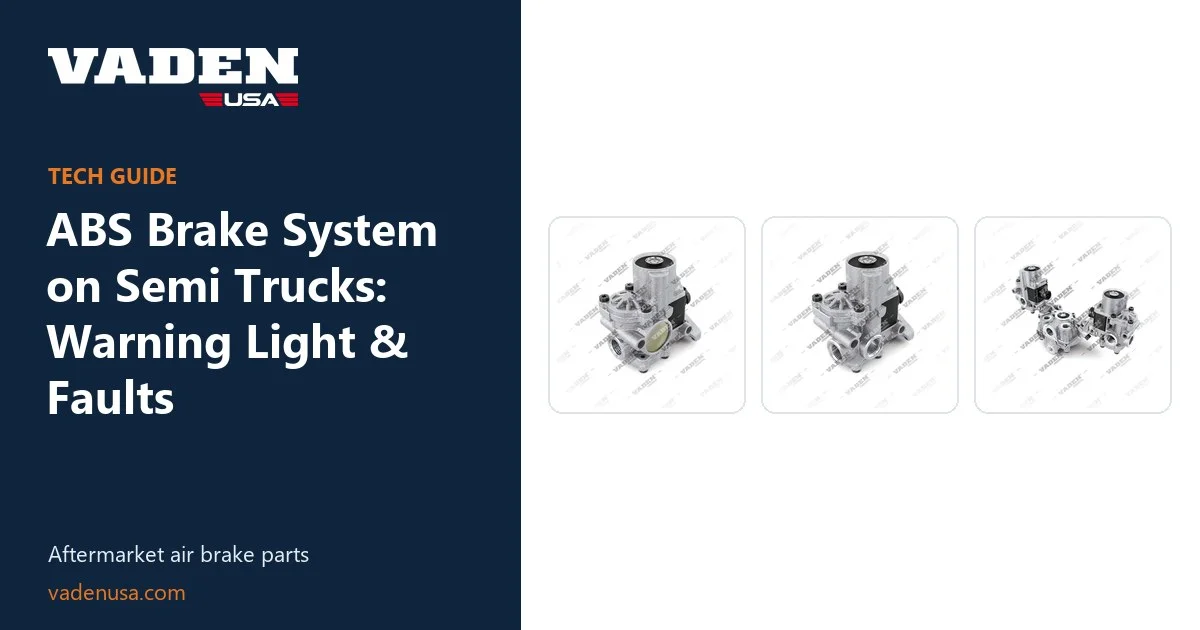
A truck ABS uses wheel speed sensors, an electronic control unit (ECU) and modulator valves to keep wheels from locking under hard braking. When the amber ABS lamp stays on, the base air brakes still work, but antilock function (and any ABS-based traction or stability features) may be reduced, so the truck should be diagnosed at the next safe stop.
How a truck ABS works
Every ABS on a tractor, straight truck or trailer has the same three building blocks:
- Wheel speed sensors read a toothed tone ring at the wheel end and report how fast each monitored wheel is turning.
- The ABS ECU compares wheel speeds against expected behavior. If a wheel slows much faster than the rest, the ECU treats it as an impending lockup.
- Modulator valves sit in the air line between the brake valve and the brake chamber. On the ECU's command they hold, release and reapply chamber pressure so the wheel keeps turning while the driver stays on the pedal.
A common trailer layout is two sensors and one modulator (2S/1M). Tractors and straight trucks typically use more sensors and modulators, and many current systems share the same sensors with traction control and electronic stability. The exact layout depends on the chassis, so check the ABS wiring diagram for the truck in front of you, whether it is a Freightliner Cascadia or M2, Kenworth T680 or W900, Peterbilt 579 or 389, International LT, Mack Anthem or Granite, or Volvo VNL.
What federal rules require
Under 49 CFR 393.55, air-braked truck tractors built on or after March 1, 1997 must have ABS meeting FMVSS 121. Other air-braked commercial vehicles built on or after March 1, 1998, including trucks, buses, semitrailers and converter dollies, must also have it. The same section requires a malfunction circuit that signals ABS faults, a way to relay trailer faults to a lamp in the towing cab, and an exterior ABS lamp on trailers and dollies. The regulation text does not describe lamp bulb-check behavior, so follow the OEM manual for how your lamp should act at key-on.
Reading the ABS warning lamp
The ABS lamp is amber. Bendix guidance published in Fleet Maintenance says the lamps should cycle on and then off during the diagnostic check, and any lamp that stays on is treated as a malfunction. At a roadside inspection, a lamp that stays on is recordable and can lead to a citation, though Bendix notes it is not an out-of-service violation by itself. Our DOT air brake inspection checklist covers the other items inspectors look at.
- Dash lamp: a fault on the tractor ABS, or a trailer fault relayed to the cab when the trailer is connected.
- Exterior trailer lamp, driver's side: a fault on the trailer or dolly ABS. Dollies need a lamp too.
- Lamp stays on with the trailer unhooked: the fault is on the tractor side.
Symptom, likely cause and first check
| Symptom | Likely cause | First check |
|---|---|---|
| ABS lamp stays on after key-on | Wheel speed sensor, wiring or connector fault; modulator fault; low system voltage | Read active codes with a diagnostic tool, then inspect the sensor and harness at the wheel named in the code |
| Lamp comes on intermittently, often when wet or on rough roads | Corroded or chafed harness, loose connector, water in a plug | Flex the harness while watching live data; inspect connectors for corrosion |
| Code for one wheel speed sensor | Damaged or contaminated sensor, loose or damaged tone ring, or a wiring fault between sensor and ECU | Check sensor seating and tone ring, then the wiring. a sensor code can trace back to a bad connection rather than the sensor |
| Modulator or solenoid code | Open or shorted solenoid circuit, damaged connector, failed modulator | Check the connector and supply voltage, then test the modulator per the service data sheet |
| Brakes feel normal but ABS and stability features are off | ABS disabled by a stored fault | Read the code before clearing anything; repair, then retest |
| Wheel drags or locks at one corner | Often a base-brake or air-line problem, not ABS | Check chamber, slack adjuster and air supply before replacing electronics |
Step-by-step diagnosis
- Confirm the air system first. Weak supply pressure or contaminated air can create complaints that look like ABS faults. Review air compressor failure symptoms and the air dryer cartridge replacement intervals if you find moisture or oil.
- Check battery and ground. Low voltage or a poor ground can set sensor and ECU codes.
- Read the codes. Use the brake manufacturer's or the OEM's diagnostic software (for Bendix systems, Bendix ACom PRO), which gives fault-specific information and repair steps. On trailers you can read blink codes from the ABS lamp as described in Bendix service data, but this method is limited.
- Test the basic parts. Wheel speed sensors and modulators are the first components to verify. Bendix says that if they test good, the cause is likely chassis wiring or a more involved issue.
- Inspect the wheel end. Look at the sensor tip and retaining clip or sleeve, the tone ring for damage or looseness, and any heavy contamination. Sensor spacing and test values differ by manufacturer, so use the OEM service data rather than a generic number.
- Repair, then retest. Cycle ignition power, confirm the lamp behavior and make sure no codes remain active.
Replacing a modulator valve
If testing confirms a failed modulator, match it to the OE number and port layout before ordering. Drain the system, label the air lines and disconnect the electrical connector. After installing the new valve, torque fittings and mounting hardware to the OEM specification, leak-test, and road-test with the diagnostic tool connected. To cross-check a part number, use our WABCO cross reference or Bendix cross reference. You can browse the full range in the ABS solenoid and modulator valve category.
Preventive habits
- Check the ABS lamps during pre-trip and post-trip inspections.
- Do not ignore an intermittent lamp; intermittent faults tend to get worse.
- Keep harnesses clipped and away from heat and moving parts around the axle and brake chamber.
- Keep connectors clean and sealed, and replace damaged plugs rather than taping them.
- Keep the air system dry and clean to protect modulator valves.
VADEN parts for this job
| VADEN part | Description | Replaces / fits |
|---|---|---|
| VADEN 303.14.0039 | ABS Modulator Valve, Replaces WABCO 4721950780 | Wabco 4721950780 |
| VADEN 303.14.0040 | ABS Modulator Valve, Replaces WABCO 4721950790 | Wabco 4721950790 |
| VADEN 303.14.0100 | ABS Modulator Valve, Replaces WABCO 4725004250 | Wabco 4725004250 |
Need help matching an application? Contact our Houston team with the OE number or the truck VIN.
FAQ
Is it safe to drive with the ABS light on?
The service brakes should still work, but antilock function and related stability or traction features may not. Bendix says a warning lamp does not demand a roadside repair and advises driving to the next safe stop to check it. Leave extra following distance until it is repaired.
Can a bad wheel speed sensor turn on the ABS light?
Yes, and it is one of the first things to check. The code can also come from a poor connection between the sensor and the ECU or from a damaged tone ring, so inspect the wiring and wheel end before replacing parts.
Will an ABS light fail a roadside inspection?
A lamp that stays on is treated as a malfunction. Per Bendix it is recordable and can lead to a citation, but it is not an out-of-service violation by itself. Repair it promptly.
Does the trailer ABS affect the tractor lamp?
Yes. Federal rules require tractors to carry a circuit that relays trailer ABS malfunction signals to a cab lamp, and trailers carry an exterior lamp. Unhook the trailer to see which side the fault is on.
How do I know the modulator is the problem?
Read the code, check the connector and voltage, then test the modulator according to the manufacturer's service data. Replace it only when the test or code confirms it.
Bendix, WABCO, Freightliner, Kenworth, Peterbilt, International, Mack, Volvo, Cummins, Detroit and PACCAR are trademarks of their respective owners. VADEN is not affiliated with these companies; names are used only to identify compatible applications.
Blog
3 2026-11-19
Air Brake Troubleshooting Guide: Symptoms, Causes, Fixes
Symptom-by-symptom air brake troubleshooting for semi trucks: slow build-up, pressure loss, constant dryer purge, locked brakes and ABS faults, with first checks.
 2026-11-19
Trailer ABS Light: Causes, Reset and DOT Violation Rules
Why the ABS light stays on a semi trailer, what the power-up check should look like, common causes, blink codes, resetting and what DOT rules say.
 2026-11-19
WABCO Air Compressor: ID, Rebuild Kits and Replacement
How to identify a WABCO air brake compressor by its 10-digit number, tell single from twin cylinder, and decide between a repair kit and a replacement unit.