

Published: · Updated:
Semi Truck Preventive Maintenance Checklist and Schedule
A practical semi truck preventive maintenance checklist by interval, with a full air system block, federal inspection and record rules, and how to build a PM schedule.
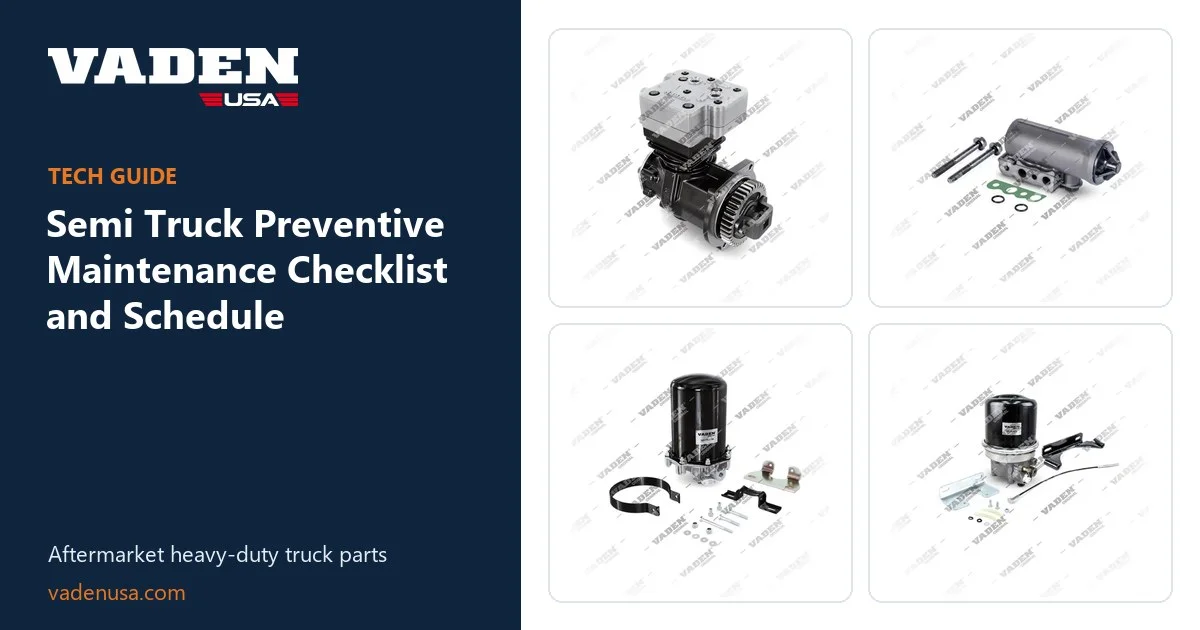
A semi truck preventive maintenance checklist lists the inspections and service tasks to perform at set mileage, hour or calendar intervals: engine oil and filters, cooling, fuel, tires, brakes, steering, lights and the air system. For air brakes, drain the tanks, check for leaks, replace the air dryer cartridge on schedule and confirm compressor and governor operation.
This page is about scheduled preventive maintenance (PM), not the daily walk-around. For the driver's daily routine see the CDL Class A pre-trip inspection checklist. Exact service intervals come from the engine, axle and component manuals, so this checklist labels them "per OEM" instead of inventing mileage numbers.
Daily checks versus scheduled PM
The two jobs are different and both are needed. The driver's pre-trip and post-trip inspection finds defects that appeared since the last run. The scheduled PM replaces wear items and checks components before they fail. Under 49 CFR 396.11, a driver must report any defect that affects safe operation in a written driver vehicle inspection report (DVIR), and the carrier or its agent must certify that the defect was repaired before the vehicle runs again. The carrier keeps the DVIR, the repair certification and the driver review for three months.
Scheduled PM is where you catch what a walk-around cannot see: worn slack adjusters, a saturated dryer cartridge, oil carryover from the compressor, a weeping hose or a failing wheel seal.
Semi truck maintenance checklist by interval
Use the table as a template and replace each "per OEM" entry with the interval printed in your engine and component manuals. Many fleets use a short A service and a longer B service plus an annual inspection, but the names and mileages vary by fleet and manufacturer.
| Interval | System | Tasks |
|---|---|---|
| Daily (driver) | Air brakes | Drain tanks per fleet policy, check air pressure build-up, governor cut-in and cut-out, low-air warning and audible leak |
| Daily (driver) | Tires, wheels, lights | Visual tire condition, inflation, lug nuts, all lamps, reflectors, mirrors, horn |
| Daily (driver) | Fluids | Engine oil, coolant level, power steering, windshield washer, visible leaks |
| Short PM (per OEM) | Engine | Oil and filter change, fuel filters, air filter restriction check, belts and hoses, coolant condition |
| Short PM (per OEM) | Chassis | Grease fifth wheel, steering and suspension points, check tire pressure and tread depth, check lights and wiring |
| Short PM (per OEM) | Air system | Drain all tanks, check for leaks, check dryer purge, inspect hoses and fittings |
| Full PM (per OEM) | Brakes | Measure pushrod stroke, inspect linings or pads and drums or rotors, check slack adjusters, brake chambers, wheel seals |
| Full PM (per OEM) | Air system | Replace air dryer cartridge if due, test governor and compressor build-up, inspect compressor discharge line for carbon, check valves |
| Full PM (per OEM) | Driveline, steering, suspension | Check u-joints, slip yokes, tie rods, drag link, kingpins, air springs, shocks, bushings |
| Annual | Whole vehicle | Periodic inspection under 49 CFR 396.17 by a qualified inspector, with a written report |
Air system preventive maintenance
The air system supplies the brakes, suspension, and often the clutch and cab devices. Compressor, governor, dryer and tanks work as a chain, and a fault early in the chain damages everything downstream. For background on how the whole circuit works, read how air brakes work on a semi truck.
Tank drains
Water and oil collect in the supply and service tanks. Drain every tank on the interval set by your fleet, and more often in humid or cold weather if the truck has no working dryer. Check that each drain valve seals after use, because a drain that leaks air will quietly lengthen compressor duty cycle. See the air tank drain valve guide for manual versus automatic types.
Air dryer cartridge and purge valve
The desiccant cartridge wears out gradually, and a saturated cartridge lets moisture into the tanks. Replace it per the dryer manufacturer's schedule, or sooner if you find water or emulsified oil in the drains. When you service the cartridge, listen for the purge burst at governor cut-out: a weak, continuous or missing purge points to the purge valve or the governor. Details are in the guides on air dryer cartridge replacement intervals, the air dryer purge valve and how the air dryer works.
Governor and compressor
With the engine running, the compressor should build the system from a low pressure to governor cut-out in a reasonable time, and the governor should cut in again at its set pressure after pressure falls. Use the manufacturer's published figures for build-up time and cut-out pressure, because they differ by system. Check the discharge line and the dryer for carbon and oil: heavy oil carryover can mean a worn compressor, a restricted air intake or a failed dryer. Follow the step-by-step method in how to test a truck air compressor, and see the air governor guide for adjustment. If the compressor is worn, the rebuild or replace decision guide helps you choose.
Leak test
Fully charge the system, shut off the engine, release the parking brake, and note the pressure drop with the service brakes released and then applied. The allowable drop rates are in the air brake test in your state CDL manual and in the CVSA out-of-service criteria. Any audible leak, even one that passes the test, is a fix-now item. Check hoses, glad hands and fittings, and the connection between tractor and trailer: see air brake hose and fittings and the glad hands guide.
Valves and safety devices
During full PM, check for sluggish release or air leaks at the relay valves, quick release valves and ABS modulators, and confirm the tractor protection valve and the compressor safety valve are operating. Related guides: relay valve guide, quick release valve, ABS modulator valve, tractor protection valve and compressor safety valve.
Air system PM at a glance
| Item | What to check | Sign of a problem |
|---|---|---|
| Tank drains | Drain, then confirm the valve seals | Water or milky oil, or a drain that leaks air |
| Dryer cartridge | Replace per dryer manual | Moisture in tanks, frozen lines in winter |
| Purge valve | Listen for purge at cut-out | Constant hiss or no purge |
| Governor | Cut-in and cut-out pressures | Cut-out outside the specified range |
| Compressor | Build-up time, oil carryover | Slow build-up, oil in the dryer |
| Slack adjusters | Pushrod stroke | Stroke beyond the limit for the chamber size |
| Hoses and fittings | Chafing, cracking, leaks | Audible leak, soap bubbles |
Brake adjustment
Measure pushrod stroke at each brake chamber with the brakes applied and compare it with the adjustment limit for your chamber type. Automatic slack adjusters should hold adjustment on their own, so an out-of-adjustment automatic unit means a fault to investigate, not a routine adjustment. See the slack adjuster guide and the table of air brake chamber sizes. For the roadside side of this, the DOT air brake inspection checklist shows what inspectors look at.
Periodic inspection and records
Federal rules add requirements to your own schedule. These are the main ones for a carrier operating under the FMCSRs; confirm details in the current text on eCFR Part 396.
- Systematic maintenance (396.3): carriers must systematically inspect, repair and maintain vehicles under their control. Records must show vehicle identification, the type and due date of each inspection and maintenance task, and a record of inspections, repairs and maintenance with dates. Keep them where the vehicle is housed or maintained for one year, and for six months after the vehicle leaves your control.
- DVIR (396.11): the driver reports defects affecting safe operation or likely to cause a breakdown; the carrier certifies repairs. Retention is three months.
- Periodic inspection (396.17): every commercial motor vehicle must pass an inspection meeting the appendix A standards at least once in the preceding 12 months, performed by a qualified inspector under 396.19. Documentation of the inspection, either the report or a decal or form based on it, must be on the vehicle.
Inspection levels at the roadside are a separate matter, covered in DOT inspection levels explained. Good PM records also help during a roadside audit or compliance review because they show the vehicle was inspected on a schedule.
How to build a PM schedule
- List every unit with make, model, engine, year and VIN, plus the duty cycle (long haul, regional, vocational, severe service).
- Pull the OEM intervals from the engine, transmission, axle and air system manuals. Where manuals disagree, use the shortest.
- Pick the trigger for each task: mileage, engine hours or calendar time, whichever comes first. Idle-heavy and short-haul trucks usually reach time or hour limits before mileage limits.
- Group tasks into tiers (for example short PM, full PM and annual) so a truck is in the shop once rather than several times.
- Print a work order for each tier with a sign-off line per task and space for measurements such as tread depth and pushrod stroke.
- Record and review findings. Repeated findings on the same component, such as wet tanks every month, point to a root cause worth fixing.
- Adjust the schedule after a few months based on what the inspections actually find.
Replacing wear parts on schedule is generally cheaper than the same repair done roadside, because a breakdown adds towing, lost loads and often related damage, such as a failed dryer cartridge feeding water into valves. Your own repair history will show the real numbers for your fleet.
Air system parts for PM
VADEN makes air brake parts for heavy-duty trucks, and the categories most often needed during PM are the air dryer cartridge valves, air dryer valves, unloader valves and air brake compressors. Order by OE reference where you have it; the cross-reference guide explains how. VADEN parts are aftermarket replacements; brand names such as Bendix, WABCO and Cummins are trademarks of their owners and are used for reference only.
FAQ
What should be on a semi truck preventive maintenance checklist?
Engine oil and filters, coolant, fuel system, belts and hoses, tires and wheels, brakes and slack adjusters, steering and suspension, driveline, lights and wiring, fifth wheel, and the air system: tank drains, dryer cartridge, governor, compressor and leak test.
How often should a semi truck have preventive maintenance?
It depends on the engine, component manuals and duty cycle, so use the intervals printed by the manufacturers. Most fleets run a short PM, a full PM and an annual inspection. Federal rules require at least one periodic inspection every 12 months under 49 CFR 396.17.
What is a fleet preventive maintenance schedule?
It is a plan that assigns inspections and service tasks to each vehicle by mileage, engine hours or calendar time, groups them into service tiers, and tracks completion and due dates in records.
What air brake maintenance should be done on a semi truck?
Drain tanks, replace the dryer cartridge per its schedule, check the purge valve, test governor cut-in and cut-out, check compressor build-up and oil carryover, run a leak test, inspect hoses and fittings, and measure pushrod stroke.
Do I need to keep maintenance records for a commercial truck?
Yes. Under 49 CFR 396.3 carriers keep inspection, repair and maintenance records for each vehicle for one year where it is housed or maintained, and six months after it leaves their control. DVIRs are kept three months.
Is there a semi truck preventive maintenance checklist PDF?
You can copy the interval table above into your own work order or spreadsheet and replace the "per OEM" entries with the intervals from your manuals.
Need air system parts for your next PM cycle? Request a quote or e-mail info@vadenusa.com with your OE numbers, and we will cross-reference them.
Blog
3 2026-11-19
Air Brake Troubleshooting Guide: Symptoms, Causes, Fixes
Symptom-by-symptom air brake troubleshooting for semi trucks: slow build-up, pressure loss, constant dryer purge, locked brakes and ABS faults, with first checks.
 2026-11-19
Trailer ABS Light: Causes, Reset and DOT Violation Rules
Why the ABS light stays on a semi trailer, what the power-up check should look like, common causes, blink codes, resetting and what DOT rules say.
 2026-11-19
WABCO Air Compressor: ID, Rebuild Kits and Replacement
How to identify a WABCO air brake compressor by its 10-digit number, tell single from twin cylinder, and decide between a repair kit and a replacement unit.