

Published: · Updated:
How to Test a Truck Air Compressor: Step by Step
A shop and pre-trip method to test a truck air compressor: build-up time, governor cycling, leak-down and oil carryover, and how to tell when the compressor itself is at fault.
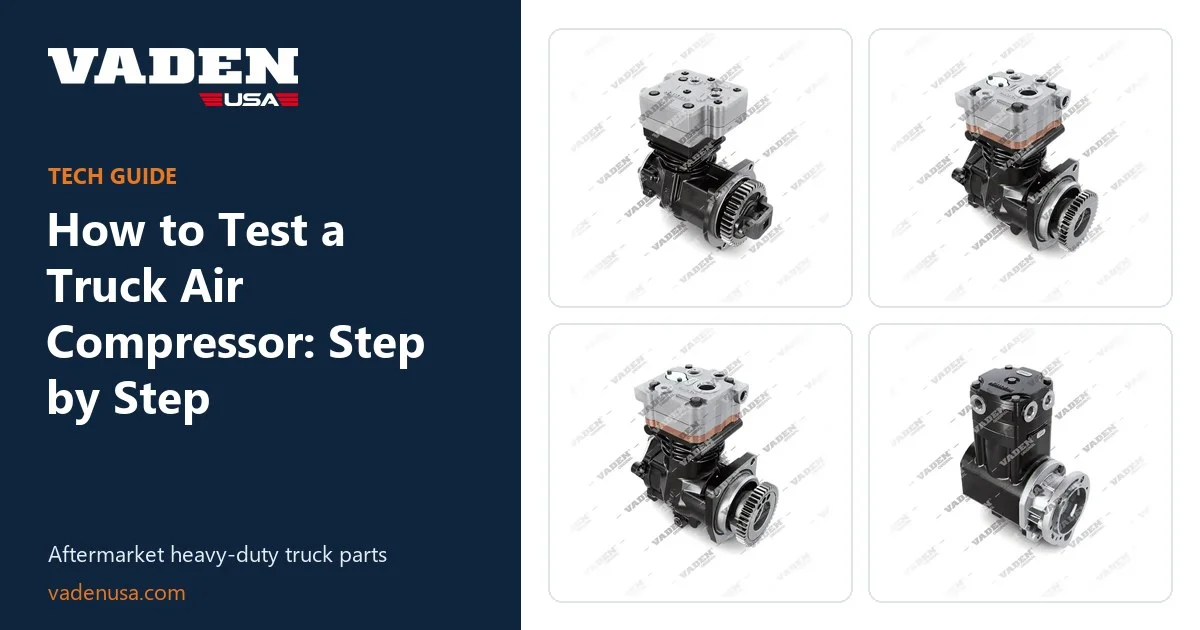
To test a truck air compressor, drain the system, run the engine and time how long it takes to build air from 85 to 100 psi, then confirm the governor cuts out and cuts in, and finally rule out leaks and oil carryover. If air builds slowly only when the system leaks, or the governor never unloads, the compressor is often not the real problem.
What a compressor test actually proves
A compressor test answers one question: can the pump move enough air into the reservoirs, and does the system hold it? Federal Motor Vehicle Safety Standard 121 gives the benchmark. It requires the compressor to raise pressure in the supply and service reservoirs from 85 psi to 100 psi, with the engine at the manufacturer's maximum recommended rpm, within a time set by a formula based on reservoir capacity (49 CFR 571.121, S5.1.1). The standard does not give one fixed number of seconds for every truck, so use the calculation or the figure in the OEM service manual for your tank set.
Remember that the test measures the whole supply side: compressor, discharge line, air dryer, check valves and tanks. Run the steps below in order so each result isolates one component. For field symptoms that come before the test, see our guide to air compressor failure symptoms.
Before you start
- Chock the wheels, set the parking brake and keep the area clear. Never work on air lines under pressure.
- Confirm the compressor drive is intact: gear, belt or coupling, depending on the engine (Cummins X15/ISX, Detroit DD13/DD15/DD16, PACCAR MX-13, Mack MP8, Volvo D13).
- Check the oil supply and coolant lines to the compressor for leaks or kinks, and the air intake path for restriction.
- Use a master gauge you trust. Dash gauges are fine for a quick pre-trip, but a bad gauge will send you after the wrong part.
- Look up the OEM cut-out pressure and build-up specification for the truck (Freightliner Cascadia/M2, Kenworth T680/W900, Peterbilt 579/389, International LT/ProStar, Mack Anthem/Granite, Volvo VNL).
Step 1: Build-up time
- Drain all reservoirs so pressure falls below 85 psi, then close the drains.
- Start the engine and bring it to the rpm the OEM specifies for the test.
- Time the climb from 85 psi to 100 psi.
- Compare the result with the OEM specification or the FMVSS 121 formula for your reservoir capacity.
A slow climb points to a worn compressor, a restricted intake, a loose or slipping drive, a stuck unloader, or a leak downstream. Do not condemn the compressor until steps 3 and 4 are done.
Step 2: Governor cut-out and cut-in
Keep the engine running and watch the gauge as pressure rises. The governor should unload the compressor at the cut-out pressure listed by the OEM, and the compressor should resume pumping at cut-in. FMVSS 121 requires the governor cut-in pressure on a truck to be 100 psi or greater (S5.1.1.1), so a cut-in far below that points to a governor that needs attention.
- No cut-out at all: pressure keeps climbing toward the safety valve. Suspect the governor or a blocked governor line before the compressor.
- Cut-out is normal but the compressor keeps bleeding air: listen at the unloader and governor ports. Our compressor valve and unloader guide covers this fault.
- Cycling very often: look for leaks first, then the governor.
Step 3: Leak-down test
Once the system is at cut-out, shut off the engine and watch the gauge with the brakes released, then with a full service application. State CDL manuals publish a maximum loss per minute, and the limit differs between a single vehicle and a combination, so use your state manual or the shop standard. Leaks at fittings, drain valves, brake chambers or the trailer line make a healthy compressor look weak. Soap the connections and fix them before judging the pump. For the full walk-around, see the DOT air brake inspection checklist.
Step 4: Low-air warning check
With the engine off, fan the brake pedal and note the pressure at which the low-air warning comes on. For vehicles covered by FMVSS 121, the warning must be a visible signal (or both audible and visible), not just the gauge, when service reservoir pressure is below 60 psi (S5.1.5). A warning that fails to operate is a separate defect from a weak compressor, and 49 CFR 393.51 covers the warning signal requirement (393.51).
Step 5: Oil carryover check
Drain the wet tank and the other reservoirs into a clean container. A light film or a few drops can show up on many in-service trucks, but oil that keeps returning, or a saturated dryer cartridge, signals a problem. Common causes are a worn compressor, a restricted intake or an air dryer that is not doing its job. Replace the cartridge on schedule (see air dryer cartridge replacement intervals) and check the OEM limits before blaming the compressor. Heavy oil is also a sign that the discharge line may be carboned up, so inspect it.
Reading the results
| What you see | Likely cause | Next check |
|---|---|---|
| Slow build-up, no leaks, governor normal | Worn compressor, restricted intake, slipping drive | Intake, drive, discharge line, then compressor |
| Slow build-up, fast pressure drop with engine off | System leak | Soap test fittings, chambers, drains |
| Pressure climbs past cut-out | Governor or governor line | Governor, line, unloader |
| Compressor never unloads, constant air bleed | Unloader or governor fault | Unloader ports and governor |
| Oil in tanks every drain | Compressor wear, dryer, intake restriction | Dryer cartridge, intake, discharge line |
When the compressor really is the problem
Replace or rebuild when build-up stays slow after the leaks, governor, dryer and intake are cleared, or when oil carryover continues with a good dryer cartridge. Our guide to rebuild or replace an air brake compressor helps weigh the two. Match the replacement using the OE number on the old compressor, not the truck model alone; see how to cross-reference an OE part number. If a part number is unclear, contact us.
VADEN parts
VADEN lists single-cylinder compressors, twin-cylinder compressors and governors in the catalog, with the OE references shown on each product page. Browse the single-cylinder compressor, twin-cylinder compressor and compressor governor categories.
| VADEN part | Description | Replaces / fits |
|---|---|---|
| VADEN 2500 030 001 | Single Cylinder Air Compressor, Replaces WABCO 9111535100 | Cummins 3104216RX, Wabco 9111535100 |
| VADEN 2200 020 001 | Single Cylinder Air Compressor, Replaces Bendix 5010803 | Bendix 5010803, Bendix 5010806 |
| VADEN 2200 020 002 | Single Cylinder Air Compressor, Replaces Bendix 5010803 | Bendix 5010803, Bendix 5010806 |
| VADEN 2500 010 001 | Single Cylinder Air Compressor, Replaces Cummins 3558072 | Cummins 3558072, Cummins 3558131 |
| VADEN 2500 030 003 | Single Cylinder Air Compressor, Replaces WABCO 9111535200 | Cummins 3103403, Cummins 3558163 |
| VADEN 2500 030 004 | Single Cylinder Air Compressor, Replaces WABCO 9111530190 | Cummins 3104216, Cummins 3687343 |
| VADEN 2500 340 001 | Single Cylinder Air Compressor, Replaces WABCO 9111530270 | Cummins 3689649, Wabco 9111530270 |
| VADEN 2600 120 001 | Twin Cylinder Air Compressor, Replaces Bendix 5004187 | Bendix 5004187, Bendix Tu-Flo 750 |
| VADEN 1100 330 001 | Single Cylinder Air Compressor, Replaces Bendix BA-921 | Bendix BA-921, Detroit Diesel DD15 |
| VADEN 2200 030 001 | Twin Cylinder Air Compressor, Replaces Bendix 5004416 | Bendix 5004416, Bendix 5004417 |
| VADEN 2600 030 001 | Twin Cylinder Air Compressor, Replaces Bendix 5012893 | Bendix 5012893, Bendix 5012894 |
| VADEN 2600 040 001 | Single Cylinder Air Compressor, Replaces Bendix 5018485X | Bendix 5018485X |
FAQ
How long should a truck air compressor take to build air?
FMVSS 121 sets the build-up from 85 to 100 psi at the maximum recommended engine rpm, within a time calculated from reservoir capacity. It is not one number for all trucks, so compare with the OEM specification.
Can a leak make the compressor look bad?
Yes. A leaking fitting, drain valve or brake chamber forces the compressor to work longer, so always run the leak-down test before replacing the pump.
Is oil in the air tanks always a compressor failure?
No. A little residue can appear in service, and a worn dryer cartridge or restricted intake can also cause it. Persistent oil after the dryer is serviced points to the compressor.
What should the governor cut-in be?
On a truck, FMVSS 121 requires cut-in at 100 psi or greater. The cut-out pressure is set by the OEM, so check the manual for your engine and chassis.
Can I test the compressor without a master gauge?
You can do a quick pre-trip check with the dash gauges, but a shop test should use a calibrated gauge so a faulty dash gauge does not mislead the diagnosis.
Freightliner, Kenworth, Peterbilt, International, Mack, Volvo, Cummins, Detroit, PACCAR, Bendix, WABCO and other OE brand names are used only to identify compatible parts. VADEN is not affiliated with these manufacturers.
Blog
3 2026-11-19
Air Brake Troubleshooting Guide: Symptoms, Causes, Fixes
Symptom-by-symptom air brake troubleshooting for semi trucks: slow build-up, pressure loss, constant dryer purge, locked brakes and ABS faults, with first checks.
 2026-11-19
Trailer ABS Light: Causes, Reset and DOT Violation Rules
Why the ABS light stays on a semi trailer, what the power-up check should look like, common causes, blink codes, resetting and what DOT rules say.
 2026-11-19
WABCO Air Compressor: ID, Rebuild Kits and Replacement
How to identify a WABCO air brake compressor by its 10-digit number, tell single from twin cylinder, and decide between a repair kit and a replacement unit.