

Published: · Updated:
Air Dryer Cartridge Replacement: Intervals and Cross-Reference
How often to replace a truck air dryer cartridge, how to match the cartridge to Bendix AD-9, AD-IS, AD-SP or AD-IP dryers, and signs it has failed. Sources cited.
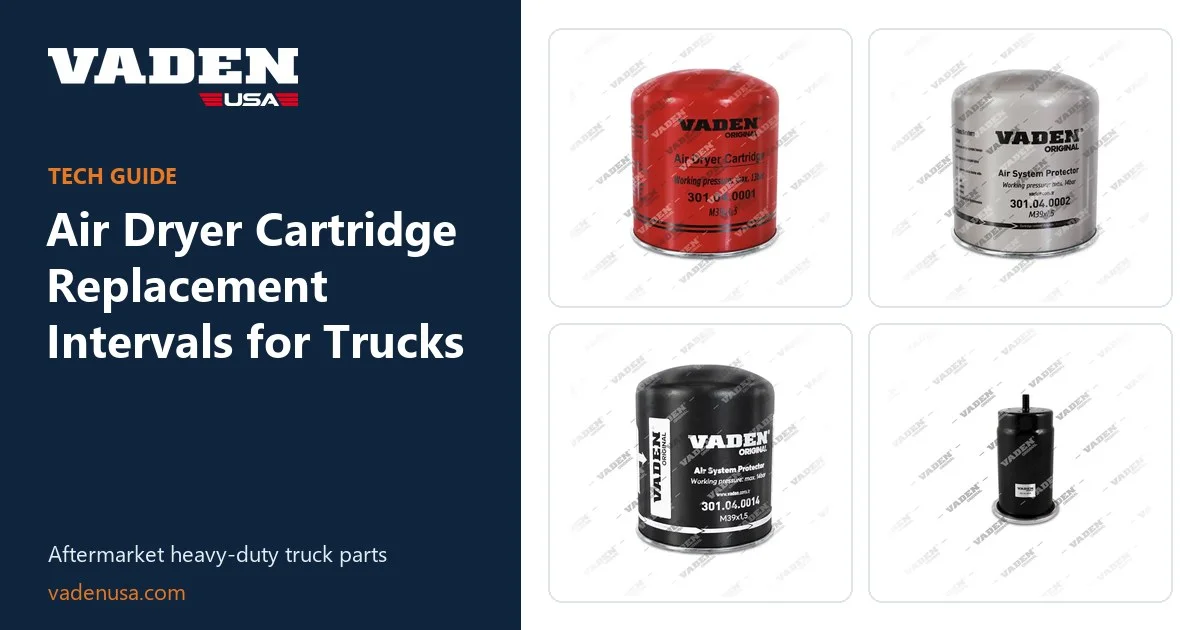
Bendix guidance, as reported by Fleet Maintenance, is to replace the air dryer cartridge every 12 to 24 months on standard line-haul trucks and every 6 to 12 months on high-demand vehicles such as city transit, off-road and automated-manual-transmission trucks. Follow the truck maker's schedule first, and replace sooner if drained tanks show water or oil.
Why the cartridge has an expiry date
The cartridge holds the desiccant that pulls water vapor out of compressed air, and in most designs it also filters oil aerosol. Desiccant does not wear out like a brake lining: it slowly saturates and gets contaminated, mostly by compressor oil carry-over. Once it can no longer adsorb moisture, water reaches the tanks, valves and chambers. That means corrosion, sluggish valves and, in winter, frozen lines.
The dryer also needs regular purge cycles to regenerate the desiccant. A healthy dryer that is overloaded, for example by a worn compressor, loses capacity faster than the calendar suggests. See our guide to DD15 air compressor failure symptoms for the oil-carry-over side of the problem, and how air brakes work on a semi truck for where the dryer sits in the system.
Replacement intervals by duty cycle
Bendix publishes intervals by air usage level. The table below summarizes the schedule in a Bendix-sourced Fleet Maintenance article from 2018. Treat it as a starting point and check the current Bendix literature for your dryer. We do not use a single fixed interval for every truck, because the right number depends on air usage, cartridge type and the truck maker's guidelines.
| Air usage | Standard (non-coalescing) cartridge | Oil-coalescing cartridge (PuraGuard) |
|---|---|---|
| Standard | 24 months | 24 months or 200,000 miles |
| Medium | 18 months | 18 months or 150,000 miles |
| High | 12 months | 12 months |
The article defines the usage levels roughly like this: standard is a vehicle with five axles or fewer in line haul, city or delivery work; medium covers doubles, light transit and vehicles with up to eight axles; high covers multiple trailers, city transit, heavy off-road work and vehicles with nine or more axles. Use these only to place your truck in a row, and confirm against current Bendix literature.
The same article also covers the Bendix GC Green Cartridge, which has a shorter schedule: 12 months for standard and medium use, and six months for high use. If you are not sure which cartridge your dryer has, check the part number on the cartridge before choosing an interval, because the schedules above do not apply to every type.
In a separate Bendix tech-tips article, the company describes the range more simply: 12 to 24 months for standard air demand and 6 to 12 months for high or sensitive demand, such as city transit buses, off-road vehicles and trucks with automated manual transmissions. Bendix advises looking first to the vehicle manufacturer's guidelines, which may vary by engine or air system.
Climate and operating environment
The Bendix sources we read give no single number for climate, so we do not either. In practice, technicians treat these conditions as reasons to inspect early:
- Large temperature swings. Bendix notes that ambient shifts of more than 30 °F can cause a temporary accumulation of moisture. Continue normal operation and recheck the tanks after about a week before concluding the cartridge has failed.
- Humid or coastal routes, where the dryer sees more moisture per cycle.
- Cold-weather operation, where any moisture that passes the dryer can freeze in valves and lines.
- Stop-and-go work with heavy air use: kneeling buses, door actuation, bulk unloading, lift axles or central tire inflation.
Match the cartridge to your dryer
Cartridges are not universal. The dryer model decides the cartridge, so identify the dryer first (the ID tag or casting on the housing, or the part number on the old cartridge), then the cartridge. The table below is a checklist only. It lists no part numbers and no mounting details on purpose: confirm the exact cartridge or kit against the service data sheet for your dryer.
| Dryer | What to check |
|---|---|
| Bendix AD-9 | Compare the new cartridge with the old one, and use the kit parts the service data calls for |
| Bendix AD-IS and AD-SP | Standard or oil-coalescing (PuraGuard) version |
| Bendix AD-IP | Do not assume an AD-IS cartridge fits; confirm the cartridge kit for the AD-IP |
| WABCO System Saver 1200 and 1200 Plus | Match by WABCO part number, not by appearance |
For model details, read our guide to Bendix AD-9, AD-IS and AD-IP air dryers. Our air dryer that replaces WABCO SS1200 Plus 4324711010 and the WABCO cross-reference help match parts by OE number. We have not verified that any cartridge is interchangeable between a Bendix and a WABCO dryer, so send us the OE number from your old part and we will check it against the catalog.
Standard desiccant vs. oil-coalescing cartridges
A standard cartridge dries the air. An oil-coalescing cartridge adds a stage that captures oil aerosol before it reaches the desiccant, so the desiccant stays usable longer when the compressor carries over some oil. Bendix says non-coalescing cartridges can be upgraded to the PuraGuard oil-coalescing type.
- If the truck came with an oil-coalescing cartridge, replace it with another oil-coalescing cartridge. For a factory-fitted PuraGuard, Bendix says to replace it with a like unit.
- Our advice: do not swap an oil-coalescing cartridge for a standard one, because the oil protection is lost.
An oil-coalescing cartridge does not fix a compressor that pumps excessive oil. If you find oil in the tanks, repair the compressor, then replace the cartridge.
Signs you should replace the cartridge early
- Water or a milky oil-and-water mix when you drain the tanks. Bendix recommends this moisture check once a month.
- Tanks that stay wet after normal running.
- Frozen valves or lines in cold weather.
- The dryer purges constantly, or never purges.
- Slow air build-up or a governor that cycles more often than before.
The 2018 article also lists moisture check intervals by usage: every 25,000 miles, three months or 900 hours for standard use; 12,000 miles, two months or 450 hours for medium; and 6,000 miles, one month or 300 hours for heavy.
How to replace the cartridge
- Park the truck, chock the wheels and drain all reservoirs to release air pressure. Record what comes out (water, oil, or both).
- Fix any oil source first, such as a worn compressor.
- Remove the old cartridge as the service data sheet describes. On some dryers the dryer must come off the vehicle for this.
- Clean the mounting surface and fit the new o-ring supplied in the kit.
- Install the same type of cartridge, tightening to the maker's specification. Do not swap an oil-coalescing unit for a standard one.
- Follow the dryer service data sheet for purge valve and check valve service.
- Build pressure, check for leaks and for correct purging, then recheck the tanks after a few days of normal running.
Write the install date and odometer reading on the new cartridge or in the maintenance record, so the next technician does not have to guess.
Browse air dryer valve cartridges, air dryer valve repair kits and air processing units. VADEN parts are aftermarket replacements. To request a quote, contact us with your OE number.
FAQ
How often should an air dryer cartridge be replaced?
Bendix guidance, as reported by Fleet Maintenance, is 12 to 24 months for standard air demand and 6 to 12 months for high or sensitive demand. The truck manufacturer's guidelines come first, and moisture in the tanks is a reason to replace sooner.
How do I know if my air dryer cartridge is bad?
Water or oil in the drained tanks, frozen valves in cold weather, constant or missing purge cycles and slow air build-up all point to it. Check the compressor for oil carry-over before blaming the cartridge alone.
Which cartridge fits a Bendix AD-IP air dryer?
Do not assume an AD-IS or AD-SP cartridge fits. Confirm the exact cartridge or kit by the part number on the old one or the dryer service data sheet, or send us the OE number.
Are an air dryer cartridge and an air dryer filter the same thing?
Usually, yes. People say filter, desiccant cartridge or dryer cartridge for the replaceable element that holds the desiccant.
Does a WABCO System Saver 1200 use the same cartridge as a Bendix AD-9?
Do not assume so. The dryers are different designs, and we have not verified any cross-fit. Match by the OE number on the old cartridge and confirm with us before ordering.
Can I use a standard cartridge in place of an oil-coalescing one?
We advise against it. Replace an oil-coalescing cartridge with another oil-coalescing one, and Bendix says a factory-fitted PuraGuard must be replaced with a like unit. Bendix does say a standard dryer can be upgraded to oil-coalescing.
Sources
- Fleet Maintenance: Updated service interval recommendations for air dryer cartridges
- Bendix Tech Tips: Air dryer system inspection and upkeep
- Vehicle Service Pros: Bendix oil-coalescing air treatment technology
VADEN ORIGINAL USA is not affiliated with Bendix, WABCO, ZF, Meritor, Haldex, Detroit or Mack. Brand names are used for reference only.
Blog
3 2026-11-19
Air Brake Troubleshooting Guide: Symptoms, Causes, Fixes
Symptom-by-symptom air brake troubleshooting for semi trucks: slow build-up, pressure loss, constant dryer purge, locked brakes and ABS faults, with first checks.
 2026-11-19
Trailer ABS Light: Causes, Reset and DOT Violation Rules
Why the ABS light stays on a semi trailer, what the power-up check should look like, common causes, blink codes, resetting and what DOT rules say.
 2026-11-19
WABCO Air Compressor: ID, Rebuild Kits and Replacement
How to identify a WABCO air brake compressor by its 10-digit number, tell single from twin cylinder, and decide between a repair kit and a replacement unit.