

Published: · Updated:
Rebuild or Replace an Air Brake Compressor? Decision Guide
A practical guide to deciding between a repair kit, a cylinder head or a complete air brake compressor, based on what the teardown and the test actually show.
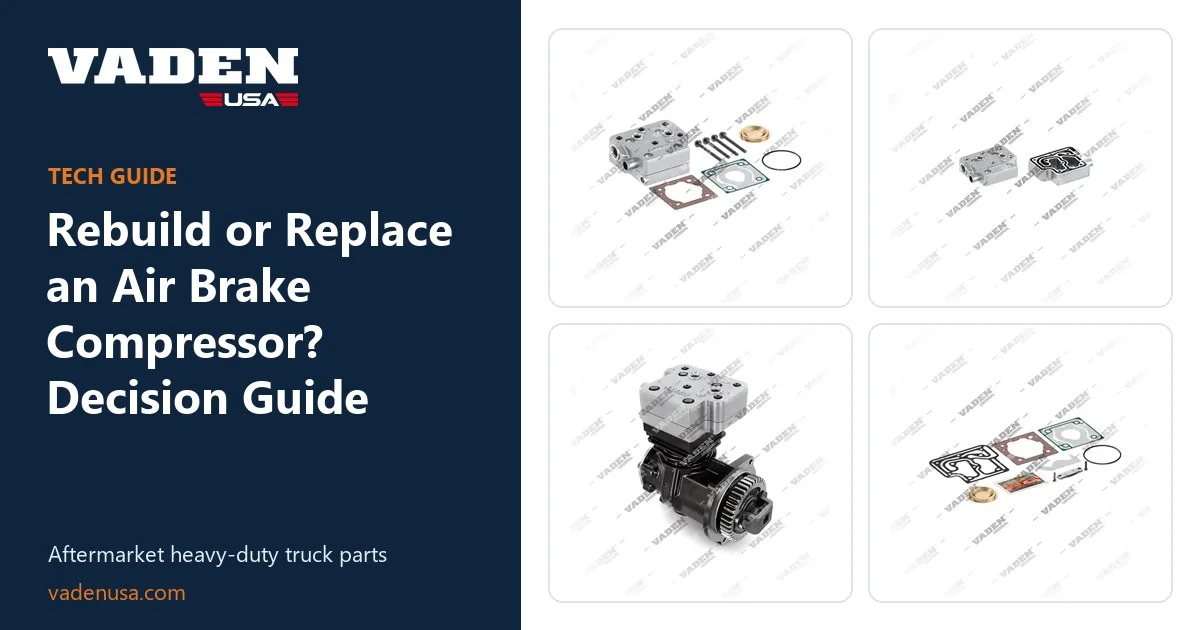
Rebuild the compressor when the wear is limited to the head, valves, gaskets or seals and the bore, crankshaft and bearings measure within the OEM limits. Replace the complete compressor when the block is scored, the bearings have play, the mounting is damaged, or the unit has already failed after a previous repair. The deciding factor is almost always what the teardown shows, not the symptom that brought the truck in.
Start with a test, not a parts list
Many compressor complaints are not compressor failures. Slow build-up, oil in the air system and a compressor that never unloads can come from a leaking governor, a saturated air dryer, a restricted discharge line or a worn unloader. Before anything is ordered, run the checks in our guide on how to test a truck air compressor and confirm the symptom against the OEM service manual for that engine and compressor.
For reference, FMVSS 121 requires the compressor to raise system pressure from 85 to 100 psi within a time set by a formula based on reservoir capacity, with the engine at the manufacturer's maximum recommended rpm (49 CFR 571.121, S5.1.1). That is a new-vehicle certification requirement, not a shop test limit, so use the build-up time in the OEM manual for your truck when judging a worn unit.
What each repair level covers
The four options differ in how much of the compressor they touch. The table summarizes the usual scope; exact contents vary by compressor model, so always compare the kit contents with the OE parts breakdown.
| Option | Typically addresses | Does not address |
|---|---|---|
| Gasket kit | External oil or air leaks at the head, cover or mounting joints | Internal wear, valve failure, oil carryover |
| Repair kit | Worn valves, seals, rings or related wear parts, depending on the kit | Scored bore, worn crankshaft or bearings, cracked castings |
| Cylinder head | Cracked or eroded head, damaged valve seats, failed unloader bore | Anything below the head |
| Complete compressor | Worn block, bearings, crankshaft or mounting; repeat failures | Upstream causes such as a faulty governor or a bad dryer |
If you are unsure which kit applies, Compressor Repair Kit vs Gasket Kit explains how the two differ in practice.
When a repair is enough
A rebuild makes sense when the problem is clearly in the wear parts and the rest of the compressor is sound. Typical cases include:
- An oil or air leak at a joint with no other symptoms, which points to a gasket kit.
- Slow build-up with a compressor that is otherwise quiet, with no play at the drive and a clean bore, which may point to valves or rings in a repair kit.
- A cracked or eroded cylinder head on a compressor whose block and bearings are in good condition.
- A newer unit with low mileage that failed from a contaminated supply, once the cause has been corrected.
In each case, inspect the bore, piston surfaces and bearings before committing. A kit installed on a worn block often fails again, and the labor is repeated.
When to replace the complete compressor
Replacement is the better call when the damage goes below the head or when the cost of a second failure is high. Look for these signs:
- Scoring or out-of-round wear in the bore, or excessive piston ring wear beyond OEM limits.
- Crankshaft or bearing play, noise from the bottom end, or metal in the oil.
- Cracked block, damaged mounting flange, or a stripped or worn drive gear or coupling.
- A compressor that has already been rebuilt and is back with the same complaint.
- A long road-service or towing exposure, where a second breakdown costs more than the part.
Complete single-cylinder units are listed in the single cylinder compressor category. Check the compressor type against the old unit before ordering; our article on single versus twin-cylinder units covers the fitment differences.
Downtime and the core question
A rebuild keeps the existing compressor on the engine, so it usually means more bench time: removal, teardown, cleaning, measuring and reassembly. A complete replacement is typically a faster swap, because the new unit is ready to install, but it requires the correct unit for the engine and model year. For a truck that has to return to service quickly, that trade-off is often the real deciding factor.
If you plan to send the old compressor back as a core, confirm the return terms with your supplier before the unit is torn down. A disassembled or damaged core may not qualify, so decide between rebuild and replace first, and check core requirements before you start work.
Check the cause before you close the hood
A new compressor will fail early if the cause is still there. Check the following whichever route you choose:
- Air dryer and cartridge condition, since a saturated desiccant sends moisture and oil downstream. See our air dryer cartridge replacement intervals.
- The governor and unloader operation, so the compressor cycles correctly.
- The discharge line for carbon build-up or restrictions.
- The air intake or engine-fed lubrication and coolant lines, where applicable, as specified in the OEM manual.
- Leaks in the system that make the compressor run more than it should.
Under 49 CFR 396.3, motor carriers must keep parts in safe and proper operating condition and keep maintenance records for each vehicle (49 CFR 396.3). Record the compressor repair or replacement and the cause found.
Match the part to the old compressor
Whatever route you choose, match the part to the unit on the engine, not to the truck badge. Read the OE number or casting number on the old compressor and check it against the cross reference. Our guide on how to cross-reference an OE part number walks through the steps, and the Bendix cross reference and WABCO cross reference pages list OE-to-VADEN matches. Heads and kits are specific to the compressor model, so confirm before you order.
VADEN parts
The VADEN catalog covers compressor repair kits, gasket kits, cylinder heads and complete compressors. Examples from the catalog are shown below.
| VADEN part | Description | Replaces / fits |
|---|---|---|
| VADEN 25 03 50 | Air Compressor Cylinder Head, Replaces WABCO 9111539212 | Cummins 4089206, Wabco 9111539212 |
| VADEN 25 03 51 | Air Compressor Cylinder Head for Freightliner and International | Blue Bird, Caterpillar, Cummins |
| VADEN 2500 030 001 | Single Cylinder Air Compressor, Replaces WABCO 9111535100 | Cummins 3104216RX, Wabco 9111535100 |
| VADEN 2500 030 100 | Air Compressor Repair Kit for Freightliner and International | Blue Bird, Caterpillar, Cummins |
| VADEN 2500 030 150 | Air Compressor Gasket Kit for Freightliner and International | Blue Bird, Caterpillar, Cummins |
| VADEN 2500 030 500 | Air Compressor Repair Kit for Freightliner and International | Blue Bird, Caterpillar, Cummins |
| VADEN 2500 030 750 | Air Compressor Repair Kit, Replaces WABCO 9111549292 | Cummins 4089238, Wabco 9111549292 |
| VADEN 22 02 10 | Air Compressor Cylinder Head for Freightliner and International | Bendix, Caterpillar, Freightliner |
| VADEN 22 02 50 | Air Compressor Cylinder Head for Freightliner and International | Bendix, Caterpillar, Freightliner |
| VADEN 2200 020 001 | Single Cylinder Air Compressor, Replaces Bendix 5010803 | Bendix 5010803, Bendix 5010806 |
| VADEN 2200 020 002 | Single Cylinder Air Compressor, Replaces Bendix 5010803 | Bendix 5010803, Bendix 5010806 |
| VADEN 2200 020 110 | Air Compressor Repair Kit for Freightliner and International | Bendix, Caterpillar, Freightliner |
Frequently asked questions
Is a repair kit enough for a compressor that pumps oil?
Not always. Oil in the air system can come from the compressor, but also from a saturated dryer or a restricted intake. Test first, and inspect the bore and rings before deciding on a kit.
Can I replace only the cylinder head?
Yes, when the head is the damaged part and the block, piston and bearings pass inspection. A head replacement is not a fix for bottom-end wear.
How do I know if the bearings are worn?
Check for crankshaft play, noise from the bottom of the compressor and metal particles in the oil. Measure against the limits in the OEM manual for that compressor model.
Should I replace the air dryer cartridge at the same time?
It is a sound practice, especially if oil or moisture reached the dryer. A contaminated cartridge can damage a new or rebuilt compressor.
Will a VADEN part fit my truck?
Fit depends on the compressor on the engine, not only on the truck model. Use the OE number on the old unit, and if you need help matching it, contact us.
Bendix, WABCO, Cummins, Detroit Diesel, Freightliner, International, Kenworth, Mack and other OE brand names are used only to identify compatibility. VADEN is not affiliated with or endorsed by these companies.
Blog
3 2026-11-19
Air Brake Troubleshooting Guide: Symptoms, Causes, Fixes
Symptom-by-symptom air brake troubleshooting for semi trucks: slow build-up, pressure loss, constant dryer purge, locked brakes and ABS faults, with first checks.
 2026-11-19
Trailer ABS Light: Causes, Reset and DOT Violation Rules
Why the ABS light stays on a semi trailer, what the power-up check should look like, common causes, blink codes, resetting and what DOT rules say.
 2026-11-19
WABCO Air Compressor: ID, Rebuild Kits and Replacement
How to identify a WABCO air brake compressor by its 10-digit number, tell single from twin cylinder, and decide between a repair kit and a replacement unit.