

Published: · Updated:
Semi Truck Clutch Guide: How It Works and Hydraulics
How a semi truck clutch works, what free play and wear signs mean, and how the pedal unit, master cylinder and servo release it, with VADEN parts.
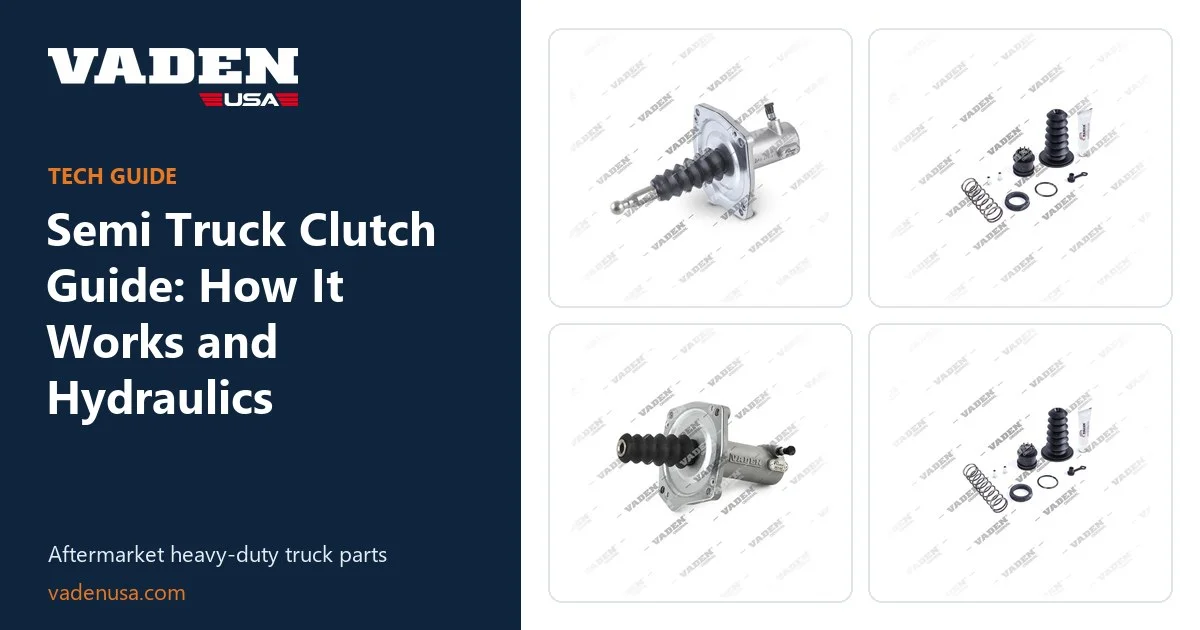
A semi truck clutch is a heavy-duty friction clutch that links the engine flywheel to a manual transmission and lets the driver disconnect drive to shift. The pedal releases it through a hydraulic circuit, often boosted by an air-assisted clutch servo. Wear, wrong free play and hydraulic leaks cause most slipping and hard-pedal complaints.
How a semi truck clutch works
The clutch sits between the engine and the transmission, inside the flywheel housing. When the pedal is up, springs in the cover clamp the driven plate (or plates) between the flywheel and the pressure plate, and torque passes through the friction facings. When the driver presses the pedal, the release bearing moves and pushes on or pulls the release levers or diaphragm fingers (depending on whether the clutch is push-type or pull-type), and the clamp load is removed. The transmission input shaft can then spin freely and gears can be changed.
Heavy-duty clutches are bigger than car clutches because they have to carry the full torque of a diesel engine with a loaded trailer behind it. Many use a ceramic or organic facing material, a clutch brake to stop the input shaft for starts from rest, and either a single plate or two plates in the clutch pack. Which one your truck has depends on the engine rating and the transmission, so always confirm it from the build sheet or the clutch data tag, not from the truck model alone.
For a view of the whole driveline, see our overview of the parts of a semi truck. The clutch brake has its own page: semi truck clutch brake. The housing that holds it all is covered in truck flywheel housing.
Semi truck clutch diagram: the release path
Most people searching for a clutch diagram want to know what is between the pedal and the clutch. On a hydraulic system the path is short:
- Pedal unit. The pedal pivots and pushes the rod of a master cylinder. On many trucks the master cylinder is built into a hydraulic clutch pedal unit.
- Hydraulic line. Fluid moves through a hose and a rigid line from the master cylinder toward the transmission area.
- Clutch servo (slave cylinder). The fluid pressure moves the servo piston. On air-assisted designs, a valve in the servo admits air from the truck's air system so the servo adds force and the driver feels a light pedal.
- Release fork and bearing. The servo moves the release fork, which moves the release bearing against the clutch.
- Clutch pack. Pressure plate, driven plate(s), intermediate plate (two-plate designs) and flywheel.
Because the hydraulic parts are the ones that leak, stick and wear their seals, many "clutch problems" are really pedal unit, master cylinder or servo problems. That is why the symptom table below separates the two groups.
Hydraulic vs air-assisted clutch control
A purely hydraulic system transfers the driver's foot force through fluid. It is simple, but pedal effort rises with larger clutches. An air-assisted system keeps the hydraulic circuit and adds an air servo that multiplies the force, so the pedal stays light even on a large two-plate clutch. The air comes from the truck's air system, so a loss of air pressure can make the pedal heavy; if you are chasing that kind of problem, compare it with our clutch servo problems guide.
| Item | Hydraulic only | Air-assisted servo |
|---|---|---|
| Source of assist | Driver's foot only | Foot plus shop air |
| Pedal feel | Heavier on large clutches | Light |
| Extra failure points | Master cylinder, line, slave | Same, plus air valve, air seals and supply |
| Typical symptom of a fault | Soft pedal, leaks, no release | Heavy pedal when air is low, air hiss at the servo |
Manual-adjust vs self-adjusting clutches
Older and some current heavy-duty clutches are manually adjusted: as the facings wear, the release bearing travel changes and an adjusting ring or mechanism has to be reset. Self-adjusting clutches have an internal wear-sensing mechanism that advances the adjustment automatically, so no routine adjustment is needed, although inspection and lubrication still are. Eaton publishes installation guidance for its self-adjusting clutches, for example the Eaton installation guide for its self-adjusting 430 mm clutch, and points technicians to its heavy-duty clutch service manual (CLSM0200) for lubrication and inspection.
| Type | How wear is compensated | What you do in service |
|---|---|---|
| Manual-adjust | Technician resets the adjustment | Check and adjust at the interval in the OEM service literature |
| Self-adjusting | Internal mechanism advances automatically | Inspect and lubricate; do not try to adjust the linkage to hide wear |
How to check and adjust a semi truck clutch
Clutch adjustment values (release bearing gap, clutch brake squeeze, free play) are set by the clutch and transmission manufacturer and vary by model. The steps below show the order of work; take every number from the OEM service manual for your clutch.
- Identify the clutch. Read the data tag or the build sheet to learn the make, size, whether it is push-type or pull-type, and whether it is manual-adjust or self-adjusting.
- Check the hydraulics first. Look for fluid at the master cylinder, the lines and the servo, check the reservoir level, and bleed the circuit if the pedal is soft. Adjusting a clutch that is being released by a leaking circuit does not fix anything.
- Check release bearing travel and clearance. Check the release bearing to clutch brake distance and the gap at the release fork, as the OEM procedure describes. This needs access through the inspection cover or a service opening. Use the tool or gauge the OEM calls for.
- Check clutch brake squeeze. With the pedal on the floor, confirm the clutch brake is squeezed as the OEM specifies, so the input shaft stops for rest-start gear selection.
- Adjust only a manual-adjust clutch. Use the adjustment tool or the clutch adjusting procedure in the manual. A clutch jack is only used to support and move the heavy transmission or clutch assembly during removal and installation, not to adjust it.
- Check in-cab free play last. Move the pedal by hand until you feel resistance and compare the travel with the specification. Free play is the result of correct adjustment, not the starting point. On some hydraulic systems it is set at the pedal unit or master cylinder, so follow the OEM procedure.
- Road test. Confirm the clutch engages smoothly, releases fully for shifts, and the brake holds the input shaft for rest-start gear selection.
Fleet maintenance guidance follows the same order: the Betts Truck Parts Q&A in Fleet Maintenance starts with the release bearing to clutch brake distance and treats in-cab free play as the end result of a correct adjustment. Our own practical advice: do not use linkage adjustment to hide worn facings.
Signs of a bad semi truck clutch
| Symptom | Likely clutch pack cause | Likely hydraulic cause |
|---|---|---|
| Engine revs rise but the truck does not accelerate | Worn or oil-contaminated facings, weak springs | Too little free play holding the release bearing against the clutch |
| Hard to get into gear, grinding at a stop | Dragging plates, worn clutch brake | Servo or master cylinder not giving full stroke, air in the fluid |
| Pedal goes to the floor or feels spongy | Rarely the clutch | Master cylinder bypass, leaking slave, air in line |
| Heavy pedal | Worn release bearing or linkage binding | Air assist not working, low supply air, stuck servo piston |
| Chatter or shudder at takeoff | Hot spots on flywheel, worn damper, oil on facings | Rare; check engine and transmission mounts first |
| Fluid on the floor or at the servo | None | Seal leak at master cylinder, servo or hose |
Many of these checks belong in a regular service routine; our semi truck preventive maintenance checklist shows where to put them.
Repair or replace a semi truck clutch
If the symptom points to the hydraulics, repair is often the right call: a repair kit restores the seals in a master cylinder or servo, and a worn unit can be replaced as a whole. Replacing the clutch pack is a larger job because the transmission has to come out, so shops normally replace the clutch, the release bearing, the clutch brake and the pilot bearing together, and check the flywheel surface and the flywheel housing at the same time. Cost depends on the parts chosen, labor time and truck downtime. We do not quote prices here, because they vary by region, shop and truck; ask your shop for a written estimate and compare it with the hydraulic repair option when the symptoms allow it.
VADEN parts for clutch hydraulic controls
VADEN does not supply clutch discs or pressure plates. We make the hydraulic controls that release them: clutch servos, master cylinders, hydraulic pedal units and repair kits. VADEN parts are aftermarket replacements, and WABCO, Volvo, PACCAR, International and other names are used only to identify parts and cross-references. To match a number, see how to cross-reference an OE part number.
Browse the categories: clutch, clutch servo, clutch servo slave cylinder, clutch servo repair kit, master cylinder and hydraulic clutch pedal unit.
| VADEN part | Description | Replaces / fits |
|---|---|---|
| VADEN 306.01.0067 | Clutch Servo, Replaces WABCO 9700515050 | Volvo 20458737, Wabco 9700515050 |
| VADEN 306.01.0067.01 | Clutch Servo Repair Kit, Replaces Knorr-Bremse 9700515050S1 | Knorr-Bremse 9700515050S1 |
| VADEN 306.01.0047 | Clutch Servo, Replaces WABCO 9700515030 | Wabco 9700515030 |
| VADEN 306.01.0047.01 | Clutch Servo Repair Kit, Replaces WABCO 9700515030S1 | Wabco 9700515030S1 |
| VADEN 306.01.0110 | Air-Assisted Clutch Servo, Replaces WABCO 9700515120 | International 3866376C91, Wabco 9700515120 |
| VADEN 306.02.0019 | Clutch Master Cylinder, Replaces Volvo 1628218 | FTE 2100228, FTE 874611 |
| VADEN 306.02.0019.01 | Clutch Master Cylinder Repair Kit, Replaces Volvo 271106 | FTE 2500228, FTE RK276834 |
| VADEN 306.02.0114 | Clutch Master Cylinder, Replaces WABCO 4008509040 | Wabco 4008509040 |
| VADEN 306.02.0114.01 | Clutch Master Cylinder Repair Kit for International | Caterpillar, International, Wabco |
| VADEN 306.10.0003 | Hydraulic Clutch Pedal Unit, Replaces PACCAR E216006 | Kenworth 1000290148, Paccar E216006 |
| VADEN 306.10.0012 | Hydraulic Clutch Pedal Unit, Replaces WABCO 4000300150 | Freightliner A0214082000, Wabco 4000300150 |
| VADEN 306.01.0107 | Air-Assisted Clutch Servo, Replaces PACCAR E176012 | Kongsberg 1000285721AM, Paccar E176012 |
FAQ
How do I adjust the clutch on a semi truck?
First confirm the clutch type. A self-adjusting clutch needs no routine adjustment. A manual-adjust clutch is reset with the adjustment tool and the release bearing travel, clutch brake squeeze and free play values listed in the OEM manual. Check the hydraulics for leaks and air first.
How much does it cost to replace a semi truck clutch?
It depends on the clutch parts, labor hours and downtime, and these differ by truck and shop, so we do not give a figure. Ask for an itemized estimate, and rule out a hydraulic fault (master cylinder or servo) before paying for a full clutch job.
What is a clutch jack and when do you need one?
A clutch jack is usually a transmission-type jack that supports and aligns the heavy transmission or clutch assembly during removal and installation; confirm the tool the OEM procedure calls for. You need it for replacing the clutch pack, not for routine adjustment or for hydraulic part changes.
What are the signs of a bad semi truck clutch?
Typical signs are slipping under load, a clutch that will not release fully, grinding into gear, chatter at takeoff, a heavy or spongy pedal and fluid leaks. Spongy pedals and leaks usually point to the hydraulic parts rather than the clutch pack.
How is a semi truck clutch operated hydraulically?
The pedal moves a master cylinder, which sends fluid through a line to a clutch servo at the transmission. The servo, often air-assisted, moves the release fork and bearing and disengages the clutch.
Does VADEN sell the whole clutch?
No. VADEN supplies the hydraulic controls: servos, master cylinders, pedal units and repair kits. Clutch discs and pressure plates come from the clutch manufacturer.
Need a clutch servo, master cylinder or pedal unit? Request a quote or email info@vadenusa.com with the OE number or the truck details.
Blog
3 2026-11-19
Air Brake Troubleshooting Guide: Symptoms, Causes, Fixes
Symptom-by-symptom air brake troubleshooting for semi trucks: slow build-up, pressure loss, constant dryer purge, locked brakes and ABS faults, with first checks.
 2026-11-19
Trailer ABS Light: Causes, Reset and DOT Violation Rules
Why the ABS light stays on a semi trailer, what the power-up check should look like, common causes, blink codes, resetting and what DOT rules say.
 2026-11-19
WABCO Air Compressor: ID, Rebuild Kits and Replacement
How to identify a WABCO air brake compressor by its 10-digit number, tell single from twin cylinder, and decide between a repair kit and a replacement unit.