

Published: · Updated:
Parts of a Semi Truck: Systems and Components Explained
A system-by-system guide to the parts of a semi truck, from the cab and engine to air brakes, the fifth wheel and trailer connections, in plain language.
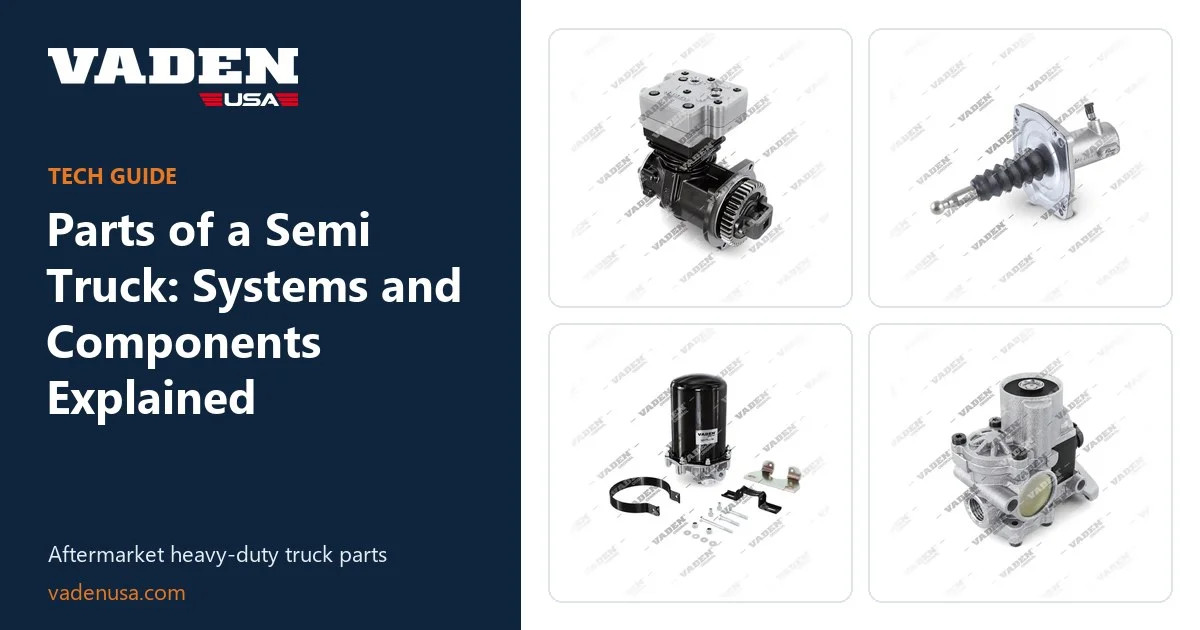
A semi truck is two machines coupled together: the tractor, which holds the cab, engine, drivetrain, axles and air brake system, and the semi-trailer, which carries the cargo and rests part of its weight on the tractor's fifth wheel. Knowing which part belongs to which system speeds up inspections, repair orders and parts searches.
The big picture: tractor, trailer and the links between them
Think of a tractor-trailer as five groups of parts: the cab where the driver works, the engine and its support systems, the drivetrain that moves power to the wheels, the chassis (frame, suspension, axles, wheels and brakes), and the coupling and connection parts that join tractor and trailer. A "parts of a semi truck trailer diagram" usually shows these same groups, just drawn from the side. Because this page is text only, the table below gives you the map, and the sections after it explain each group.
| System | Main parts | What it does |
|---|---|---|
| Cab | Sleeper, dash, seats, steering column, cab mounts, cab air springs | Houses the driver and controls; rides on its own suspension |
| Engine | Block, turbo, manifolds, oil and coolant pumps, filters, fuel system | Makes power and compressed air |
| Drivetrain | Clutch, transmission, driveshaft, differentials | Carries power to the drive wheels |
| Air brake system | Compressor, governor, air dryer, tanks, valves, chambers, slack adjusters | Stops and holds the whole combination |
| Chassis | Frame rails, springs or air bags, shocks, axles, wheels, tires | Carries the load and absorbs the road |
| Coupling | Fifth wheel, kingpin, glad hands, electrical cable, landing gear | Joins and supplies the trailer |
Cab parts
The cab holds the driver, the gauges and every control. Day cabs are short; sleeper cabs add a bunk and storage behind the seats. Key items are the instrument cluster (including air pressure gauges), the steering column and wheel, the pedals, the shift lever or selector, the trailer air supply and parking brake valves on the dash, the seats, the HVAC system, and the lighting controls.
Most modern cabs do not bolt rigidly to the frame. They sit on cab mounts and air springs, with a cab leveling valve that adds or releases air to hold ride height. If the cab sags on one side or the ride turns harsh, the leveling valve and air springs are the first things to check. VADEN offers cab leveling valves and a range of truck cab parts.
Engine and support systems
The diesel engine makes the power, and it also drives the air compressor that feeds the brakes. Around the block you will find these groups:
- Lubrication: the oil pump pushes oil through the engine, and the oil filter and oil cooler clean and cool it.
- Cooling: the water pump circulates coolant through the block, radiator and oil cooler. See cooling system parts.
- Fuel: tanks, lines, filters, the feed pump and the injection system. See fuel system parts.
- Air in and exhaust out: the intake, turbocharger, intake manifold and exhaust manifolds, followed by the aftertreatment system.
- Flywheel and housing: the flywheel connects the engine to the clutch, and the flywheel housing bolts the engine to the transmission.
For the full range, browse engine parts.
Drivetrain: clutch, transmission, driveshaft and axles
Power leaves the engine through the clutch (manual transmissions) or a torque converter or clutch pack (automated and automatic units), then moves through the transmission, driveshaft and drive axle differentials to the wheels.
- Clutch: connects and disconnects the engine from the transmission. Many heavy trucks use an air-assisted clutch servo so the pedal feels light.
- Clutch controls: a clutch master cylinder turns pedal travel into hydraulic pressure. A worn servo is a common cause of a hard pedal; see clutch servo problems and replacement.
- Transmission: selects the gear ratio. Manual, automated manual and automatic versions all appear on Class 8 trucks.
- Driveshaft and universal joints: carry rotation to the rear axles and flex as the suspension moves.
- Differentials and axle shafts: split power between the wheels on each drive axle.
Browse the full truck clutch parts range.
Air brake system
Most Class 8 tractors and trailers stop with compressed air, which is why this system has the most parts. The overall flow is simple: the engine-driven compressor makes air, the governor controls when it pumps, the air dryer cleans it, tanks store it, and valves send it to the brake chambers when you press the pedal. For a deeper explanation, read how air brakes work on a semi truck.
| Part | Job | Learn more / shop |
|---|---|---|
| Air compressor | Pumps air into the system, driven by the engine | Air brake compressors, repair parts |
| Governor | Tells the compressor when to load and unload | Governors, governor guide |
| Air dryer | Removes moisture and oil from compressed air | Air dryers, cartridges |
| Air processing unit | Combines the dryer and other valves in one housing | Air processing units |
| Air tanks and drain valves | Store air; drains remove collected moisture | Air tank drain valves |
| Relay valves | Speed up application and release at the rear axles and trailer | Relay valves, relay valve guide |
| ABS modulator valves | Pulse brake pressure at a wheel to prevent lockup | ABS modulator valves |
| Brake chambers and spring brakes | Convert air pressure into mechanical push force | Chamber sizes (information only) |
| Slack adjusters and S-cams or discs | Transfer chamber force to the friction parts | Slack adjuster guide (information only) |
Two things worth remembering. First, parking and emergency braking rely on spring brakes: powerful springs inside the chamber that apply the brake when air pressure drops. Safety warning: a spring brake chamber can release its stored force suddenly and cause serious injury or death if it is opened or taken apart. Never remove clamps or bolts from a spring brake chamber, chock the wheels and park on level ground before any work, and cage a spring brake only as the chamber and vehicle manufacturer instruct. See how to cage spring brakes for background. Second, wheel-end parts such as chambers and slack adjusters wear with use, so they belong on every pre-trip inspection and on the DOT air brake inspection checklist.
Where the brake system spreads across components, the air brake system parts category is the best starting point. If you are unsure whether you need a dryer or a full unit, see air dryer vs air processing unit.
Suspension, axles and wheels
Under the frame rails sit the axles, which carry the load, and the suspension that connects them to the frame. Tractors typically use leaf springs or air springs on the drive axles; trailers often use air ride. Shock absorbers control bounce, and on air suspensions a height control valve keeps the ride level. Wheels, hubs, bearings and seals sit at the ends of each axle, and the brake components mount there too. Tandem drive axles share the load, and many trailers use a sliding tandem so the axle position can be moved to adjust weight distribution.
Fifth wheel, kingpin and landing gear
The fifth wheel is the large plate mounted on the tractor frame behind the cab. It has a slot and a locking mechanism that grip the kingpin, a steel pin on the underside of the trailer. Together they let the trailer pivot as you turn. Under 49 CFR 393.70(b), the lower half must be secured to the frame with properly designed brackets or plates. The locking mechanism must keep the upper and lower halves from separating unless a positive manual release is operated, and readily separable designs must lock automatically on coupling. The lower half must also be located so that, regardless of loading, the kingpin-to-axle relationship distributes weight properly and does not unduly interfere with steering or braking.
The landing gear is the pair of crank-operated legs under the front of the trailer. They hold the trailer up when it is parked, and are raised before driving. The upper coupler plate is the part of the trailer that contacts the fifth wheel.
Trailer connections: glad hands and the electrical cable
Three lines link the tractor to the trailer. Two are air hoses ending in couplers called glad hands, one for the service line and one for the emergency (supply) line. The California commercial driver handbook describes color coding with blue for the service line and red for the emergency line, and many trailers also label them. The third is the electrical cable, a seven-conductor connector for trailer lights and auxiliary power. The common plug is standardized in SAE J560; the SAE J560 listing shown here is the 1998 revision, and SAE lists newer ones.
On the dash, the red trailer air supply control works the tractor protection valve. It keeps air in the tractor if the trailer breaks away or leaks badly. In newer vehicles the red knob pops out and the valve closes when pressure falls to the manufacturer's specified range; the handbook notes that older tractors may use a lever-type control whose valve may not close automatically. It also warns that crossed air lines can let you drive away with no trailer brakes, so always test the trailer brakes before driving. See the California Commercial Driver Handbook (large PDF). When parked, store glad hands in the dummy couplers to keep dirt out.
Trailer parts at a glance
The semi-trailer has fewer systems than the tractor. A dry van or reefer box sits on a floor and frame with crossmembers, with rear doors, a bumper (rear impact guard), tandem axles, brake chambers, a suspension, tires, and lights. A flatbed replaces the box with a deck. Refrigerated trailers add a refrigeration unit with its own engine. Some trailers have an auxiliary air tank and relay valve to speed brake response.
Related VADEN parts
VADEN supplies aftermarket parts for the air brake and engine groups described above. Most relevant:
- Air brake compressors and compressor repair parts
- Air compressor governors
- Air dryers, cartridges and air processing units
- Relay valves and ABS modulator valves
- Air tank drain valves
- Clutch servos and clutch master cylinders
- Cab leveling valves
- Water pumps and oil pumps
We do not sell brake chambers, slack adjusters, brake shoes or drums. Need to match a number? Read how to cross-reference an OE part number.
FAQ
What are the main parts of a semi truck?
The main parts are the cab, engine, transmission and drivetrain, air brake system, frame with suspension and axles, wheels and tires, fifth wheel, and the trailer connections (air lines and electrical cable). The trailer adds its own frame, axles, brakes, landing gear and kingpin.
What are the parts of a tractor trailer?
A tractor trailer has two parts: the tractor (cab, engine, drivetrain, fifth wheel) and the semi-trailer (box or deck, kingpin, landing gear, axles, brakes). Glad hands and an electrical cable connect them.
What is the fifth wheel on a semi truck?
It is the coupling plate on the back of the tractor that locks onto the trailer's kingpin. It lets the trailer pivot while the two units stay connected, and 49 CFR 393.70 sets requirements for its mounting, locking mechanism and location.
What does a semi truck parts diagram usually show?
Most diagrams label the cab, engine, fifth wheel, drive axles, steer axle, fuel tanks, landing gear, trailer axles and the kingpin. This page describes the same layout in text, system by system.
What is the difference between a tractor and a semi-trailer?
The tractor is the powered unit with the cab and engine. The semi-trailer has no engine and rests part of its weight on the tractor's fifth wheel, relying on the tractor for air, power and steering.
Which parts of a semi truck are part of the air brake system?
The compressor, governor, air dryer, air tanks, drain valves, relay and ABS valves, brake chambers, slack adjusters and the brakes themselves. Spring brakes, tractor protection valve and glad hands are part of the same system.
Request a quote
If you know the system but not the part, send us the OE number or a photo of the old part. Contact VADEN USA to request a quote or open an account.
Blog
3 2026-11-19
Air Brake Troubleshooting Guide: Symptoms, Causes, Fixes
Symptom-by-symptom air brake troubleshooting for semi trucks: slow build-up, pressure loss, constant dryer purge, locked brakes and ABS faults, with first checks.
 2026-11-19
Trailer ABS Light: Causes, Reset and DOT Violation Rules
Why the ABS light stays on a semi trailer, what the power-up check should look like, common causes, blink codes, resetting and what DOT rules say.
 2026-11-19
WABCO Air Compressor: ID, Rebuild Kits and Replacement
How to identify a WABCO air brake compressor by its 10-digit number, tell single from twin cylinder, and decide between a repair kit and a replacement unit.