

Published: · Updated:
Truck Flywheel Housing: SAE Sizes, Leaks and Replacement
The flywheel housing encloses the flywheel and clutch and mounts the transmission. Learn SAE J617 sizes, crack and leak checks, and how to match a replacement.
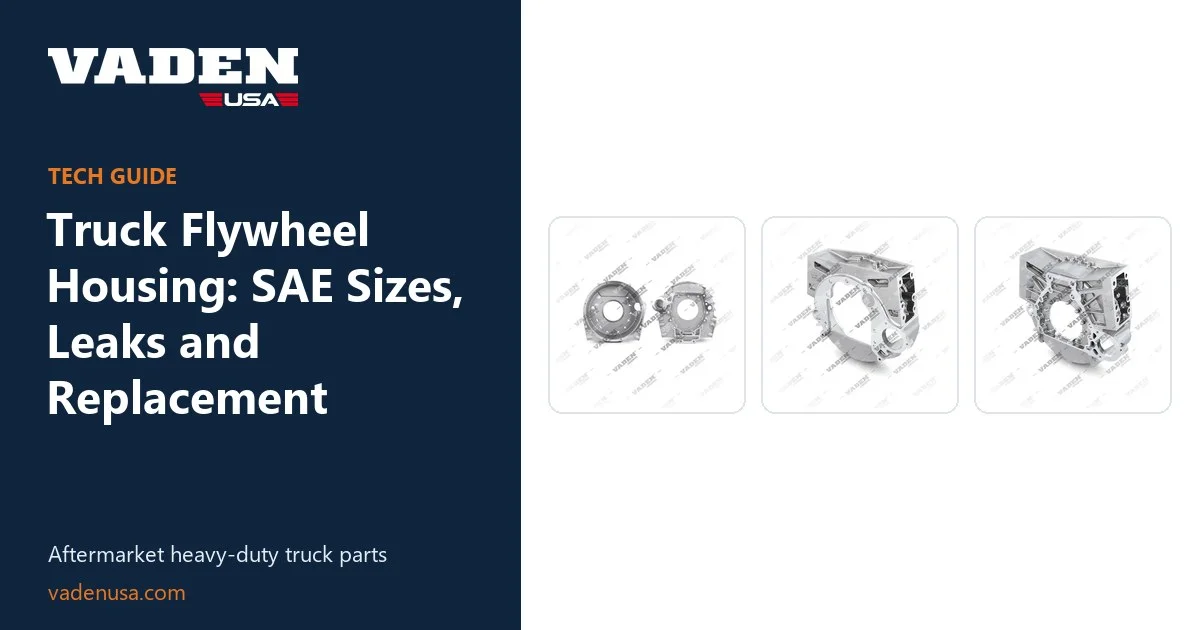
The flywheel housing is the bell-shaped casting bolted to the rear of a diesel engine. It encloses the flywheel and clutch, locates the transmission square to the crankshaft, and carries the starter. Heavy-duty engines use standardized SAE housing sizes, so before you replace a housing or its gasket, match the SAE size, the engine model and the OE number.
What the flywheel housing does
On a heavy truck the flywheel housing is a structural part, not just a cover. It does four jobs at once:
- Mounts the transmission. The front face of the gearbox (or clutch housing) bolts to the rear flange of the flywheel housing, and the housing bore centers the transmission input shaft on the crankshaft.
- Encloses the flywheel and clutch. It keeps road dirt and water out and keeps clutch debris and any rear-seal oil inside, away from the cab and the frame rails.
- Carries the starter. The starter motor bolts into a machined pocket in the housing and engages the flywheel ring gear.
- Takes load. Torque reaction, driveline vibration and the weight of the transmission pass through this casting into the engine block.
Depending on the engine and chassis, the housing may also carry a PTO opening, an inspection cover, a timing or speed sensor boss, and an access plug for turning the engine over. For where this part sits in the larger driveline, see our overview of the parts of a semi truck and the semi truck clutch guide.
SAE flywheel housing sizes explained
The dimensions that matter at the transmission end of the housing are standardized in SAE J617, "Engine Flywheel Housing and Mating Transmission Housing Flanges." The 2020 edition covers internal combustion engines that use SAE No. 6 through SAE No. 00 size housings to mount a transmission, and it sets the main dimensions and tolerances of the housing flange and the matching transmission flange. Earlier editions state that the standard does not cover the face that mates to the engine block or the design of housing walls and ribs. You can read the scope on the SAE Mobilus J617 page.
In practice the SAE number tells you whether a transmission or clutch housing can bolt to the engine. It does not tell you whether a replacement casting will fit the block, because the engine-side bolt pattern, starter position and sensor bosses are set by the engine maker. We do not list dimensions here; the full figures are in the standard itself and in the engine manufacturer's parts data. Use the table below as a checklist of what has to match.
| What to confirm | Why it matters | Where to find it |
|---|---|---|
| SAE housing size | Sets the transmission flange pattern and pilot bore | Engine data plate or parts manual, SAE J617 |
| Engine model and rating | Block-side bolt pattern and casting differ between engine families | Engine ID plate, parts manual |
| Starter position and type | Housing pocket must match the starter nose and mounting | Compare the old housing and the starter |
| PTO opening or sensor bosses | Missing or extra openings stop the housing from working | Compare the old housing side by side |
| OE number on the casting | Fastest way to match an exact replacement | Cast or stamped number on the housing |
Fitment by engine family
Engine makers design their own housing castings and offer variants, so confirm the casting number for your engine rather than choosing a housing by engine name. For a Cummins engine, for example, the casting number and the SAE size from the engine record decide the part, not the model badge.
The reliable method is the one used for any heavy-duty part: read the OE number from the old housing or from the engine parts list, then cross-reference it. Our guide to cross-referencing an OE part number walks through that process. If the old casting is unreadable, send us the engine model, serial number and a photo, and we will help match it through the contact page.
Signs of a cracked or leaking flywheel housing
Housings are cast iron or aluminum and last a long time, but they fail in predictable ways. Common signs include:
- Oil wetting the bottom of the housing or dripping from the inspection hole or the drain. This is often a rear main seal, but it can also be a failed housing gasket or a porous casting.
- Clutch slip or contamination that returns after a clutch job, because oil keeps reaching the disc.
- Hairline cracks radiating from bolt holes, the starter pocket or the transmission flange, often found after a heavy impact or a long period of driveline vibration.
- Loose or stripped mounting bolts and elongated bolt holes.
- Noise or vibration at the bell area, and repeated transmission input shaft or pilot bearing wear that points to misalignment.
Not every leak at the bell is the housing. Compare the likely sources first:
| Symptom | Likely source | Next check |
|---|---|---|
| Engine oil at the bottom of the bell | Rear main seal or housing gasket | Clean, run, and trace the leak to its origin |
| Oil at the housing-to-block joint | Gasket, loose bolts or distorted flange | Check bolt torque and flange flatness |
| Oil from the casting surface itself | Porous or cracked housing | Dye or visual inspection of the casting |
| Transmission oil in the bell | Input shaft seal or front bearing cover | Check the transmission side |
| Clutch slip with a dry bell | Clutch wear or adjustment, not the housing | Inspect the clutch and linkage |
If the clutch is also worn, see our notes on clutch wear and service.
How to replace a flywheel housing or its gasket
This is major work: the transmission has to come off, so plan it with a clutch job when possible. Always follow the engine manufacturer's service manual for the sequence and the torque values. The outline below is the general order of work.
- Secure the truck, disconnect the batteries, and drain or cap whatever lines the transmission removal requires.
- Remove the driveline, clutch linkage, and the transmission, supporting it with a transmission jack.
- Remove the clutch and flywheel. Mark the flywheel position and follow the manual on whether the flywheel bolts may be reused.
- Remove the starter, sensors and any PTO or accessory parts attached to the housing.
- Unbolt the housing from the engine and lift it off. Note the bolt lengths and locations, because they are often not all the same.
- Clean the block face and the new housing face. Check the dowels and bolt holes for damage and remove old gasket and sealant fully.
- Fit the new gasket (where the engine uses one) or sealant as the manufacturer specifies, set the housing on the dowels, and install the bolts in the correct holes.
- Tighten in the sequence and to the torque in the service manual, then check housing bore and face runout if the manual calls for it.
- Replace the rear main seal while the area is open, reinstall the flywheel and clutch, and reassemble in reverse order.
- Run the engine, warm it up, and check the joint for leaks before returning the truck to service.
Can you reuse a flywheel housing gasket?
Generally no. A gasket that has been compressed and heat-cycled will not seal reliably the second time, and a failed gasket here means another transmission-out job. Replace it whenever the housing is removed, as the manual directs, and replace the rear main seal and any worn dowels at the same time. Some engines seal the joint with sealant instead of a gasket, so follow the manual for your engine.
VADEN parts
VADEN lists Cummins flywheel housings cross-referenced to the OE numbers shown below. Check the number on your existing casting against the table, and ask us if you need to confirm the engine and SAE size before ordering. VADEN parts are aftermarket replacements; brand names and OE numbers are used for reference only.
| VADEN part | Description | Replaces / fits |
|---|---|---|
| VADEN 0125 002 | Flywheel Housing, Replaces Cummins 3102196 | Cummins 3102196, Cummins 3103584 |
| VADEN 0125 003 | Flywheel Housing, Replaces Cummins 06003 | Cummins 06003, Cummins 3036011 |
| VADEN 0125 005 | Flywheel Housing, Replaces Cummins 060006 | Cummins 060006, Cummins 060007 |
Browse the full ranges in flywheel housing and flywheel housings, or see related engine parts and clutch parts.
FAQ
What is a flywheel housing on a diesel engine?
It is the casting bolted to the back of the engine that encloses the flywheel and clutch and provides the mounting flange for the transmission. It also holds the starter and aligns the transmission with the crankshaft.
What does SAE flywheel housing size mean?
It is a size number defined in SAE J617 that standardizes the transmission-end flange of the housing, covering sizes from SAE No. 6 through SAE No. 00. It tells you which transmissions can bolt on, but you still need the engine-specific casting.
What size flywheel housing does a Cummins ISX use?
It depends on the engine configuration and the transmission it is paired with, so we do not give a single size. Read the SAE size from the engine record or parts manual, or match the OE number cast on the housing.
Why is my flywheel housing leaking oil?
The most common sources are the rear main seal and the housing gasket. Loose bolts, a distorted flange or a cracked or porous casting can also leak. Clean the area and trace the oil to its origin before replacing parts.
Can I reuse a flywheel housing gasket?
Generally no. Gaskets lose their seal after compression and heat cycles. Replace it whenever the housing is removed and follow the manufacturer's torque sequence.
How do I find the right replacement housing?
Start with the OE number cast or stamped on the old housing, then confirm engine model and SAE size. Cross-reference the number and compare starter position and openings before ordering.
Need a flywheel housing for a Cummins or similar engine? Send your OE number or engine details through our contact page or email info@vadenusa.com to request a quote or open an account.
Blog
3 2026-11-19
Air Brake Troubleshooting Guide: Symptoms, Causes, Fixes
Symptom-by-symptom air brake troubleshooting for semi trucks: slow build-up, pressure loss, constant dryer purge, locked brakes and ABS faults, with first checks.
 2026-11-19
Trailer ABS Light: Causes, Reset and DOT Violation Rules
Why the ABS light stays on a semi trailer, what the power-up check should look like, common causes, blink codes, resetting and what DOT rules say.
 2026-11-19
WABCO Air Compressor: ID, Rebuild Kits and Replacement
How to identify a WABCO air brake compressor by its 10-digit number, tell single from twin cylinder, and decide between a repair kit and a replacement unit.