

Published: · Updated:
Clutch Servo Problems: Symptoms, Testing and Replacement
How an air-assisted clutch servo works on heavy trucks, symptoms of a failing one, how to test it, and when to rebuild or replace it with a repair kit.
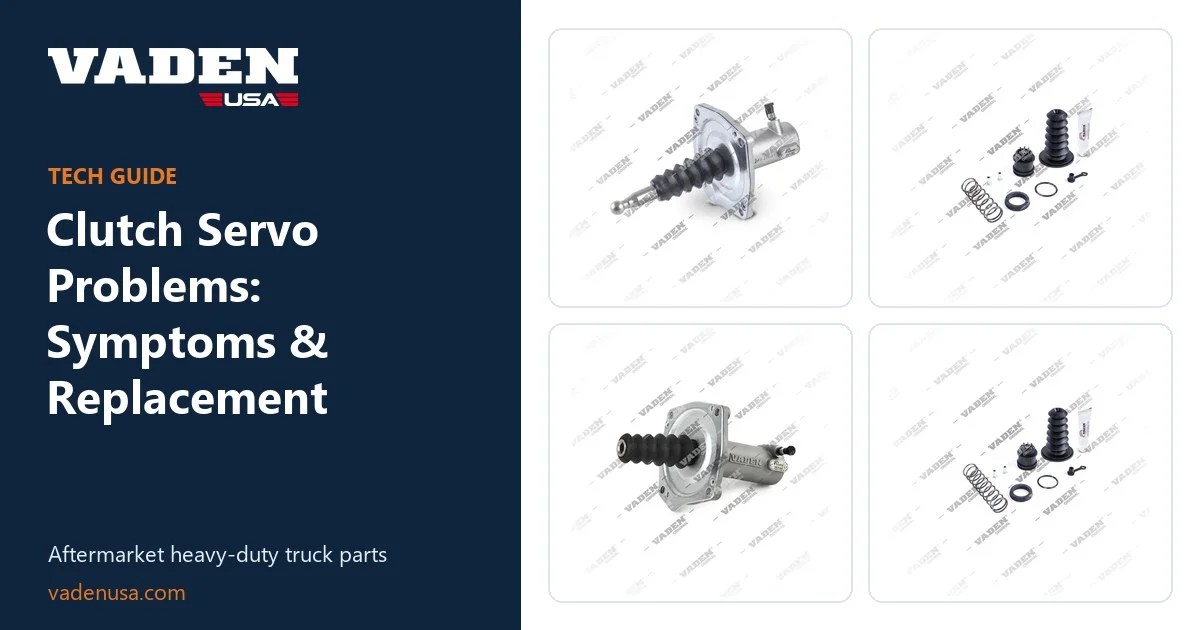
A clutch servo is an air-assisted unit that uses the truck's compressed air to multiply pedal effort so a heavy-duty clutch is easy to press. A failing one causes a stiff or sinking pedal, hard shifting, or air and fluid leaks. Rebuild it with a repair kit or replace it, then bleed the clutch hydraulics.
What a clutch servo does
A heavy-duty clutch needs a lot of force to release. Without help, the pedal would be tiring to use over and over in city and regional work. The servo adds air-powered force in proportion to what the driver applies at the pedal, so the driver still controls the release, but the air does much of the work.
Designs vary by truck maker and transmission. On many trucks the pedal drives a hydraulic master cylinder, the servo boosts that hydraulic pressure with air, and a slave cylinder moves the release fork. Other trucks use a linkage or cable-operated air assist instead. Because the layout differs, always check the OEM service manual for the exact circuit on the truck in front of you.
The servo draws from the vehicle's air supply, so its health is tied to air quality. Moisture, oil carry-over and dirt from a tired dryer or compressor shorten seal life. If you see repeated servo or valve contamination, look at the supply side too; our truck air dryer guide covers what clean, dry air should look like.
Symptoms of a failing clutch servo
Technicians and fleet shops commonly report the following. None of them points only to the servo, so treat them as a reason to test, not a diagnosis.
- Heavy or stiff clutch pedal. The assist is not helping, so the driver feels the full load of the clutch.
- Slow pedal return or incomplete release. The pedal comes back lazily, or the clutch drags and the truck creeps or grinds when selecting a gear.
- Hard shifting or gear clash. The clutch is not fully disengaging, often seen when starting off in gear or shifting at low speed.
- Spongy, soft or sinking pedal. Often a sign of air in the hydraulic side, or an internal leak, rather than a loss of air assist.
- Air hiss or air loss near the pedal or servo. A leak at the servo body, vent or air line. If the air gauge drops faster than normal, it can also affect the rest of the air system.
- Fluid weeping at the servo. A wet or stained body points to worn hydraulic seals.
Diagnostic table
| Symptom | Common cause | First check |
|---|---|---|
| Heavy pedal, no assist felt | No air supply to servo, blocked or capped line, failed control valve or piston seals | Confirm system air pressure and air at the servo inlet |
| Slow pedal return | Servo not venting, sticking piston, weak return spring or binding linkage | Disconnect the air line and see whether the pedal returns normally |
| Spongy pedal, poor release | Air in the hydraulic circuit, low fluid, leaking master or slave cylinder | Check reservoir level and look for fluid leaks, then bleed per the OEM manual |
| Hiss at the servo | Worn seals or a cracked air fitting | Apply the pedal and check fittings and the servo body with soap solution |
| Clutch drags, hard to engage gears | Insufficient release travel from servo or incorrect clutch adjustment | Verify clutch adjustment and free travel before blaming the servo |
How to test a clutch servo
- Build full system air pressure. Start the engine and let the governor cut out so the servo has a normal supply. Keep the truck chocked and the parking brake set.
- Compare pedal effort with and without air. With the assist working, the pedal should feel noticeably lighter. A pedal that feels the same with air supplied, or very heavy once air is removed, shows the assist is not doing its job. Check against the OEM description of normal feel.
- Check for leaks. Listen for hissing with the pedal pressed and released. Use a soap solution on fittings and the servo body, and look for wet hydraulic seepage.
- Inspect the lines and fittings. Look for kinked, capped, crushed or chafed air lines and loose hydraulic connections.
- Check fluid and bleed. Verify the reservoir level and bleed the hydraulic circuit following the OEM procedure, including the servo bleeder where one is fitted. Re-test the pedal afterward.
- Verify clutch adjustment. Many complaints that look like servo failure are an out-of-adjustment clutch, worn release parts or linkage problems, so rule these out before replacing parts.
A heavy pedal with no audible air leak can still be a blocked or capped air line or a failed control valve, so a quiet servo is not a good servo. A pedal that is soft or slowly sinks points more to air in the hydraulics or an internal leak than to a loss of air assist. Specific pressures, travel and clearance specs depend on the truck, transmission and clutch. Use the figures in the OEM service manual rather than a general rule.
Rebuild or replace the servo
A repair kit makes sense when the body, bore and mounting points are in good condition and the problem is worn seals. Replacing the whole servo is usually the better choice when you see a scored bore, a cracked or corroded housing, damaged threads, a sticking piston, or a unit that has already been rebuilt and is leaking again. Labor time is often the bigger cost on a truck that is down, so a complete servo can be the more predictable repair.
| Condition | Rebuild with repair kit | Replace the servo |
|---|---|---|
| Seal wear, body and bore clean | Yes | Optional |
| Scored bore or pitted piston | No | Yes |
| Cracked or corroded housing | No | Yes |
| Repeat failure after a prior rebuild | No | Yes |
| Time-critical return to service | Possible | Often simpler |
Whichever you pick, bleed the system, adjust the clutch and road test. Also fix the root cause: a wet or oily air supply will damage the new seals as well.
Master cylinder and pedal unit
The servo is only one part of the hydraulic clutch circuit. If the pedal stays soft after a servo repair, or fluid is leaking at the pedal end, the master cylinder or pedal unit may be the real problem. Replacement and bleeding steps differ by truck model and year, including on Freightliner, Volvo, International and other heavy trucks, so follow the OEM workshop manual for your exact chassis. Browse our master cylinder and hydraulic clutch pedal unit categories.
Matching the right part
Read the number on the old servo and match it before you order. Many servos are cataloged by the WABCO, Knorr-Bremse or truck-maker number, and the same family can cover several truck brands. Our WABCO cross reference explains how to match an OE number. If a number does not match anything you can find, contact us and we will help check it.
VADEN parts
VADEN lists clutch servos, servo repair kits and related slave cylinders. Browse the clutch servo, clutch servo repair kit and clutch slave cylinder categories, or see the catalog items below. VADEN parts are aftermarket replacements.
| VADEN part | Description | Replaces / fits |
|---|---|---|
| VADEN 306.01.0067 | Clutch Servo, Replaces WABCO 9700515050 | Volvo 20458737, Wabco 9700515050 |
| VADEN 306.01.0067.01 | Clutch Servo Repair Kit, Replaces Knorr-Bremse 9700515050S1 | Knorr-Bremse 9700515050S1 |
| VADEN 306.01.0047 | Clutch Servo, Replaces WABCO 9700515030 | Wabco 9700515030 |
| VADEN 306.01.0047.01 | Clutch Servo Repair Kit, Replaces WABCO 9700515030S1 | Wabco 9700515030S1 |
| VADEN 306.01.0110 | Air-Assisted Clutch Servo, Replaces WABCO 9700515120 | International 3866376C91, Wabco 9700515120 |
| VADEN 306.01.0107 | Air-Assisted Clutch Servo, Replaces PACCAR E176012 | Kongsberg 1000285721AM, Paccar E176012 |
Inspection and records
Under the Federal Motor Carrier Safety Regulations, parts and accessories must be kept in safe and proper operating condition at all times (49 CFR 396.3). A clutch that will not release cleanly can make a truck hard to control at low speed, so note any servo repair in the maintenance record.
FAQ
What is a clutch servo on a truck?
It is an air-assisted unit in the hydraulic clutch circuit. It uses the truck's compressed air to multiply the force from the driver's foot, so a heavy-duty clutch releases with a light pedal.
How do I know if the clutch servo is bad?
Look for a heavy or sinking pedal, slow pedal return, hard shifting, air hiss near the servo, or fluid weeping from its body. Then run the air, leak and bleed checks above and verify clutch adjustment before condemning the servo.
Can the clutch servo be repaired with a kit?
Yes, when the problem is worn seals and the bore, housing and threads are in good condition. A scored bore, cracked housing or a repeat leak after a rebuild calls for a complete servo instead.
Is the clutch servo the same as the slave cylinder?
Not always. Some trucks use a separate slave cylinder at the release fork, with the servo boosting the hydraulic pressure. Others combine the air assist and the release cylinder in one unit, and catalogs may list it either way. Match by the number on the old part.
Can I drive with a failed clutch servo?
Some trucks can still be driven because the clutch can be pressed without assist, but the pedal will be much heavier and the driver may not fully release the clutch. That can cause hard shifting and extra wear, so plan the repair soon and follow the OEM guidance.
Should I replace the master and slave cylinders with the servo?
Inspect them. If either cylinder leaks or the fluid is dark or contaminated, replacing it at the same time avoids a repeat repair. A leak-free cylinder in good condition can stay in service.
WABCO, Knorr-Bremse, Volvo, International, Freightliner, PACCAR, Kongsberg and other brand names are used only to identify compatible parts. VADEN is not affiliated with, sponsored by or endorsed by these companies.
Blog
3 2026-11-19
Air Brake Troubleshooting Guide: Symptoms, Causes, Fixes
Symptom-by-symptom air brake troubleshooting for semi trucks: slow build-up, pressure loss, constant dryer purge, locked brakes and ABS faults, with first checks.
 2026-11-19
Trailer ABS Light: Causes, Reset and DOT Violation Rules
Why the ABS light stays on a semi trailer, what the power-up check should look like, common causes, blink codes, resetting and what DOT rules say.
 2026-11-19
WABCO Air Compressor: ID, Rebuild Kits and Replacement
How to identify a WABCO air brake compressor by its 10-digit number, tell single from twin cylinder, and decide between a repair kit and a replacement unit.