

Published: · Updated:
Semi Trailer Air Brakes: How They Work, Adjust and Test
How semi trailer air brakes work: supply and service lines, reservoir, relay valve, spring brakes, ABS and breakaway, plus how to check and adjust them.
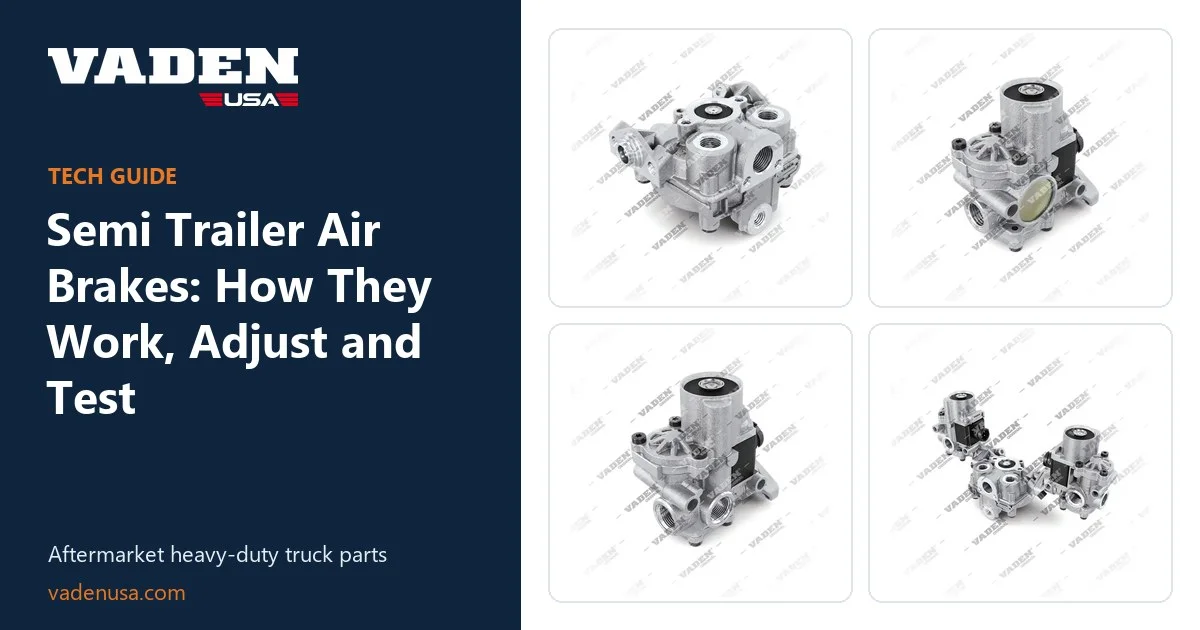
Semi trailer air brakes work on air from the tractor, sent through two hoses. The red supply line fills the trailer reservoir and holds the spring brakes released. The blue service line carries the driver's brake signal to the trailer relay valve, which sends reservoir air to the brake chambers. If the supply line loses pressure, the spring brakes apply.
How semi trailer air brakes work
A trailer has no engine and no compressor, so every bit of braking energy comes from the tractor's air system. Two lines connect the tractor and trailer through the glad hands (see our glad hands guide):
- Supply (emergency) line, red: keeps the trailer reservoirs charged and keeps the spring brakes released while pressure is held.
- Service (control) line, blue: carries only a pressure signal that rises when the driver presses the brake pedal. It does not carry the air that actually applies the brakes.
The big picture is the same as on the tractor, which we explain in how air brakes work on a semi truck. The difference on a trailer is that the braking air is stored on the trailer itself and metered out by a valve close to the axles.
Main parts of the trailer brake system
| Part | What it does |
|---|---|
| Glad hands and hoses | Connect the tractor's supply and service lines to the trailer. |
| Trailer air tank (reservoir) | Stores the air used to apply the brakes. It collects moisture and needs regular draining, see the drain valve guide. |
| Relay valve or relay-emergency valve | Receives the small service signal and releases reservoir air to the chambers quickly. The relay-emergency version also applies the brakes if the supply line is lost. |
| Spring brake chambers | Provide parking and emergency braking. A powerful spring applies the brake whenever supply air is released. |
| Slack adjusters and S-cam foundation brakes | Turn chamber pushrod movement into brake shoe force on drum brakes. |
| ABS modulator valve and ECU | Reduce brake pressure at a wheel that is about to lock. |
What the tractor protection valve does
On the tractor, the tractor protection valve and the trailer air supply control (the push-pull knob in the cab) decide whether trailer air is connected or cut off. If the trailer has a major leak, the tractor protection valve closes so the tractor does not lose its own air. We cover testing in the tractor protection valve guide.
Relay valve and relay-emergency valve on the trailer
Without a relay valve, the driver's brake signal would have to push air all the way from the tractor to every chamber, and the trailer brakes would apply late. The relay valve solves this. It reads the blue-line signal, then opens a direct path from the trailer reservoir to the chambers, so air only has a short distance to travel. It releases the same air quickly when the pedal is let go.
Most semi trailers use a relay-emergency valve. On top of the relay function, it senses supply line pressure. If the red line pressure falls, the valve exhausts the spring brake air and the brakes apply. Federal rules require air-braked trailers to have no-bleed-back relay emergency valves or an equivalent device, so reservoir air does not drain back toward the tractor when the tractor loses pressure (49 CFR 393.43). For the valve types and symptoms, see our air brake relay valve guide.
Spring brakes and breakaway
Each spring brake chamber has a service side, which is pressurized to apply the brakes normally, and a spring side. Supply air compresses the spring and keeps the brake released. When that air leaves, the spring pushes the pushrod out and applies the brake. This is why a trailer sits with its brakes applied when it is parked and disconnected: there is no supply air.
The same principle covers a breakaway. If the trailer separates from the tractor, the air lines pull apart, the supply pressure drops and the trailer brakes apply automatically. Under 49 CFR 393.43, trailer brakes must apply automatically and immediately on separation, and stay applied for at least 15 minutes. Trailers with three or more axles are treated differently in the rule, so check the section text for your equipment. For more on spring brakes, including how to cage them safely, see what are spring brakes.
Trailer ABS
Air-braked trailers built on or after March 1, 1998 must have ABS and an exterior malfunction indicator lamp. Trailers and converter dollies built on or after March 1, 2001 must also have an electrical circuit that signals an ABS malfunction, with a means of connecting it to the towing vehicle (49 CFR 393.55). In practice, the trailer ABS ECU watches wheel speed sensors and commands the modulator valves to hold, release or reapply pressure at a wheel that is slowing too fast. A modulator that sticks or leaks can cause a lit ABS lamp or uneven braking. For causes and what the light means, read trailer ABS light and ABS modulator valve on semi trucks.
How to check trailer brakes (static test)
Do this at the start of a trip and whenever you couple to a different trailer. The full routine is in our pre-trip inspection checklist and the DOT air brake inspection checklist.
- Park on level ground, set the tractor parking brake and chock the wheels if needed.
- Connect the red and blue glad hands to the correct tractor couplers and check the seals. Look for cracked, rubbing or leaking hoses.
- Push in the trailer air supply control to charge the trailer and let the system reach governor cut-out pressure.
- Listen for air leaks at the glad hands, hoses, chambers and valves.
- Pull the trailer air supply control out. The trailer spring brakes should apply, which you can hear as air exhausts. Then do a gentle tug test: with the tractor parking brake released, pull forward lightly in a low gear and confirm the trailer resists.
- Push the control back in to release the brakes.
- Apply the service brake and listen for air at the chambers on each axle. Check that every pushrod moves and returns.
- Check the ABS lamp on the trailer and on the dash. It should light briefly at power up and then go out.
How to adjust semi trailer brakes
Most trailers built since the 1990s have automatic slack adjusters. Federal rules require air-braked commercial vehicles made on or after October 20, 1994 to meet the automatic adjustment requirements of FMVSS 121, and to have an adjustment indicator if they use an external adjuster with an exposed pushrod (49 CFR 393.53).
The important point: an automatic slack adjuster should not be adjusted by hand to correct excess pushrod stroke. Brake manufacturers advise that a long stroke on an automatic adjuster points to a different problem, such as a worn or damaged adjuster, a bent or loose component, worn S-cam bushings or a seized cam, so a manual re-adjustment only hides it. Follow the manufacturer's procedure for that adjuster.
A practical way to handle a trailer with long stroke:
- Chock the wheels, release the trailer spring brakes with supply air, shut the engine off, and measure pushrod stroke with the service brakes fully applied at the reservoir pressure given in the manufacturer or CVSA instructions.
- Compare the stroke with the limit for that chamber type and size. Each chamber has its own limit, so read the chamber tag.
- If the stroke is over the limit, inspect the slack adjuster, its anchor and clevis, the S-cam bushings and the drum and lining condition before touching any adjustment.
- Replace worn or damaged parts, then re-check stroke. Only follow the adjuster maker's setup procedure when installing a new adjuster.
Our slack adjuster guide covers manual and automatic types, and S-cam bushings and brake shoes explains the wear points behind most stroke problems. Brakes that are out of adjustment or defective are among the most commonly cited brake violations at roadside inspections. Under the CVSA out-of-service criteria, a vehicle or combination can be placed out of service when 20 percent or more of its service brakes are defective. See the current criteria and stroke limits at cvsa.org.
Note that electric trailer brakes (used on light recreational and utility trailers) are a different system with a controller and magnets, and they are adjusted differently from the air brakes on a semi trailer. This guide covers air brakes only.
Common trailer brake problems
| Symptom | Likely cause | First check |
|---|---|---|
| Trailer brakes will not release | No supply air, closed trailer air supply control, damaged or cross-connected glad hands, faulty relay-emergency valve | Confirm red line pressure and that the hoses are on the right couplers |
| Trailer brakes drag or run hot | Stuck relay valve, seized cam, weak return spring, partly caged spring brake | Feel the hubs and drums after a short stop, check the exhaust port of the relay valve |
| Slow application or slow release | Restricted or kinked line, worn relay valve, frozen moisture | Inspect hoses and drain the reservoir, see frozen air brakes |
| Constant air leak at the valve | Worn seals in the relay or modulator valve | Soap test the valve exhaust and fittings |
| Trailer ABS lamp stays on | Sensor, wiring, modulator or power problem | Check the power connection and read the ABS fault codes |
| Long pushrod stroke | Worn slack adjuster, bushings, linings or drum | Inspect the foundation brake first, do not just turn the adjuster |
Moisture is behind many of these faults, so keep the air dryer working. See how the air dryer works.
VADEN parts
VADEN makes relay valves and ABS modulator valves for air-braked trailers and trucks. These are aftermarket replacements, and the brand names shown are for reference only.
| VADEN part | Description | Replaces / fits |
|---|---|---|
| VADEN 303.01.0053 | Relay Valve, Replaces WABCO 9730110240 | Wabco 9730110240 |
| VADEN 303.14.0039 | ABS Modulator Valve, Replaces WABCO 4721950780 | Wabco 4721950780 |
| VADEN 303.14.0040 | ABS Modulator Valve, Replaces WABCO 4721950790 | Wabco 4721950790 |
| VADEN 303.14.0100 | ABS Modulator Valve, Replaces WABCO 4725004250 | Wabco 4725004250 |
Browse the full ranges in our relay valve and ABS modulator valve categories. For help matching a number, see our WABCO cross reference and how to cross-reference an OE part number. WABCO is a trademark of its owner and is used only to identify the original part.
FAQ
How do trailer brakes work?
On a semi trailer, the red supply line keeps the reservoir charged and the spring brakes released. When the driver brakes, the blue service line sends a signal to the relay valve, which releases reservoir air to the chambers. The chambers push the slack adjusters and cams to press the shoes against the drums.
How do you adjust semi trailer brakes?
Do not routinely adjust automatic slack adjusters by hand. Measure pushrod stroke, compare it with the limit for the chamber type, and if it is over, find the cause such as a worn adjuster, bushings or linings. Adjust only where the adjuster maker's procedure calls for it, for example on a manual adjuster or during installation.
How do you test trailer brakes?
Connect the glad hands, charge the system, and pull the trailer air supply control to confirm the spring brakes apply. Push it back in, apply the service brake and listen for leaks while checking that each pushrod moves. Finally confirm the ABS lamp goes out after power up.
How do you release trailer brakes manually?
The normal method is to charge the trailer from the tractor so the spring brakes release. If there is no air source, spring brakes can be caged mechanically, but this stores spring force and must be done by following the proper procedure. See our guide on caging spring brakes safely.
How do you unfreeze trailer brakes?
Drain the reservoirs, find where moisture has frozen, usually in lines, valves or chambers, and warm the area. Do not pour alcohol into the system unless the manufacturer allows it. Fix the source, which is often a failing air dryer. Read air line antifreeze and frozen air brakes.
What happens to the trailer brakes if the air line breaks away?
Supply pressure drops, the relay-emergency valve exhausts the spring brake air and the spring brakes apply automatically. Federal rules require the trailer brakes to stay applied for at least 15 minutes after separation.
Need a relay valve or ABS modulator valve for a trailer or truck? Send the OE number to info@vadenusa.com or use the contact page to request a quote.
Blog
3 2026-11-19
Air Brake Troubleshooting Guide: Symptoms, Causes, Fixes
Symptom-by-symptom air brake troubleshooting for semi trucks: slow build-up, pressure loss, constant dryer purge, locked brakes and ABS faults, with first checks.
 2026-11-19
Trailer ABS Light: Causes, Reset and DOT Violation Rules
Why the ABS light stays on a semi trailer, what the power-up check should look like, common causes, blink codes, resetting and what DOT rules say.
 2026-11-19
WABCO Air Compressor: ID, Rebuild Kits and Replacement
How to identify a WABCO air brake compressor by its 10-digit number, tell single from twin cylinder, and decide between a repair kit and a replacement unit.