

Published: · Updated:
PACCAR MX-13 Air Compressor: Location, Leaks, Replacement
Where the PACCAR MX-13 air compressor sits, how to tell a worn head, gasket or coolant line from a failed unit, and which related parts to check.
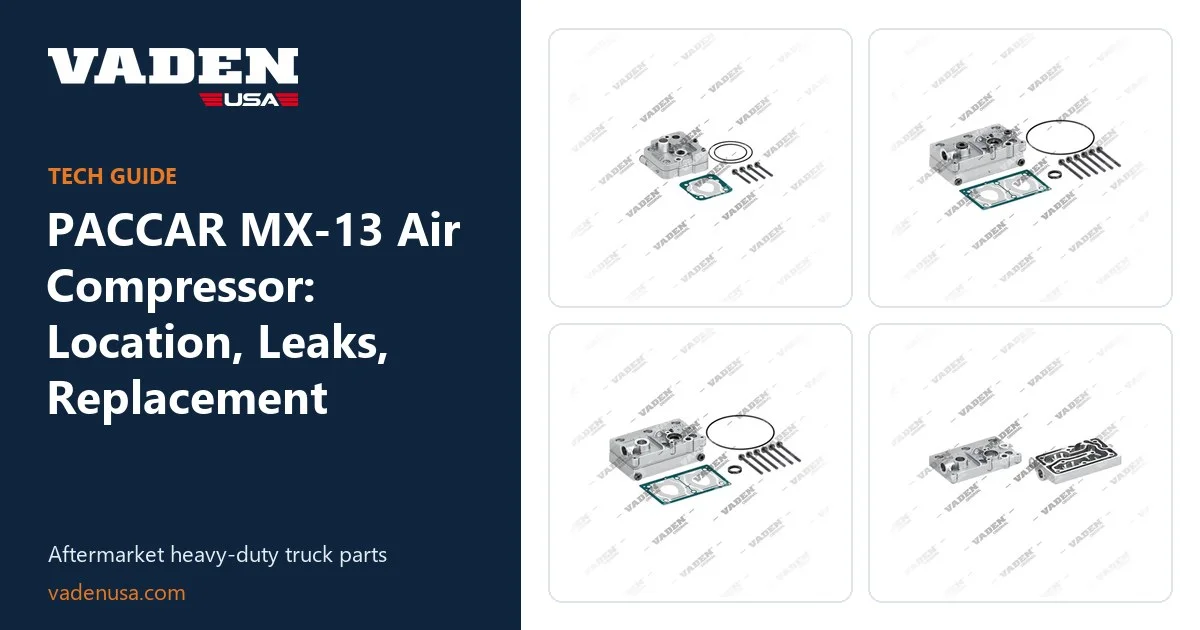
The PACCAR MX-13 air compressor is mounted on the engine and driven by the engine gear train, with coolant, oil, inlet and discharge connections. When the truck is slow to build air, the usual fixes are a head or valve plate repair, a gasket or coolant line repair, or a full replacement. Confirm the cause before ordering parts.
This guide is for fleets and shops working on Kenworth and Peterbilt trucks with the MX-13. It covers where the compressor sits, how to check the air system before you blame the compressor, when a head gasket or coolant line is the real problem, and how to identify the unit before you order parts. VADEN parts are aftermarket replacements. PACCAR, Kenworth, Peterbilt, WABCO and other names are trademarks of their owners and are used here only to identify parts and cross-references.
Where is the air compressor on a PACCAR MX-13?
The compressor is mounted on the engine and driven from the engine gear train, not by a belt. Its exact position and access depend on the engine build and the chassis (a Kenworth T680 and a Peterbilt 579 do not give you the same access), so confirm in PACCAR service information for your truck before you start pulling lines.
Four connections matter on the compressor. Details vary by build, so check them against the service information:
- Coolant supply and return: the compressor head is water-cooled from the engine cooling system. A leak here shows up as coolant loss, not as an air problem.
- Oil feed: the compressor is lubricated from the engine. A loose or leaking oil supply fitting can starve the compressor and also leak oil outside.
- Air inlet: the compressor draws air through an inlet line from the engine side (check service information for the exact source), so restricted or leaking inlet lines hurt output.
- Discharge line: hot compressed air leaves the head through the discharge line to the air dryer. Carbon build-up here is a clue to oil carry-over. See our truck air dryer guide for the next component downstream.
The governor and the unloader mechanism control when the compressor loads and unloads. Our air governor guide explains that part of the system.
How to identify the compressor before you order parts
Do not order from engine model alone. The same engine can be built with different compressor versions, and a compressor can be changed by a previous repair. Identify the unit in this order:
- Read the PACCAR part number and any casting or serial marks on the compressor body or its tag.
- Write the numbers without spaces, dashes or dots so they can be searched and compared.
- Note the engine model, engine serial number and truck model.
- Compare the number against the cross-reference for the brand you intend to buy. Our guide to cross-referencing an OE part number shows the method, and the PACCAR cross-reference page lists the numbers we have on file.
- If a number does not match anything on file, send photos and numbers to us before ordering. Guessing wastes more time than asking.
For background on how engine and compressor pairings work, read truck air compressor by engine and air compressor fitment by truck model. For engine-level information, see our PACCAR MX-13 engine page.
Check the air system before you blame the compressor
Many "bad compressor" complaints turn out to be leaks, a stuck governor or a plugged air dryer. Run through this check first. It also helps you decide whether the compressor is pumping oil or coolant into the system.
- Drain the wet tank into a clean container. Note whether the liquid is water, oil or a mix, and whether it smells of coolant. Some oil is common in older systems; a steady oily slug is not.
- Check the air dryer purge and the cartridge. A saturated cartridge or a stuck purge valve can look like a compressor problem. See air dryer cartridge replacement intervals.
- Listen for leaks with the engine off and the system charged. Check the build-up time against the figure in your truck's service information, with the engine at the speed that document specifies.
- Inspect the discharge line for heavy carbon or oil. A hot, carbon-clogged line restricts airflow and can overheat the head.
- Check coolant level and the compressor coolant lines for seepage, wet fittings or dried coolant trails.
- Run a formal test. Our how to test a truck air compressor guide shows the build-up and leakage test steps in detail.
Symptoms and likely causes
| Symptom | Likely cause | First check |
|---|---|---|
| Slow air build-up, no coolant or oil loss | Worn valves or head, air leaks, governor fault | Leak test, then compressor build-up test |
| Coolant level drops, no visible external leak | Head gasket or head crack allowing coolant to pass into the air side or to the outside | Look for coolant in the wet tank and at the drain valves |
| Wet coolant trail at the compressor | Coolant line, hose or fitting leak | Inspect both coolant lines and clamps with the system warm and cold |
| Oil in air tanks and dryer | Worn rings or bore, restricted inlet, failing dryer | Check the inlet and the dryer, then the compressor wear |
| Hissing from the compressor area while unloaded | Unloader or valve plate leakage | Check governor line and unloader operation |
| Carbon in the discharge line | Heat, oil carry-over, restricted line | Replace or clean the line and find the cause |
Head gasket and head leaks versus full replacement
A compressor head sits on the valve plate, which sits on the compressor body. Gaskets seal the joints between them, and the head carries the water passage that cools the compressor. If the fault is limited to a leaking gasket, a worn valve plate or a cracked head, a repair using a head, valve plate or repair kit is usually cheaper than a full compressor, provided the bore, crankshaft and bearings are in good condition.
Replace the whole compressor when:
- The bore, piston or crankshaft area is scored or worn.
- There is end play or noise from the drive side.
- The compressor has been run with coolant or oil contamination for a long time.
- Labor to repair costs more than the difference to a replacement unit.
Our rebuild or replace guide goes through that decision, and repair kit versus gasket kit explains what each kit contains. For details on the water-cooled part of the unit, see compressor cooling plate and coolant faults.
A head gasket leak shows up as coolant loss, coolant in the air tanks or a mix of oil and coolant. Do not assume the head gasket is at fault until you have confirmed it: a leaking coolant line or fitting gives similar symptoms, is far cheaper to fix, and is easier to see.
How to replace the compressor: general steps
The detailed procedure and torque values are in PACCAR service information for your engine, and we do not reproduce them here. In general the job runs like this:
- Park the truck, chock the wheels, disconnect the batteries and drain the air system.
- Let the engine cool, then drain enough coolant to open the compressor coolant lines without a spill.
- Label and disconnect the coolant lines, discharge line, inlet and governor or unloader lines. Cap open ports.
- Remove the oil supply fitting or line and catch the oil.
- Support the compressor and remove the mounting fasteners, then pull it clear of the drive gear. Check the gear and the mounting face for wear or damage.
- Compare the old and new units: port positions, mounting pattern, gear and drive end.
- Fit new gaskets and O-rings, install the compressor, and torque to the manufacturer's values.
- Replace worn coolant lines and clamps, reconnect the lines, refill and bleed the coolant, and check the oil feed.
- Replace the air dryer cartridge if the system was contaminated, and clean or replace the discharge line.
- Run the engine, check for coolant, oil and air leaks, and verify build-up time and governor cut-in and cut-out against the truck's specifications.
Inspection and repair of air brake components is part of roadside and periodic inspections. The low air pressure warning requirement is in 49 CFR 393.51, and general inspection and maintenance duties are in 49 CFR Part 396. For what inspectors check on the brake system, see our DOT air brake inspection checklist, and the CVSA publishes the out-of-service criteria.
VADEN parts
VADEN does not list a complete MX-13 compressor in this table. The Kenworth and Peterbilt cylinder heads and valve plate (16 08 10, 16 08 11, 16 08 12, 16 17 10) are the closest matches; the remaining rows are related WABCO-cross compressor parts for other engines and are shown for reference. Confirm the PACCAR number on your unit before ordering, because a listing alone does not confirm fit for a particular MX-13. VADEN parts are aftermarket replacements; brand names are for reference only.
| VADEN part | Description | Replaces / fits |
|---|---|---|
| VADEN 11 21 10 | Air Compressor Cylinder Head, Replaces WABCO 4123528012 | DAF 1528798, Mercedes Benz 0001315419 |
| VADEN 13 19 10 | Air Compressor Cylinder Head, Replaces WABCO 4127049402 | Volvo 20774299, Volvo 20889546 |
| VADEN 13 25 10 | Air Compressor Cylinder Head, Replaces WABCO 9125129352 | Volvo 22203109, Wabco 9125129352 |
| VADEN 13 25 11 | Air Compressor Cylinder Head, Replaces WABCO 9125126524 | Wabco 9125126524 |
| VADEN 13 25 12 | Air Compressor Valve Plate, Replaces WABCO 9125006624 | Wabco 9125006624 |
| VADEN 1300 250 100 | Air Compressor Repair Kit for Mack and Volvo | Daf, Evobus, Iveco |
| VADEN 1300 250 750 | Air Compressor Repair Kit for Mack and Volvo | Daf, Evobus, Iveco |
| VADEN 1300 250 770 | Air Compressor Repair Kit, Replaces WABCO 9125129362 | Wabco 9125129362 |
| VADEN 16 08 10 | Air Compressor Cylinder Head, Replaces WABCO 9125189222 | DAF 1732080, Wabco 9125189222 |
| VADEN 16 08 11 | Air Compressor Cylinder Head for Kenworth and Peterbilt | Daf, Kenworth, Paccar |
| VADEN 16 08 12 | Air Compressor Valve Plate for Kenworth and Peterbilt | Daf, Kenworth, Paccar |
| VADEN 16 17 10 | Air Compressor Cylinder Head for Kenworth and Peterbilt | Kenworth, Paccar, Peterbilt |
You can browse the full categories: air compressors, cylinder heads, valve plates, repair kits, gasket kits, cooling plates, single-cylinder and twin-cylinder compressors. For truck-brand views, see Kenworth, Peterbilt and PACCAR applications. Single versus twin-cylinder choice is explained in this fitment guide.
FAQ
Where is the air compressor on a PACCAR MX-13?
It is mounted on the engine and driven by the engine gear train, with coolant, oil, inlet and discharge connections. Exact access depends on the chassis, so check the service information for your Kenworth or Peterbilt model.
How do I replace a PACCAR MX-13 air compressor?
Drain the air system and enough coolant, label and disconnect the coolant, oil, inlet, governor and discharge lines, unbolt the compressor, then fit the new unit with new gaskets and O-rings and torque to PACCAR specifications. Refill the coolant, bleed it, and leak-test the system. Use the PACCAR service procedure for torque values.
What causes a head gasket leak on a PACCAR MX-13 air compressor?
Typical contributors are age, heat, repeated pressure cycling and contaminated coolant. The result is coolant loss or coolant in the air system. Because a coolant line or fitting leak looks similar, confirm the source before you replace the gasket or head.
Can I fix a coolant line leak without replacing the compressor?
Often yes. If the leak is at a line, hose, clamp or fitting and the compressor itself runs and builds air normally, replacing the line is the lower-cost repair. Check the fitting seats for damage first.
How do I know if the compressor or the air dryer is passing oil?
Drain the wet tank and check the dryer cartridge. Heavy oil in the tank with a worn or saturated cartridge points to compressor oil carry-over; a good compressor with a failing dryer shows mostly water. A compressor test settles it.
Is the Kenworth T680 air compressor the same as on a Peterbilt 579?
Do not assume so. Match the compressor by the PACCAR or OE number on the unit itself, not by truck model, because access and line routing differ by chassis. Other engines such as Mack or Volvo are covered in separate guides.
Need help matching a PACCAR number? Send the compressor number and the truck model through the contact page or write to info@vadenusa.com and we will quote the replacement parts.
Blog
3 2026-11-19
Air Brake Troubleshooting Guide: Symptoms, Causes, Fixes
Symptom-by-symptom air brake troubleshooting for semi trucks: slow build-up, pressure loss, constant dryer purge, locked brakes and ABS faults, with first checks.
 2026-11-19
Trailer ABS Light: Causes, Reset and DOT Violation Rules
Why the ABS light stays on a semi trailer, what the power-up check should look like, common causes, blink codes, resetting and what DOT rules say.
 2026-11-19
WABCO Air Compressor: ID, Rebuild Kits and Replacement
How to identify a WABCO air brake compressor by its 10-digit number, tell single from twin cylinder, and decide between a repair kit and a replacement unit.