

Published: · Updated:
Cat C15 Air Compressor: ID, Problems and Rebuild Parts
How to identify the air compressor on a Cat C15, C13 or 3406 engine, the common faults (unloader, head gasket, oil passing, intake hose) and rebuild vs replace.
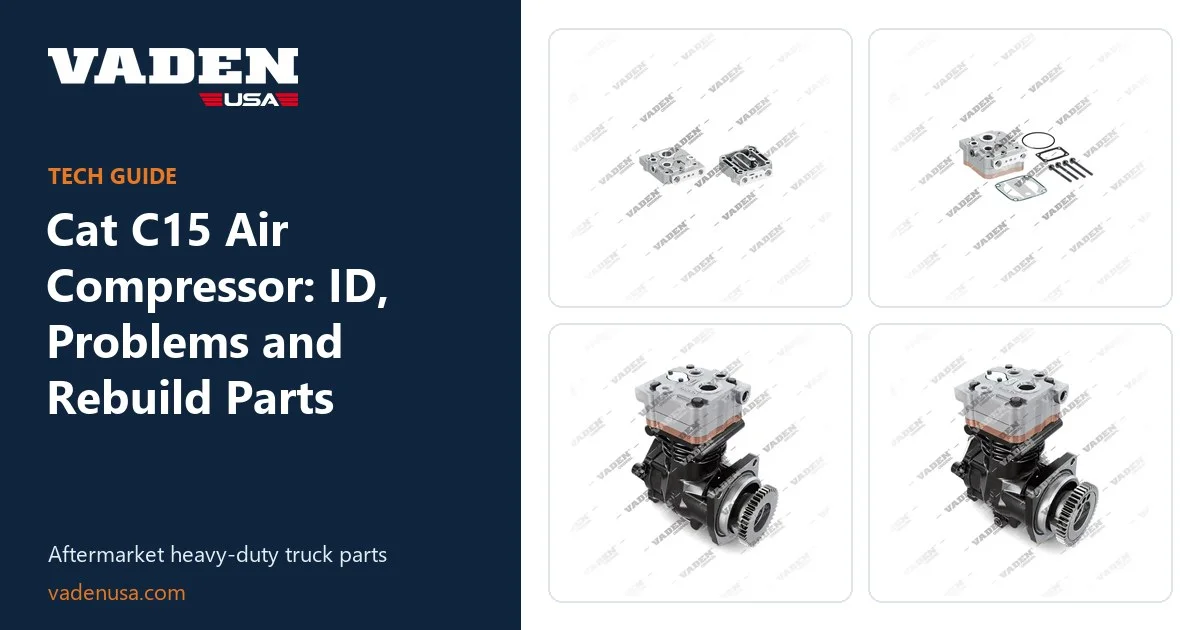
A Cat C15 uses an engine-mounted, engine-driven piston air compressor, and the exact model depends on the engine year, build and serial number. Bendix compressors such as the BA-921 and Tu-Flo 550 style units are among those listed for Caterpillar engines. Read the model plate and casting number on the compressor itself, not just the engine model, before you order a kit or replacement.
The C15 and C13 powered many Peterbilt, Kenworth and Freightliner tractors, and the older 3406 is still working in plenty of fleets. Caterpillar on-highway engines used more than one compressor design, so check the plate every time. Nothing here replaces the engine and compressor manufacturers' service literature, so confirm the details for your serial number.
How the C15 air compressor works
The compressor is driven by the engine, usually from the engine's gear train, and runs all the time the engine runs. It pulls in air, compresses it on the piston upstroke, and pushes it through the discharge line to the air dryer and then to the tanks. When tank pressure reaches the governor's cut-out setting, the governor sends an air signal to the compressor's unloader, which holds the inlet valves open so the compressor stops building pressure while the engine keeps turning it. When pressure falls to the cut-in setting, the signal is released and the compressor builds again.
That unloader action is why a worn unloader piston or a leaking governor line causes so many "compressor problems" that are not really a worn-out compressor. For a deeper look, see our guide to the compressor valve and unloader and the air governor.
How to identify the compressor on a Cat C15, C13 or 3406
Do not order by engine model alone. Use this sequence.
- Park the truck, chock the wheels and let the engine cool. Drain the air tanks if you plan to disconnect any air line.
- Find the compressor on the side of the engine block, normally on the gear housing end. Locate the metal model plate or the stamped or cast numbers on the body.
- Write down the model name, the part number on the plate and any casting number. Photograph them.
- Count the mounting bolts and note the flange style, whether the unit is water cooled, and where the discharge, inlet, coolant and governor ports sit.
- Note the engine model, year and serial number. The compressor and its plumbing can differ between engine generations.
- Cross-reference the OE number. Our guide on how to cross-reference an OE part number and the one on reading a Bendix casting number walk through the steps.
Bendix publishes air compressor listings by engine, and older Caterpillar engines such as the 3406 have used Tu-Flo 550 style compressors. See the Bendix quick reference guide for current listings, and our articles on the Bendix BA-921 and the Tu-Flo 550 and 750. The plate on your unit decides which one you have.
Common Cat C15 air compressor problems
Most failures fall into a few patterns. Use the table to narrow it down before you buy anything.
| Symptom | Likely cause | First check |
|---|---|---|
| Slow air build-up, tanks never reach cut-out | Worn valves or valve plate, worn rings, leaking discharge line or fitting | Test pump-up time, listen for leaks at the head and discharge line |
| Compressor never stops pumping, or cycles constantly | Sticking unloader piston, bad governor, leaking governor line | Check the governor signal at cut-out |
| Oil in the air dryer, tanks or drained water | Worn rings, carbon in the discharge line, restricted intake, failed dryer cartridge | Inspect intake, discharge line and dryer |
| Air or oil leaking at the head joint | Failed head gasket or loose head bolts | Clean the area, run the compressor, look for the leak path |
| Coolant in the air system or coolant loss | Cracked water-cooled head or failed gasket between the head and body | Pressure test the compressor coolant circuit |
| Knocking or metallic noise | Worn rod bearings, loose drive gear | Stop the engine and inspect the drive |
| Safety valve popping off | Blocked discharge line (carbon), stuck governor or unloader | Inspect the discharge line for restriction |
Unloader and governor
If the compressor keeps building pressure past the cut-out setting, the first suspects are the unloader piston and the governor, not the whole compressor. An unloader kit is an item to check before replacing the compressor, and Bendix lists unloader service as routine maintenance. See compressor unloader kits.
Head gasket and valve plate
The head gasket seals the cylinder head to the valve plate and the valve plate to the compressor body. A failed gasket shows up as air leaking at the joint, oil seepage, or slow build-up. Whenever the head is off, inspect the valve plate and discharge valves. Do not reuse old gaskets, and replace them as a set. A gasket kit is the matching set for a reseal job. See compressor gasket kits and compressor valve plates.
Oil passing
A small amount of oil in the air system is normal with any engine-lubricated compressor. A lot of oil is not. Before you blame the compressor, check the air dryer cartridge, the intake supply and the discharge line. Our guide to compressor failure symptoms shows how to separate normal oil carryover from a worn compressor. If the dryer is old, replace it too, as covered in our air dryer cartridge guide.
Intake hose
On many installations the compressor draws its air from the engine's air intake or turbo plumbing, through a short hose. A cracked, collapsed or loose hose lets unfiltered air in and wears the cylinder and rings quickly, and a restricted one starves the compressor and can raise oil consumption. Replace the intake hose and clamps whenever you replace or rebuild the compressor.
Diagram and hose routing, in general terms
Every compressor installation has the same basic connections, though the layout differs by engine and truck:
- Intake: engine intake air or turbo plumbing in, through a hose to the compressor inlet.
- Discharge: a metal or high-temperature line from the head to the air dryer inlet.
- Governor or unloader signal: a small line from the governor to the unloader port.
- Coolant: supply and return hoses on water-cooled units.
- Oil: supply and drain through the mounting flange, with no external line on most flange-mounted units.
Photograph every hose before you remove it. For the exact routing on your truck, use the manufacturer's diagram for your engine serial number. See also compressor adapters and discharge line.
How to test the compressor before you replace it
- Uncouple any trailer and drain the tank pressure below 85 psi.
- Start the engine, hold the manufacturer's recommended engine speed and time the rise from 85 to 100 psi. The federal in-use inspection rule, 49 CFR 570.57, allows 45 seconds for vehicles built on or after March 1, 1975 (30 seconds for earlier ones). Compare the result with the manufacturer's spec as well.
- Let pressure rise to cut-out and confirm the compressor unloads and the gauge stops climbing.
- With the engine off, check the air pressure drop for leaks.
Our full procedure is in how to test a truck air compressor. The federal rule is on eCFR (49 CFR 570.57).
Rebuild kit or replacement?
Rebuild when the body and bore are in good shape and the fault is in the head, valves, unloader or gaskets. Replace when there is scoring in the bore, a cracked body, a worn crankshaft or bearing noise, or when downtime costs more than the unit. A repair kit gives you the wear parts, a gasket kit reseals, and a full replacement resets the whole unit. Our rebuild or replace decision guide and the page on repair and gasket kits go step by step. Browse compressor repair kits, cylinder heads, single cylinder compressors and twin cylinder compressors.
VADEN parts
VADEN parts are aftermarket replacements. Caterpillar, Bendix, Peterbilt, Kenworth and Freightliner names are used only to identify engines and cross-references; VADEN is not affiliated with or approved by them. Confirm fitment against your compressor plate before ordering, and ask us if you are not sure.
| VADEN part | Description | Replaces / fits |
|---|---|---|
| VADEN 22 02 10 | Air Compressor Cylinder Head for Freightliner and International | Bendix, Caterpillar, Freightliner |
| VADEN 22 02 50 | Air Compressor Cylinder Head for Freightliner and International | Bendix, Caterpillar, Freightliner |
| VADEN 2200 020 001 | Single Cylinder Air Compressor, Replaces Bendix 5010803 | Bendix 5010803, Bendix 5010806 |
| VADEN 2200 020 002 | Single Cylinder Air Compressor, Replaces Bendix 5010803 | Bendix 5010803, Bendix 5010806 |
| VADEN 2200 020 110 | Air Compressor Repair Kit for Freightliner and International | Bendix, Caterpillar, Freightliner |
| VADEN 2200 020 150 | Air Compressor Gasket Kit for Freightliner and International | Bendix, Caterpillar, Freightliner |
| VADEN 2200 020 310 | Air Compressor Unloader Kit for Freightliner and International | Bendix, Caterpillar, Freightliner |
| VADEN 2200 020 650 | Air Compressor Valve Plate for Freightliner and International | Bendix, Caterpillar, Freightliner |
| VADEN 2200 020 760 | Air Compressor Repair Kit for Freightliner and International | Bendix, Caterpillar, Freightliner |
| VADEN 26 12 50 | Air Compressor Cylinder Head, Replaces Bendix 107082 | Bendix 107082 |
| VADEN 2600 120 001 | Twin Cylinder Air Compressor, Replaces Bendix 5004187 | Bendix 5004187, Bendix TUFLO750 |
| VADEN 2600 120 100 | Air Compressor Repair Kit for Freightliner and International | Bendix, Caterpillar, Detroit Diesel |
Related guides
- Truck air compressor by engine make
- Single vs twin-cylinder compressor fitment
- Air compressor by truck model
- Cummins air compressor guide
FAQ
What air compressor does a Cat C15 use?
It depends on the engine year and build. Bendix compressors such as the BA-921 are among those listed for Caterpillar engines. Read the model plate on your compressor and cross-reference the number before you buy.
Does a C15 ACERT use a different air compressor?
It can. Compressor and plumbing can differ between engine generations, so check the plate and the engine serial number instead of assuming by engine family.
What are the most common Cat C15 air compressor problems?
Slow pressure build-up, a compressor that will not unload, oil in the air system, leaking head gaskets and a bad intake hose. Test the governor and unloader first, because they are quicker and simpler to check than the compressor.
Where does the compressor intake hose go?
Generally from the engine air intake or turbo plumbing to the compressor inlet. Photograph the routing before removal and use the manufacturer's diagram for your engine serial number.
Does the C13 use the same air compressor as the C15?
Do not assume it does. Mounting, drive gear and ports can differ. Match the plate number and the engine serial number, not just the engine family.
What causes oil in the air system on a Cat engine?
Worn piston rings, a restricted intake, carbon in the discharge line or a worn-out air dryer cartridge. Check these before replacing the compressor.
Should I rebuild or replace a C15 air compressor?
Rebuild when the fault is in the head, valves, unloader or gaskets. Replace when the bore is scored, the body is cracked, or bearings and the crankshaft are worn.
Need a compressor part for a Cat engine?
Send us the compressor plate numbers, the engine model and the serial number at info@vadenusa.com or through our contact page, and request a quote.
Blog
3 2026-11-19
Air Brake Troubleshooting Guide: Symptoms, Causes, Fixes
Symptom-by-symptom air brake troubleshooting for semi trucks: slow build-up, pressure loss, constant dryer purge, locked brakes and ABS faults, with first checks.
 2026-11-19
Trailer ABS Light: Causes, Reset and DOT Violation Rules
Why the ABS light stays on a semi trailer, what the power-up check should look like, common causes, blink codes, resetting and what DOT rules say.
 2026-11-19
WABCO Air Compressor: ID, Rebuild Kits and Replacement
How to identify a WABCO air brake compressor by its 10-digit number, tell single from twin cylinder, and decide between a repair kit and a replacement unit.