

Published: · Updated:
Cummins Air Compressor: ISX, X15, N14, M11 Guide
How to identify, test and replace a Cummins ISX, X15, N14 or M11 engine air compressor, and how to match it by engine, compressor model and OE number.
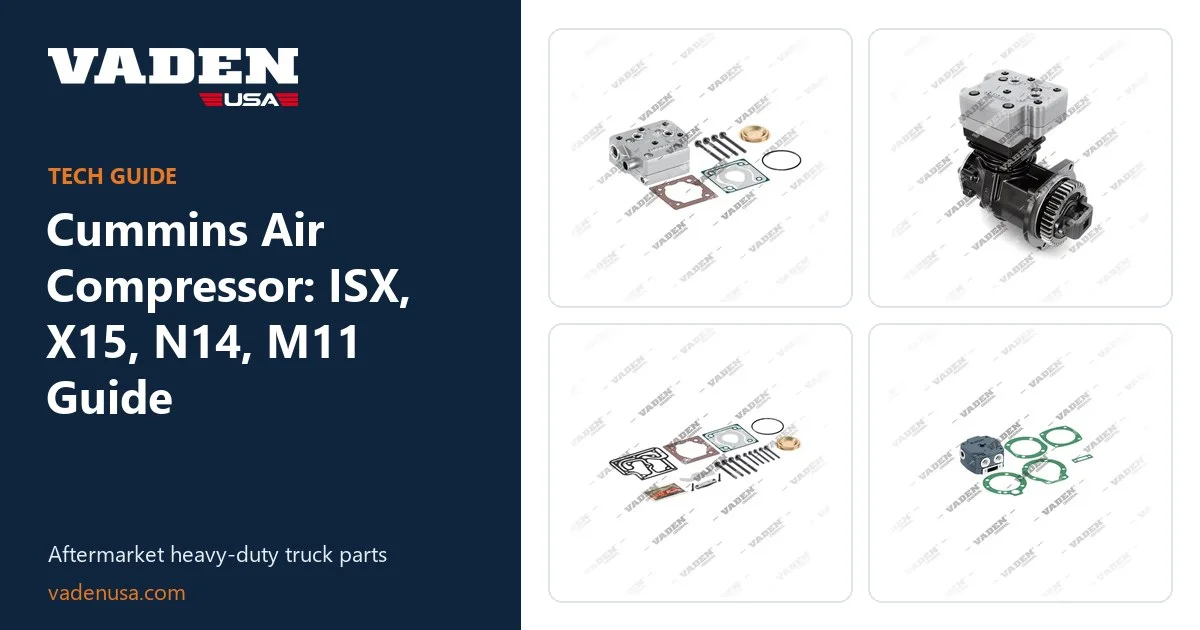
A Cummins air compressor is the engine-driven pump that fills the air brake system on ISX, X15, N14 (Big Cam) and M11 trucks. To buy the right replacement, match the engine model and serial number, the compressor model and part number cast or tagged on the housing, and the mounting, drive and coolant or oil connections before you order.
Cummins engine to compressor: what to match
Cummins does not build one compressor for every engine. The compressor on a given truck depends on the engine family, the model year, the chassis builder and sometimes the options selected when the truck was ordered. The table below shows what to check for each family. Compressor make and model are not assumed here, because they vary by build.
| Engine family | Typical use | What to check on the compressor |
|---|---|---|
| N14 (Big Cam) | Older line-haul and vocational trucks | Compressor model on the housing, Cummins or OE number, mounting flange and drive type |
| M11 | Mid-range line-haul, vocational and bus | Compressor model, number of cylinders, coolant and oil ports |
| ISX / ISX15 | Line-haul tractors | Engine serial number, compressor model, governor or unloader port position |
| X15 | Current line-haul and vocational tractors | Engine serial number, compressor part number, head and port layout |
The X15 is the successor to the ISX15, so do not assume the compressor carries over. Confirm by engine serial number and compressor part number, not by name. Our guide on truck air compressors by engine make covers the other brands, and air compressor fitment by truck model explains the matching method in more detail.
Cummins N14 air compressor
The Cummins N14 air compressor is an engine-mounted pump, usually gear-driven, and the right replacement is found by reading the nameplate or casting number on the compressor itself and comparing it with the engine serial number. The N14 had several compressor builds over its life, so the engine name alone does not identify the part.
How to identify the compressor on an N14
- Nameplate or tag: look for a metal tag on the compressor body, usually on the crankcase, showing the maker, model and part number. Clean off oil and road grime first.
- Casting numbers: if the tag is missing, the head and crankcase carry cast numbers. Read them as written, without spaces or dashes.
- Engine data plate: note the engine serial number and the engine family (for example N14 Celect or Celect Plus). Different builds can use different compressor models.
- Physical check: count the cylinders, then check the mounting flange, the drive end, the coolant and oil ports, and the governor port position.
What to match
Match the compressor model and part number first, then the engine serial number, then the connections. Many N14 engines use a Bendix Tu-Flo 750 style compressor, but compressors from other makers are also possible, so confirm against your own unit. Cross-reference numbers for VADEN compressors are listed in the table below. Confirm your own unit's number first; the table does not state engine fitment. Bendix publishes its compressor part numbers in the Bendix quick reference guide.
Common N14 compressor faults
- Oil carry-over into the air dryer and tanks from worn rings or bore, or a plugged oil return.
- Slow air build-up from a worn head, valve plate or leaking gasket.
- Compressor that keeps pumping because of a governor or unloader fault.
- Coolant in the oil or air from a cracked head or failed cooling passage.
- Knocking from a worn rod bearing or drive parts.
Check the air dryer and governor before you condemn the compressor. The symptom table later in this guide separates the causes.
Rebuild kit or replacement?
Use a repair kit when the crankcase, bore and crankshaft are sound and the problem is rings, valves or gaskets. Replace the whole compressor when the bore is scored, the crankcase or head is cracked, the drive or crankshaft is worn, or the unit has passed a lot of oil and failed more than once. Our rebuild or replace guide explains the decision. For the rest of the engine, see the semi-truck engines guide.
Cummins and Bendix are trademarks of their owners and are used here only to identify engines and parts. VADEN parts are aftermarket replacements.
Where the Cummins air compressor is and how it is driven
On these engines the compressor is mounted on the engine and driven by it, not by a separate belt or electric motor. It is usually at the front of the engine and normally uses engine oil, and on most builds engine coolant. Exact position and drive type depend on the engine and build, so check the Cummins service manual for your engine serial number.
Identify these points before you remove anything:
- Air inlet: the compressor draws air either from the engine intake system or through its own filtered line, depending on the build.
- Discharge line: the line that carries hot air to the air dryer.
- Governor or unloader port: the small line that signals the compressor to stop pumping when the system is full. On most designs this port is on or near the cylinder head. See our air governor guide and the compressor valve and unloader fault guide.
- Coolant lines: supply and return to the head or cooling plate, where fitted. See the compressor cooling plate guide.
- Oil feed and return: the compressor is lubricated from the engine oil system.
Cummins air compressor failure signs
Most compressor problems show up in the air system first. Common causes include the items below. Use this table to separate the compressor from the dryer, governor and leaks.
| Symptom | Likely cause | First check |
|---|---|---|
| Slow air build-up, low air warning | Worn piston rings, leaking head gasket or valve plate, system leak | Build-up time test, then leak check |
| Oil in the air dryer or tanks | Worn rings or bore, plugged oil return, dryer failure | Drain tanks, inspect dryer purge |
| Compressor never stops pumping | Governor or unloader fault | Governor cut-out and cut-in, unloader line |
| Air leaks at the head | Gasket or valve plate wear | Soap test at the head joints |
| Coolant in the oil or air | Cracked head or failed cooling passage | Pressure test coolant side |
| Knocking from the compressor | Worn rod bearing or drive parts | Inspect crankshaft and drive |
Oil in the air system does not always mean the compressor is bad. A failed air dryer cartridge or a plugged oil return can cause it too, so check the air dryer before you condemn the compressor. Our symptoms guide and how to test a truck air compressor walk through the tests step by step.
Air pressure matters for safety, not only for uptime. Federal rules in 49 CFR 393.51 (also readable at Cornell LII) require a low air pressure warning signal for the driver, and an air system that cannot build or hold pressure can fail an inspection. See the DOT air brake inspection checklist.
How to replace a Cummins ISX or X15 air compressor
This is an outline only. Torque values, gear timing and sealing steps differ by engine and must come from the Cummins service manual for your engine serial number. Do not use numbers from any other source.
- Park on level ground, chock the wheels and shut the engine off. Drain the air tanks fully.
- Let the engine cool, then drain or contain the coolant that will escape when the coolant lines come off.
- Label and disconnect the air inlet, discharge line, governor or unloader line, coolant lines and oil lines. Cap the open ports.
- Remove the mounting bolts and take the compressor off. Support its weight while the drive disengages.
- Inspect the mounting face, drive gear or coupling and oil supply passage. Clean the mating surfaces and replace any gasket or seal the manual calls for.
- Compare the new unit to the old one: flange, drive, port positions and port sizes must match before you install.
- Fit the new compressor and tighten the bolts to the manual specification. Reconnect all lines and refill the coolant.
- Run the engine, check for coolant, oil and air leaks, and run a build-up test and a governor cut-out test.
- Replace the air dryer cartridge if the old compressor passed oil, and clean or replace the discharge line.
To decide between a rebuild and a new unit, see the rebuild or replace guide.
Wear parts you can replace separately
Many compressor faults come from a small group of wear parts. If the body and crankcase are sound, these can be replaced without changing the whole unit.
- Cylinder heads and valve plates, the usual source of slow build-up and head leaks.
- Gasket kits for leaks at the head and mounting joints.
- Repair kits with piston rings and valves. See repair kit vs gasket kit.
- Pistons, rings and rods, covered in the piston ring and rod guide.
- Crankshaft and drive parts, covered in the crankshaft and drive guide.
Browse the full air compressor category, including single cylinder and twin cylinder compressors. Not sure which type you have? Read single vs twin-cylinder compressors.
Match by OE number
The most reliable way to match a Cummins compressor is by number. Read the part number on the compressor tag or housing, note the engine serial number, and compare both against the Replaces / fits column in the table below and our WABCO cross reference guide. Numbers are written without spaces or dashes, for example Cummins 4089206 or WABCO 9111539212. Some compressors carry a Cummins number and a compressor-maker number for the same unit. Our guides on cross-referencing an OE number and the WABCO cross reference show how to read them. Bendix compressors have their own numbering, see how to read a Bendix casting number. Cummins, WABCO and Bendix are trademarks of their respective owners.
VADEN parts for Cummins air compressors
These VADEN compressors, cylinder heads and repair kits list Cummins and WABCO numbers among the references they replace. Always confirm the number on your own compressor before ordering. VADEN parts are aftermarket replacements, and the Cummins and WABCO names and numbers are trademarks of their owners, used for reference only.
| VADEN part | Description | Replaces / fits |
|---|---|---|
| VADEN 25 03 50 | Air Compressor Cylinder Head, Replaces WABCO 9111539212 | Cummins 4089206, Wabco 9111539212 |
| VADEN 2500 030 001 | Single Cylinder Air Compressor, Replaces WABCO 9111535100 | Cummins 3104216RX, Wabco 9111535100 |
| VADEN 2500 030 750 | Air Compressor Repair Kit, Replaces WABCO 9111549292 | Cummins 4089238, Wabco 9111549292 |
| VADEN 25 01 50 | Air Compressor Cylinder Head, Replaces Cummins 2K97876MS1 | Cummins 2K97876MS1 |
| VADEN 25 01 51 | Air Compressor Cylinder Head, Replaces Cummins 2K97876MS2 | Cummins 2K97876MS2 |
| VADEN 25 03 10 | Air Compressor Cylinder Head, Replaces WABCO 9111539202 | Cummins 4936226, Wabco 9111539202 |
| VADEN 2500 010 001 | Single Cylinder Air Compressor, Replaces Cummins 3558072 | Cummins 3558072, Cummins 3558131 |
| VADEN 2500 010 100 | Air Compressor Repair Kit, Replaces Cummins 2K97876MS5 | Cummins 2K97876MS5 |
| VADEN 2500 030 003 | Single Cylinder Air Compressor, Replaces WABCO 9111535200 | Cummins 3103403, Cummins 3558163 |
| VADEN 2500 030 004 | Single Cylinder Air Compressor, Replaces WABCO 9111530190 | Cummins 3104216, Cummins 3687343 |
| VADEN 2500 340 001 | Single Cylinder Air Compressor, Replaces WABCO 9111530270 | Cummins 3689649, Wabco 9111530270 |
| VADEN 25 15 10 | Air Compressor Cylinder Head, Replaces Cummins 4089216 | Cummins 4089216 |
FAQ
Where is the air compressor on a Cummins X15?
It is mounted on the engine and driven by it, usually toward the front. Exact position and ports depend on the build, so confirm with the Cummins service manual and your engine serial number.
Where is the unloader valve on a Cummins ISX air compressor?
The unloader is part of the compressor head, and the governor signal line connects to a port on or near the head. Trace the small air line from the governor to the compressor to find it, and confirm against the manual for your engine.
What are the symptoms of a bad Cummins ISX air compressor?
Slow air build-up, a low air warning, oil in the air dryer or tanks, a compressor that never stops pumping, air leaks at the head and knocking noises. Test the dryer and governor too, since they cause similar symptoms.
How do I replace a Cummins ISX air compressor?
Drain the air tanks and coolant, label and disconnect the lines, unbolt the compressor, compare the new unit to the old one, install it, and test for leaks and air build-up. Take torque values and timing from the Cummins service manual only.
Is the Cummins X15 compressor the same as the ISX?
Do not assume so. The X15 is the successor to the ISX15, so the compressor may not carry over. Confirm by engine serial number and compressor part number, not by name.
What air compressor does a Cummins N14 use?
It depends on the year, application and chassis. Many N14 engines use a Bendix Tu-Flo 750 style compressor, but not all. Read the model and part number on the compressor nameplate or casting and compare it with the engine serial number before ordering.
How do I identify a Cummins N14 air compressor?
Find the nameplate on the compressor body, or the cast numbers on the head and crankcase, and note the engine serial number. Then compare the cylinder count, flange, drive and ports with the replacement.
Need a compressor, head or repair kit for a Cummins engine? Send the engine serial number and the compressor part number to info@vadenusa.com or use the contact page to request a quote.
Blog
3 2026-11-19
Air Brake Troubleshooting Guide: Symptoms, Causes, Fixes
Symptom-by-symptom air brake troubleshooting for semi trucks: slow build-up, pressure loss, constant dryer purge, locked brakes and ABS faults, with first checks.
 2026-11-19
Trailer ABS Light: Causes, Reset and DOT Violation Rules
Why the ABS light stays on a semi trailer, what the power-up check should look like, common causes, blink codes, resetting and what DOT rules say.
 2026-11-19
WABCO Air Compressor: ID, Rebuild Kits and Replacement
How to identify a WABCO air brake compressor by its 10-digit number, tell single from twin cylinder, and decide between a repair kit and a replacement unit.