

Published: · Updated:
Semi Truck Water Pump: Location, Failure Signs, Replacement
Where the water pump sits on a heavy-duty diesel, how to read the weep hole, spot a failing pump, replace it step by step and match a part by OE number.
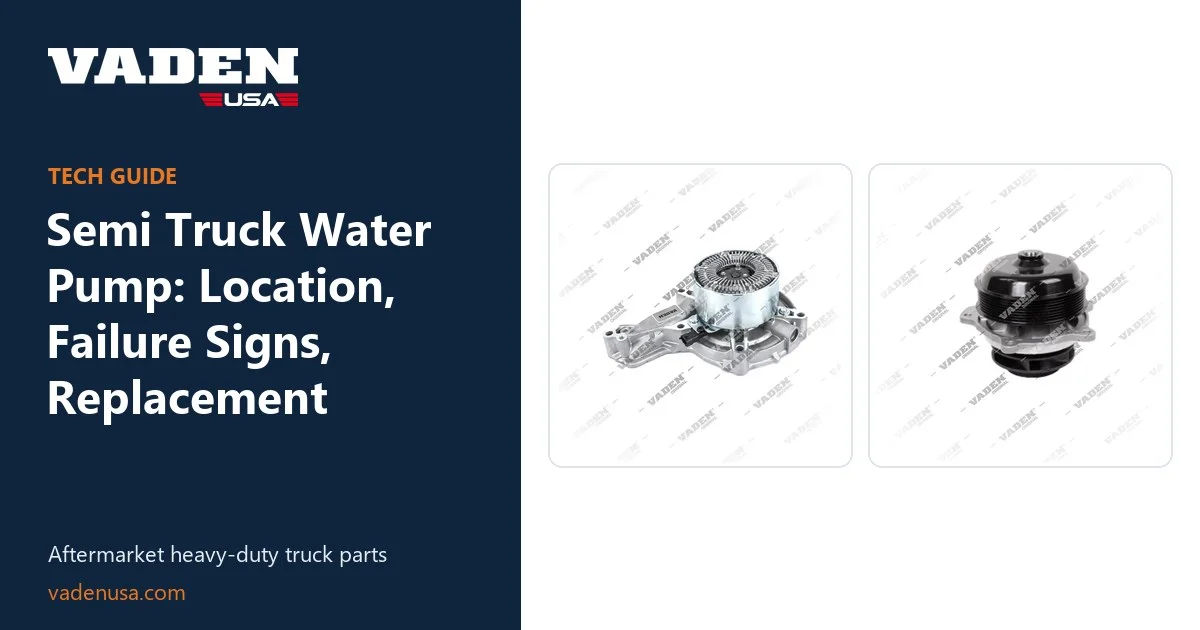
The semi truck water pump is the engine-driven coolant pump on a heavy-duty diesel. It moves coolant through the block, head, oil cooler and radiator. Typical failure signs are a leak at the weep hole, a whine or grinding from the bearing, and rising coolant temperature.
Where is the water pump on a heavy-duty diesel engine?
Location and drive type change from one engine family to another, so never assume. On many heavy-duty diesels the pump sits on the front of the engine, close to the timing cover and the accessory drive, and it is often reached after moving the fan, shroud or belts. On other designs it is gear driven, or mounted lower on the side of the block with the coolant inlet from the radiator hose and the outlet into the block.
The reliable way to find it on your truck is simple:
- Start at the lower radiator hose and follow it to the engine. The hose normally ends at the inlet of the pump or the thermostat housing.
- Look for a cast housing with a small hole or short tube in its underside. That is the weep hole.
- Confirm with the engine manufacturer's service manual, since pump position, drive and number of bolts are specific to the engine and model year.
For a wider view of where the cooling system fits among the other truck systems, see Parts of a Semi Truck: Systems and Components Explained.
What the weep hole tells you
A heavy-duty water pump has a weep hole (also called a tell-tale or drain hole) that signals seal failure. On many designs it sits between the coolant seal and the bearing or oil side, so fluid that gets past the seal escapes outside instead of washing into the bearing. It is the first place to look when you suspect a leak, and the engine maker's guidance tells you what is normal for your pump.
- Dry or a faint damp mark: a small amount of seepage can happen on a new pump while the seal beds in. Note it and recheck at the next service.
- Steady drip, crust or a large coolant stain around the hole: the seal is failing. Once coolant reaches the bearing it can wash out the grease and the bearing follows.
- Oil or grease coming out: the bearing or oil side may be leaking. Have the pump inspected and plan to replace it.
See the GMB guide to water pump weep holes in heavy-duty trucks for an aftermarket maker's explanation. Some newer pump designs have a weep hole built to collect a little fluid, so check the engine maker's guidance before condemning a pump on a damp spot alone.
Failure signs of a bad diesel water pump
| Symptom | Likely cause | What to check |
|---|---|---|
| Coolant dripping from the weep hole | Worn shaft seal | Look for crust or a wet trail under the pump. Check coolant condition. |
| Whine, growl or grinding that follows engine speed | Bearing wear | With the engine off and belt removed (if belt driven), turn the pulley or shaft by hand and feel for roughness or play. |
| Temperature rises under load or on hills | Worn impeller, slipping drive or restricted flow | Check belt tension, fan drive, radiator and thermostat first, then the pump. |
| Coolant loss with no visible leak | Leak evaporating on a hot engine, or an internal leak | Pressure test the system and inspect the weep hole with a mirror. |
| Loose or wobbling pulley | Failed bearing | Replace the pump. Do not run the engine. |
| Steam or sweet smell after shutdown | Leak onto hot parts | Let the engine cool, then inspect pump, hoses and housings. |
A failing pump is not the only reason a truck runs hot. Before ordering parts, rule out low coolant, a stuck thermostat, a collapsed hose, a clogged radiator core, a fan clutch that does not engage and a loose or glazed belt. A coolant leak can also come from components that share the system, such as the compressor cooling plate (see Compressor Cooling Plate: Coolant Faults and Replacement).
Can you drive a semi with a failing water pump?
Treat it as a stop-and-repair item. A pump that leaks slowly can sometimes get a truck to a shop if you watch the gauge and carry coolant, but a noisy bearing or a pump that cannot move enough coolant can overheat the engine in minutes. Overheating can warp heads and damage gaskets, which costs far more than the pump. If the temperature gauge climbs, pull over and shut down.
How to replace a semi truck water pump
This is an overview, not a substitute for the engine manual. Always take torque values, coolant type, bolt sequence and bleed procedure from the engine manufacturer's service information for your exact engine.
- Make it safe. Park on level ground, let the engine cool completely, chock the wheels, disconnect the batteries and tag the key. Hot, pressurized coolant causes serious burns.
- Drain the coolant. Open the drain and catch the coolant in a clean container. Dispose of used coolant according to local rules.
- Remove what is in the way. Depending on the engine this means the fan, shroud, belts, tensioner or hoses. Mark or photograph routing before you pull anything.
- Remove the old pump. Unbolt it, note bolt lengths and positions, and clean the mating surface without gouging it. Check for corrosion or pitting around the bore.
- Compare old and new. Match the pump body, impeller type, pulley or gear, inlet and outlet positions, bolt pattern and weep hole location before installation.
- Fit the new gasket or O-ring. Use the seal supplied or specified, keep it clean, and do not add sealant unless the manual calls for it.
- Install and torque. Seat the pump by hand, start all bolts, then tighten in the specified sequence to the specified torque.
- Refit belts, fan and hoses. Replace worn belts and hoses now; the labor is already done. Check belt alignment and tension.
- Refill and bleed. Fill with the coolant type the engine maker specifies, bleed trapped air as the manual describes, run the engine to temperature and top up.
- Recheck. Inspect the weep hole, hoses and joints for leaks, and look at the coolant level again after the first heat cycle and after the first day of work.
If the old pump failed because of dirty or exhausted coolant, flush the system before filling. A new pump in a contaminated system will wear out early. Add the coolant check to your routine with the semi truck preventive maintenance checklist.
Matching a pump by OE number
Engine family, year, pump drive, pulley or gear style and pump casting all affect which pump fits, so match by number rather than by truck model alone. Take the number cast or stamped on the old pump, or the number from the engine parts book, and write it without spaces, dashes or dots (for example DAF 1912939). Then look for the same number in the replacement part's cross-reference list. Our guide How to Cross-Reference an OE Part Number explains the steps. When two numbers look alike, compare the physical pump against a photo and dimensions before ordering.
VADEN water pumps
VADEN lists engine water pumps in the Water Pump category, with related items under Cooling System and Engine. The pumps below are matched to the OE references shown. VADEN parts are aftermarket replacements; brand names and OE numbers are used only for reference and identification.
| VADEN part | Description | Replaces / fits |
|---|---|---|
| VADEN 525.03.0008 | Water Pump, Replaces Volvo 20920065 | Renault Trucks 7421072412, Renault Trucks 7421648715 |
| VADEN 525.06.0017 | Water Pump, Replaces DAF 1912939 | DAF 1912939, DAF 2042162 |
FAQ
Where is the water pump on a semi truck?
It is mounted on the engine, usually at the front or on the side of the block, and connected to the lower radiator hose. Exact position and drive type depend on the engine, so confirm with the service manual.
What are the symptoms of a bad water pump on a diesel truck?
Coolant leaking from the weep hole, whining or grinding noise from the bearing, a wobbling pulley, coolant loss and engine temperature that rises under load are the most common signs.
What does the weep hole on a water pump mean?
It is a drain that signals seal failure, and on many designs it sits between the coolant seal and the bearing or oil side. A little moisture on a new pump can be normal, but a steady drip, crust or oil from the hole means the seal or bearing is failing and the pump should be replaced. Check the engine maker's guidance for your pump.
How do I replace a semi truck water pump?
Let the engine cool, drain the coolant, remove the fan, belts or hoses in the way, unbolt the old pump, clean the surface, fit the new pump with its gasket or O-ring, torque to specification, then refill and bleed the system. Follow the engine manual for values.
Can I drive a semi with a failing water pump?
Only a very short distance for a slow seep, and only while watching the temperature gauge. A noisy or loose pump can overheat the engine quickly and cause head and gasket damage, so repair it before continuing.
How do I choose the right replacement pump?
Match the OE number from the old pump or parts book against the replacement's cross-reference list, then compare mounting, pulley or gear and inlet and outlet positions.
Need a water pump matched to an OE number? Request a quote or e-mail info@vadenusa.com with the old pump number and engine details.
Blog
3 2026-11-19
Air Brake Troubleshooting Guide: Symptoms, Causes, Fixes
Symptom-by-symptom air brake troubleshooting for semi trucks: slow build-up, pressure loss, constant dryer purge, locked brakes and ABS faults, with first checks.
 2026-11-19
Trailer ABS Light: Causes, Reset and DOT Violation Rules
Why the ABS light stays on a semi trailer, what the power-up check should look like, common causes, blink codes, resetting and what DOT rules say.
 2026-11-19
WABCO Air Compressor: ID, Rebuild Kits and Replacement
How to identify a WABCO air brake compressor by its 10-digit number, tell single from twin cylinder, and decide between a repair kit and a replacement unit.