

Published: · Updated:
Semi Truck Exhaust Manifold Leak: Symptoms, Causes, Fix
How to spot an exhaust manifold leak on a heavy-duty diesel truck, what causes it, how to confirm it, and whether a gasket or a new manifold is the right fix.
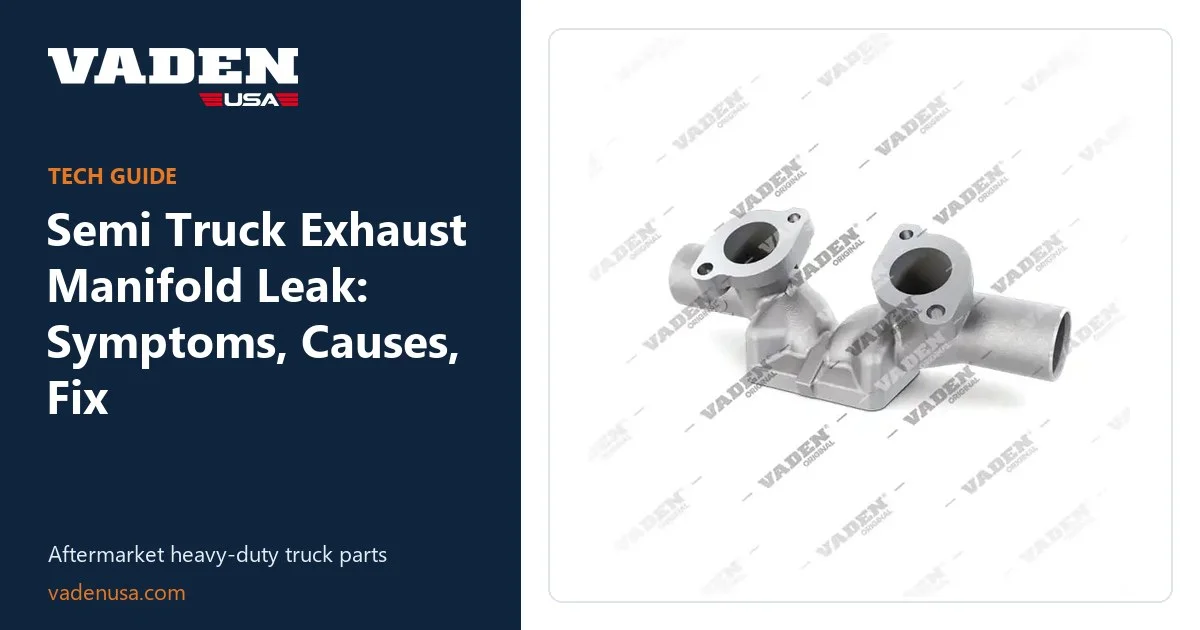
An exhaust manifold leak on a semi truck usually shows up as ticking at cold start that fades as the engine warms, black soot around a joint, exhaust smell near the cab and weaker turbo response. Common causes are a cracked manifold, a failed gasket or broken studs. Repair it promptly, because a leak can also lead to a DOT citation.
This guide is written for heavy-duty diesel trucks. The same idea applies to a pickup or a car (a leaking gasket or a cracked cast manifold), but the engines, the turbo setup and the inspection rules covered here are those of Class 8 tractors.
What the exhaust manifold does and why it leaks
The exhaust manifold bolts to the cylinder head and collects the exhaust from each cylinder into one path that feeds the turbocharger. On most heavy-duty diesels it sits in the hottest part of the engine and swings from ambient temperature to very hot and back every time the engine runs. If you want the bigger picture of where it sits, see our parts of a semi truck guide and the semi truck engines guide.
That constant heating and cooling is the root of almost every manifold leak. The metal expands and contracts, the bolts and studs stretch and loosen, the sealing surfaces move against each other, and eventually something gives: the gasket, a stud, or the casting itself.
Exhaust manifold leak symptoms
A leak rarely announces itself with a single clear sign. These are the symptoms drivers and technicians report most often:
- Ticking or tapping at cold start. Exhaust escaping through a small gap makes a rhythmic tick that follows engine speed. It often quiets down as the engine warms, because the metal expands and partly closes the gap.
- A brief tick that stops once warm. A brief tick at cold start that stops once warm can be a slip joint that seals with heat; look for soot and check other areas before replacing parts.
- Hissing or puffing under load. A bigger leak sounds like a puff or a blow-by noise, loudest when you accelerate or climb.
- Soot tracks. Black, dry streaks around a flange, a stud or a crack are a classic sign. Exhaust gas carries soot, so it leaves a trail where it escapes.
- Exhaust smell in or near the cab. A smell of exhaust inside the cab, or fumes coming through the firewall or vents, needs attention right away.
- Low boost or slow turbo response. Gas that leaks before the turbo does not spin the turbine. Expect sluggish response, weaker pull and sometimes more smoke.
- Higher fuel use and exhaust temperatures. The engine works harder to make the same power. Treat this as a hint, not proof, because many faults cause it.
- Burnt or melted parts nearby. Discolored wiring, hoses or heat shields close to the manifold show where hot gas has been blowing.
Common causes
Cracked manifold
Heat cycling can crack a cast manifold, most often between ports or near a mounting boss. Some manifolds are made in sections with expansion joints, and those joints can leak without any visible crack.
Failed or blown gasket
The gasket between the manifold and the head (or between manifold sections and the turbo flange) can burn through, especially if the sealing surface is warped or the bolts have lost clamping force.
Broken or loose studs and bolts
Studs break from heat fatigue, from corrosion, or when someone over-tightens them. One broken stud lets the flange lift and leak at that spot. A stud that breaks on removal is a known headache, so plan for it.
Warped flange or sealing surface
If the manifold or the head surface is no longer flat, a new gasket will not seal for long. This is why you should check the surfaces before putting everything back together.
Turbo flange and clamp leaks
The joint between the manifold and the turbo, and any V-band clamp or expansion joint, can leak and feel just like a manifold problem. Always look at the whole path from the head to the turbo inlet.
Symptom guide at a glance
| What you notice | Likely source | Next check |
|---|---|---|
| Tick at cold start that fades | Small gasket leak or a hairline crack | Look for soot at each port and flange |
| Soot streak at one stud | Loose or broken stud | Check stud tension and condition per the OEM procedure |
| Puffing noise when accelerating | Blown gasket or large crack | Inspect the full manifold and turbo flange |
| Weak boost, slow turbo response | Leak ahead of the turbo | Check the manifold joints before blaming the turbo |
| Exhaust smell in the cab | Leak near the firewall or cab air intake | Park the truck and inspect before driving it again |
How to find an exhaust manifold leak
Do this with the engine cold, never hot, and with the truck parked, brakes set and wheels chocked. Hot exhaust parts cause serious burns.
- Look first. With a good light, check every port, flange and joint for black soot trails, white or rust-colored deposits, and visible cracks.
- Listen at cold start. Start the engine cold and listen along the manifold with a length of hose held to your ear, keeping clear of belts and fans. The tick is loudest right at the leak.
- Check the studs and bolts. Look for missing, broken or loose fasteners. A missing stud head is a strong clue.
- Test if you cannot see it. Have a shop do a smoke or pressure test if the leak is not visible.
- Confirm the whole path. Follow the exhaust from the head to the turbo, then to the downstream piping, so you do not replace a gasket when the real leak is at the turbo flange or a clamp.
- Check for fault codes. Boost-related codes can support the diagnosis, but a leak does not always set a code.
Gasket or manifold: which one do you replace?
If the manifold is straight, uncracked and the studs are sound, a new gasket set is often enough. Replace the whole manifold when you find any of these:
- A crack in the casting (check the engine maker's criteria; a hairline crack that grows or leaks usually means replacement).
- A flange or sealing surface that is warped or pitted beyond what the OEM allows.
- Repeated gasket failures at the same spot.
- Damaged threads or ports that cannot be repaired the way the engine maker allows.
Replace the studs, bolts and gaskets as a set whenever the manufacturer says they are one-time-use or when they show heat damage. Reusing tired fasteners is a common reason for a second leak a few weeks later.
Replacement basics
Exact steps differ by engine, so always follow the engine maker's service manual. The general order is:
- Let the engine cool completely, disconnect the batteries, and drain or relieve anything the procedure calls for.
- Remove heat shields, the turbo connection and any piping in the way.
- Loosen and remove the manifold fasteners in the order the manual gives. Note which ones are studs and which are bolts.
- Clean the head and manifold surfaces without gouging them, and check flatness.
- Fit new gaskets and fasteners, then tighten in the sequence and to the torque specification published by the OEM. Do not use a generic torque figure: the right value depends on the engine and the fastener.
- Rebuild the turbo connection and piping, start the engine, and recheck for leaks and soot after the first heat cycle.
Is an exhaust leak a DOT problem?
Often, yes. Under 49 CFR 393.83(g), no part of the exhaust system may leak or discharge at a point forward of or directly below the driver or sleeper compartment, and 393.83(f) bars temporary repairs with wrap or patches. A leak elsewhere is not named in that paragraph, but it can still be cited under the general maintenance duty of 49 CFR 396.3, and it can send fumes into the cab. Read the rule itself here: 49 CFR 393.83 on eCFR. For how inspections are graded, see our DOT inspection levels article.
Beyond the citation, exhaust gas contains carbon monoxide. If you smell exhaust in the cab, stop, ventilate and get the truck inspected.
What does it cost to fix?
There is no single number. Cost depends on the engine, how hard the manifold is to reach, whether studs break during removal, whether the turbo has to come off, and shop labor rates. A gasket job is the cheaper end, while a cracked manifold with seized studs is the expensive end. Ask for a quote that separates parts from labor, and ask whether new studs, gaskets and clamps are included.
Prevent a repeat leak
- Include a look at the manifold, studs and turbo flange in your regular preventive maintenance.
- Fix a small tick early. A tiny leak erodes the sealing surface and gets worse.
- Use new fasteners where the manufacturer requires them and tighten to the published specification.
- Avoid long hard pulls on a cold engine when you can, because fast heat changes stress the casting.
VADEN parts
VADEN offers an aftermarket exhaust manifold for Detroit Diesel applications. Browse the exhaust manifold category and always confirm fitment against your engine and the OE number before ordering. Detroit Diesel is a trademark of its owner; VADEN parts are aftermarket replacements and the name is used for reference only.
| VADEN part | Description | Replaces / fits |
|---|---|---|
| VADEN 433.13.0001 | Exhaust Manifold, Replaces Detroit Diesel 23532122 | Detroit Diesel 23532122 |
FAQ
What does an exhaust manifold leak sound like?
Most often a rhythmic ticking or tapping that follows engine speed, loudest at cold start and often quieter once the engine is warm. A larger leak sounds like puffing or hissing under load.
What are the symptoms of an exhaust manifold leak?
Ticking at cold start, soot around a joint or stud, an exhaust smell near or inside the cab, weaker turbo response and sometimes higher fuel use. Burnt wiring or hoses next to the manifold also point to a leak.
Can I drive with an exhaust manifold leak?
It is not a good idea. A leak can reduce boost, overheat nearby parts, let fumes into the cab, and under 49 CFR 393.83(g) a leak forward of or directly below the driver or sleeper compartment is a violation.
Is it the exhaust manifold gasket or the manifold itself?
Check for cracks, soot at each port and the condition of the studs. If the manifold is flat and uncracked, the gasket is the likely cause. A crack or warped surface means the manifold needs replacement.
How much does exhaust manifold leak repair cost?
It varies with the engine, access, broken studs, whether the turbo must be removed and local labor rates. Request an itemized quote that lists parts and labor separately.
Do I need to replace the studs with the gasket?
Replace any stud or bolt that is damaged, heat-worn or marked as single-use in the OEM manual. New fasteners help the new gasket seal and last.
What torque should I use on manifold bolts?
Use only the torque value and tightening sequence from the engine maker's service manual for your exact engine. Generic figures are unsafe here.
Need an exhaust manifold for a Detroit Diesel application? Request a quote or write to info@vadenusa.com with your engine and OE number.
Blog
3 2026-11-19
Air Brake Troubleshooting Guide: Symptoms, Causes, Fixes
Symptom-by-symptom air brake troubleshooting for semi trucks: slow build-up, pressure loss, constant dryer purge, locked brakes and ABS faults, with first checks.
 2026-11-19
Trailer ABS Light: Causes, Reset and DOT Violation Rules
Why the ABS light stays on a semi trailer, what the power-up check should look like, common causes, blink codes, resetting and what DOT rules say.
 2026-11-19
WABCO Air Compressor: ID, Rebuild Kits and Replacement
How to identify a WABCO air brake compressor by its 10-digit number, tell single from twin cylinder, and decide between a repair kit and a replacement unit.