

Published: · Updated:
Diesel Fuel Primer Pump: How It Works and How to Prime
What a diesel fuel primer (lift) pump does on a heavy truck, when you need to prime the system, a generic priming procedure and signs of a failing pump.
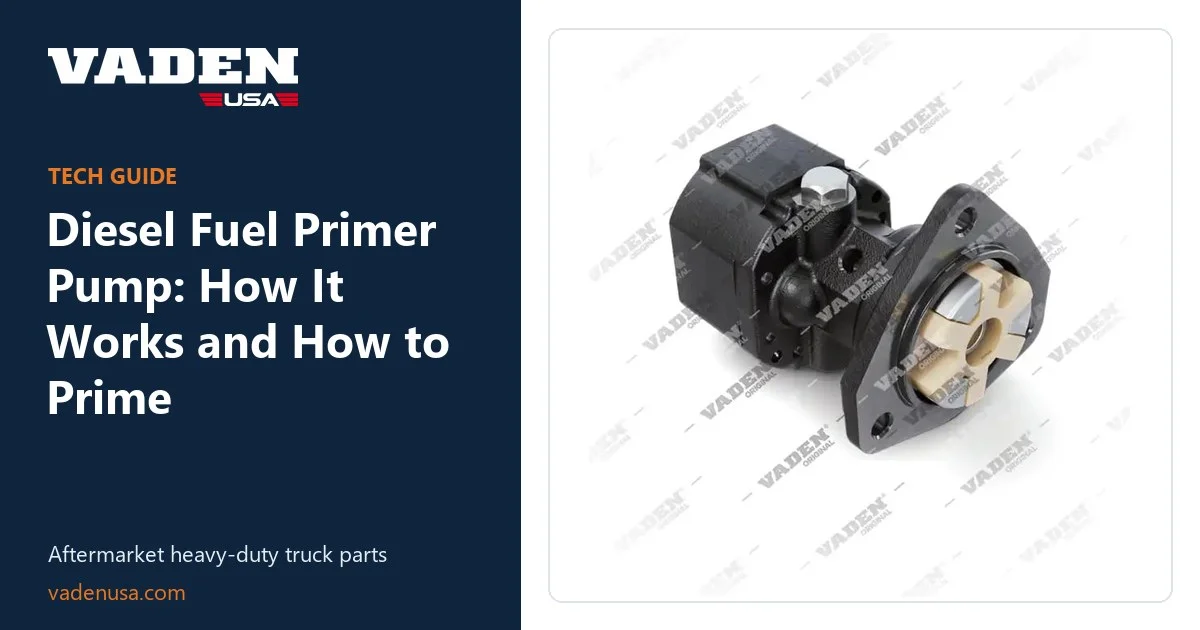
A diesel fuel primer pump is a hand or electric pump that fills the filters and fuel lines and pushes out air when the engine is off, usually after a filter change or running out of fuel. A lift (feed) pump does that work continuously while the engine runs. If the engine cranks but will not start after fuel work, prime first.
What a lift pump and a primer pump do
Most heavy-duty diesels use a low-pressure pump to move fuel from the tank to the high-pressure injection system. That pump may be mechanical (driven by the engine, often a diaphragm, piston or gear type) or electric. It keeps the filters and the inlet of the injection pump or common rail full of fuel under modest pressure. Without it, the high-pressure side starves.
The primer is the manual or electric way to do the same job when the engine is not running. Depending on the engine, it can be a plunger or lever on the fuel filter head or on the engine-mounted feed pump, a hand pump fitted in the line, or an electric pump that runs when you turn the key on. The names are used loosely: shops say "lift pump", "feed pump", "transfer pump" and "primer pump" for the same circuit, and what you actually have depends on the engine and model year. Always check the service information for your engine.
Hand primer vs electric lift pump
| Feature | Hand primer | Electric lift or priming pump |
|---|---|---|
| How it runs | You pump a plunger or lever by hand | Runs on vehicle power, often on key-on or by a command from the ECM |
| Main use | Priming after a filter change or running out of fuel | Keeps pressure up, often primes the filter automatically |
| Works with the engine off | Yes, no electrical power needed; on some engine-mounted pumps the engine may need to be turned so the cam is off its lobe (see the manual) | Yes if the battery and wiring are good |
| Typical failure | Worn seals or check valve, air gets sucked in, stroke feels soft | Motor wear, relay or wiring faults, low flow |
| Effort | Can take many strokes on an empty system | Little effort, but the pump can overheat if run dry |
Some engines have both. Others, especially newer electronically controlled engines, use a combination of a mechanical feed pump and an electric priming function. Never assume one truck behaves like another, even in the same brand.
When you need to prime the fuel system
- After changing the primary or secondary fuel filter, especially if the new filter is dry.
- After running out of fuel.
- After replacing a lift pump, fuel line, injector or other part that opens the fuel circuit.
- After the truck sat for a long time and fuel drained back toward the tank.
- When air has entered through a loose fitting, a cracked line or a worn seal.
Cummins guidance for the X15 is a good example of why you should follow the OEM: its quick reference guides (EPA 2017 and EPA 2024) say to install the engine-mounted fuel filter dry and cycle the key switch on three to four times so the priming pump fills the filter, and never to pre-fill through the center hole on the clean side. If you must pre-fill, use the smaller outer holes on the dirty side so fuel passes through the media. Other engines, such as Caterpillar and Detroit, have different primers and different steps.
How to prime a diesel truck engine (general procedure)
This is a generic routine, not an OEM procedure. Use it only as a checklist and follow the manual for your engine where it differs.
- Park on level ground, set the parking brake and shut the engine off. Let the engine cool if you are working near hot surfaces.
- Check there is enough fuel in the tank and, if the truck has a tank shutoff or ball valve, that it is open.
- Install the new filter as the manufacturer states, and make sure the seals are seated and the drain valves are closed. Some engines, such as the Cummins X15, call for installing the filter dry; never pour fuel into the clean side unless the manual allows it.
- Locate the primer: a plunger or lever on the filter head or feed pump, or the key-on priming cycle on engines that have it.
- Pump the hand primer with smooth, straight strokes, or cycle the key as directed. You should feel resistance build as the system fills. On an empty system this can take many strokes.
- If the engine has a bleed screw or air purge point, open it as the manual says and keep priming until fuel flows without bubbles, then close it.
- Lock or secure the primer plunger, if it has a locking design.
- Start the engine. Do not hold the starter longer than the limit in the manual (many OEMs limit a single crank to about 30 seconds) and let the starter cool between attempts. Long cranking can overheat the starter and drain the batteries.
- Let the engine idle and check for leaks around the filter, fittings and primer. Fix any leak before driving, since a leak on the suction side lets in air.
Do not crank the engine continuously to pull fuel through a dry system. It strains the starter and batteries, and on many engines the injection pump can run dry. Never loosen high-pressure lines on a running or recently running engine: that fuel is under high pressure and can cause serious injury. Relieve pressure only at the points the OEM specifies.
Symptoms of a bad primer or feed pump
| Symptom | Likely cause | What to check |
|---|---|---|
| Hard starting after a filter change | Air in the system or a primer that does not hold | Primer stroke, fittings, filter seals |
| Hand primer feels soft, no resistance builds | Worn seal or check valve in the primer or feed pump | Primer assembly, pump check valve |
| Engine loses power under load, then recovers | Weak feed pump or restricted filter | Fuel pressure, filter condition |
| Engine stalls, restarts after prime | Air leak on the suction side | Lines, fittings, filter head, pump seals |
| Fuel in the engine oil or leaking at the pump | Failed pump seal or diaphragm | Pump body and weep hole |
| Electric pump noisy, hot or not running | Worn motor, relay or wiring fault | Voltage at the pump, relay, fuse |
A pressure or vacuum test tells you more than guessing. Measure supply pressure and compare it with the engine specification. A restricted filter and a weak pump can look identical on the road, so check the filter first. Air in the fuel often shows up as a foamy or bubbly stream in a clear section of line, or as a fuel level that falls back after you prime. Write down what you found and what you replaced, so the next technician does not have to start from zero if the symptom returns.
Common causes of air getting in
- Loose or cracked suction-side fittings, including those at the filter head and water separator.
- Worn O-rings or seals on the filter housing.
- A tired primer plunger seal.
- Cracked fuel lines, especially where they flex or rub.
- A feed pump with worn internal seals or a stuck check valve.
If the truck loses prime repeatedly, find the leak. Priming over and over only hides a fault that will leave you stranded.
VADEN parts
VADEN lists a fuel feed pump that replaces Detroit Diesel 23517845. Check the cross-reference against your engine before ordering. You can also browse our manual feed pump category.
| VADEN part | Description | Replaces / fits |
|---|---|---|
| VADEN 0137 001 | Fuel Feed Pump, Replaces Detroit Diesel 23517845 | Detroit Diesel 23517845, Detroit Diesel R23517845 |
VADEN parts are aftermarket replacements. Detroit Diesel and the other names in this article are trademarks of their owners and are used only to identify engines and cross-references. VADEN is not the OEM and is not approved by it. For more on matching numbers, see our guide on how to cross-reference an OE part number.
Related reading
- Semi truck engines guide to see which engines you are working on.
- Semi truck preventive maintenance checklist and schedule for filter change intervals in your service plan.
- Parts of a semi truck for how the fuel system fits with the rest of the truck.
FAQ
What is a lift pump on a diesel engine?
A lift pump is the low-pressure pump that draws fuel from the tank and sends it through the filters to the high-pressure injection system. It can be mechanical, driven by the engine, or electric. Many shops also call it a feed pump or transfer pump.
What does a diesel fuel primer pump do?
It lets you fill the filters and lines with fuel and push out air when the engine is not running, usually after a filter change, a run-dry or repair work. It may be a hand plunger, a lever or an electric priming function.
What are the symptoms of a bad diesel lift pump?
Common signs are hard starting, loss of power under load, stalling that clears after priming, a soft primer with no resistance, fuel leaking at the pump and, on electric pumps, noise or no run. Always rule out a clogged filter and air leaks first.
How many strokes does a hand primer take?
It depends on the engine, the filter size and whether the system is empty. An empty system takes many more strokes than a system that only had a filter swapped. Keep pumping until you feel firm resistance or the manual says the system is full.
Can I prime the system by cranking the engine?
You should not rely on it. Long cranking strains the starter and batteries and can run the injection pump dry. Use the primer or the key-on priming cycle, and keep any cranking within the limit in your manual.
Do I need to prime after changing a fuel filter?
Yes, in most cases. The new filter and the lines between it and the engine hold air. Follow the OEM steps. For example, the Cummins X15 guides call for installing the engine-mounted filter dry and cycling the key where the engine has an electric priming pump; other engines may allow pre-filling.
Need a feed pump or a cross-reference for your engine? Send the engine model and OE number to info@vadenusa.com or use our contact page to request a quote.
Sources: Cummins X15 (EPA 2017) Truck Maintenance and Operation quick reference guide; Cummins X15 (EPA 2024) quick reference guide.
Blog
3 2026-11-19
Air Brake Troubleshooting Guide: Symptoms, Causes, Fixes
Symptom-by-symptom air brake troubleshooting for semi trucks: slow build-up, pressure loss, constant dryer purge, locked brakes and ABS faults, with first checks.
 2026-11-19
Trailer ABS Light: Causes, Reset and DOT Violation Rules
Why the ABS light stays on a semi trailer, what the power-up check should look like, common causes, blink codes, resetting and what DOT rules say.
 2026-11-19
WABCO Air Compressor: ID, Rebuild Kits and Replacement
How to identify a WABCO air brake compressor by its 10-digit number, tell single from twin cylinder, and decide between a repair kit and a replacement unit.