

Published: · Updated:
DD15 & DD13 Air Compressor: Location, Symptoms, Fix
Find the DD15 and DD13 air compressor, spot failure symptoms, check the unloader and governor, match by OE number, and compare replace vs rebuild.
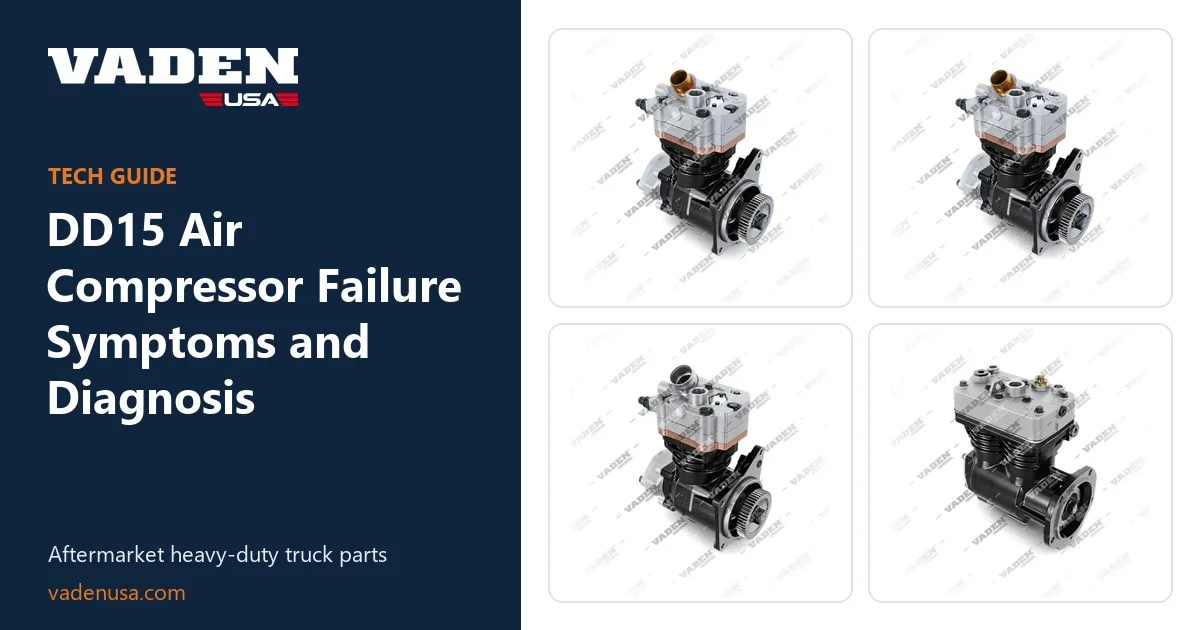
The DD15 and DD13 air compressor is a gear-driven pump on the Detroit engine that supplies air to the brake system. Failure signs include slow air build-up, oil in the tanks, knocking, coolant in the air system and poor loading or unloading. Rule out the governor, unloader line, discharge line and air dryer before replacing it.
Where is the air compressor on a DD15 or DD13?
On a Detroit DD13 or DD15 the compressor bolts to the engine and is driven from the engine gear train, with engine coolant circulating through it. In a Freightliner Cascadia the engine sits under the hood, so the compressor is reached by tilting the hood and working from the engine compartment, and on some builds you must remove other parts for access. Layout varies by model year and options, so use the Freightliner or Detroit service manual for your engine serial number.
Think of the compressor as a block with five connections:
- Air inlet: a hose that feeds filtered air to the compressor, from the engine intake side.
- Discharge port: a metal line carrying hot compressed air toward the air dryer.
- Coolant supply and return lines: two lines that circulate engine coolant through the compressor. On many Cascadia engines these are plastic lines with O-rings.
- Unloader port: a small air line from the governor. Air pressure here makes the compressor stop pumping (unload).
- Oil supply and return: lubrication comes from the engine, and oil drains back to the engine.
This is a description, not a diagram. Your engine's parts catalog shows the exact view for your build.
Which compressor do the DD15 and DD13 use?
Bendix sells its BA-921 as a remanufactured compressor for 2007 EPA and 2010 EPA Detroit DD13 and DD15 engines. Fitment differs between engine generations, so always match the compressor by engine serial number and OE number before ordering. Read the OE number from the old compressor or its tag and write it without spaces or dashes. BA-921 is a Bendix model name, not an OE number; our BA-921 air compressor guide explains how to compare numbers. Check whether the replacement unit includes a drive gear; if it does not, move the gear from the old unit as the Bendix or Detroit instructions direct. See the Freightliner application page for the Cascadia and other models.
Detroit DD13 air compressor
The Detroit DD13 air compressor is an engine-mounted, gear-driven pump like the one on the DD15. Bendix lists the same BA-921 remanufactured unit for both engines, but brackets, lines and routing vary by model year, so check the service manual for your engine serial number.
DD13 air compressor unloader valve
The unloader is the air-operated part of the compressor head. When the governor sends air pressure to the unloader port, the compressor stops pumping. If it never unloads, cycles constantly or builds air slowly, do the unloader line leak test below and check the governor before blaming the compressor. Worn unloader parts are covered by the compressor unloader kit linked below.
Freightliner air brake compressor: DD15 in the Cascadia
When people search for a Freightliner air brake compressor, they usually mean the Detroit engine compressor, because Freightliner builds the truck and Detroit builds the engine. The same DD15 compressor family appears in many Cascadia trucks, but the coolant lines, brackets and air line routing differ by model year. The air system downstream is the same idea on any Class 8 truck: compressor, discharge line, air dryer, wet tank, governor and service tanks. For the basics, read how air brakes work on a semi truck.
DD15 air compressor failure symptoms
- Slow build-up or no build-up: tank pressure rises slowly, or the truck takes a long time to recover after a brake application.
- Oil in the air system: oily residue when you drain the wet and supply tanks, oil at the air dryer exhaust, or a sticky film in downstream valves.
- Noise: knocking, ticking or a new rattle from the compressor area that follows engine speed.
- Coolant in the air system: water-glycol mixture in the tanks, or coolant level dropping with no external leak.
- Cycling problems: the compressor never unloads, never loads, or cycles very often, and the air dryer purges rapidly.
- Safety valve popping off or air leaking from the compressor head.
Rule out the cheap causes first
Bendix points out that slow build-up can come from the discharge line between the compressor and the dryer, which can clog with carbon or develop pinholes that leak only while the engine runs. Problems loading or unloading often come from the governor, its control lines or fittings. Do these checks before removing the compressor:
- Pressurize the unloader line with shop air to the pressure given in the Bendix or Detroit test procedure and check it for leaks.
- Check that the unloader line is sealed at the governor fitting and test again.
- Inspect the air intake hose for cracks, chafing, loose clamps and damaged adapters.
- Inspect the metal discharge and supply tubes for cracks, pinholes and loose fittings.
- Look at the outside of the compressor and the coolant lines for oil, air or coolant leaks.
Symptom-by-symptom diagnosis
| Symptom | Likely causes | What to check |
|---|---|---|
| Slow build-up | Worn rings or valves, restricted or leaking discharge line, leaking governor line or fittings, system air leaks, air dryer problem | Air leaks first, then the discharge line for carbon, then the governor and unloader. Compare build-up time with the OEM specification. |
| Oil in air tanks | Compressor passing oil, restricted air intake, restricted oil return to the engine, saturated or failed air dryer cartridge | Intake hose and filter, oil return path, discharge line carbon, dryer service history. |
| Knocking or ticking | Worn bearings, connecting rod or gear wear, loose drive gear | Listen with the engine at idle and at higher rpm, check gear lash and mounting per Detroit service data. |
| Coolant in air system | Internal leak between coolant passage and air side, damaged seals on coolant connections | Drain tanks, pressure test the cooling system, inspect the compressor and its coolant lines. |
| Will not unload / cycles constantly | Governor fault, leaking unloader line, unloader piston wear | Unloader line leak test, governor cut-in and cut-out, then the compressor head. |
Oil passing and oil in the air tanks
A compressor uses engine oil and passes some of it into the air system, so a little oil is normal. Bendix notes that no system can prevent all contaminants, particularly oil, and that long duty cycles from air leaks or high air demand make the compressor run longer and hotter and pass more oil. Heavy oil is a concern, but it does not always mean a bad compressor.
- Restricted air intake: a clogged filter or collapsed hose pulls oil past the rings.
- Restricted oil return: if oil cannot drain from the compressor back to the engine, more oil passes.
- Air dryer condition: a saturated cartridge cannot hold oil, and oil carryover can ruin a new cartridge.
To judge the compressor itself, remove the discharge line and look inside. Heavy carbon or oil there points to the compressor as the source. Use the carbon limit in the Bendix or Detroit service data for your compressor to decide between cleaning and replacement.
Coolant lines and coolant in the air system
Coolant in the air tanks points to an internal leak between the cooling passages and the air side, and the compressor should be replaced and the system cleaned. External coolant loss is a different problem: the compressor coolant lines and their connections can leak. Inspect the lines, O-rings and connections for leaks, replace any damaged line or seal, and follow the Detroit service manual for your engine serial number. Bleed the cooling system after any repair.
Unloader valve and governor issues
The governor tells the compressor when to load and unload, using air pressure sent to the unloader port. If the governor or its control line leaks, the compressor can run loaded too long, cycle rapidly or fail to unload. Use the unloader line leak test above, then compare cut-in and cut-out pressures with the OEM specification. Do not guess the setpoints. Unloader parts are available as a compressor unloader kit.
Replace or rebuild a DD15 air compressor?
| Option | Best when | Watch for |
|---|---|---|
| Rebuild with a kit | Head, valve or unloader fault, clean discharge line, no coolant contamination | Use the kit for the exact compressor model; replace gaskets and O-rings |
| Replace the compressor | Coolant in the air system, bearing or drive noise, heavy carbon in the discharge line, oil returning after intake and oil return are fixed | Confirm engine serial number and OE number; reuse or replace the drive gear per the instructions |
What drives the cost
We do not publish prices here, but these factors decide the total:
- Labor: access in the engine compartment, coolant draining and bleeding, and any lines that must be disturbed.
- Parts: a complete compressor or a repair kit, plus gaskets, O-rings, coolant lines and the air dryer cartridge.
- Cleaning the system: draining all tanks and servicing downstream valves when oil or coolant got in.
- Downtime: a truck off the road while the repair is done.
- Core and remanufactured options: whether a core is required and whether a new or remanufactured unit is used.
How a replacement goes, in outline
- Release air pressure from all tanks and disconnect the air lines to and from the compressor.
- Disconnect and drain the coolant supply and return lines.
- Remove the compressor and move the drive gear if the instructions for your unit direct.
- Fit the new compressor with new gaskets and O-rings, and reconnect the lines.
- Refill and bleed the cooling system, clean the air system, service the air dryer, and recheck build-up time and leaks.
A new compressor will fail early if oil is still in the lines. Check the compressor mounting bolts and brackets at every inspection.
Parts and next steps
Browse our air brake compressors, air compressors, compressor repair kits and compressor gasket kits. To compare numbers, use the Bendix and Detroit Diesel cross-reference pages. For more symptoms, see our guide to air compressor failure symptoms. VADEN parts are aftermarket replacements; brand and engine names are for reference only. To check fitment, request a quote and send your engine serial number.
FAQ
Where is the air compressor on a DD15 or DD13?
It is bolted to the engine and driven from the gear train, with air, coolant and unloader connections. On a Cascadia you reach it by tilting the hood and working from the engine compartment. Check the service manual for your engine serial number.
Does the DD13 use the same air compressor as the DD15?
Bendix lists the same BA-921 remanufactured compressor for 2007 EPA and 2010 EPA DD13 and DD15 engines, but fitment differs by generation, so confirm by engine serial number and OE number.
How much does it cost to replace a DD15 air compressor?
It depends on labor, whether you choose a new or remanufactured unit, the lines and gaskets needed, system cleaning and downtime. We do not list prices in this guide; request a quote with your engine serial number.
What does the DD13 air compressor unloader valve do?
It lets the compressor stop pumping when the governor sends air pressure to the unloader port. If it never unloads or cycles constantly, leak test the unloader line and check the governor before replacing the compressor.
Why is there oil in my air tanks?
A little oil is normal. Heavy oil can come from a restricted air intake, restricted oil return, a saturated air dryer cartridge, long duty cycles from air leaks, or a worn compressor. Check those first, then inspect the discharge line.
Why does my DD15 leak coolant near the compressor?
The compressor coolant lines, O-rings and connections can leak externally; inspect and replace any damaged line or seal, then bleed the cooling system. Coolant inside the air tanks is different: it points to an internal leak, so replace the compressor and clean the system.
Can I rebuild a DD15 air compressor?
Yes, for head, valve or unloader faults when the discharge line is clean and there is no coolant contamination. Replace the compressor for coolant contamination or bearing and drive noise.
Sources
- Bendix BA-921 remanufactured compressor for Detroit DD13/DD15 (Heavy Duty Trucking)
- Bendix Tech Tips: compressor air quality
- Bendix Tech Tips: common air system questions
VADEN ORIGINAL USA is not affiliated with Detroit, Freightliner, Bendix or any other brand named here. Brand names are used for identification only. Always follow the OEM service manual.
Blog
3 2026-11-19
Air Brake Troubleshooting Guide: Symptoms, Causes, Fixes
Symptom-by-symptom air brake troubleshooting for semi trucks: slow build-up, pressure loss, constant dryer purge, locked brakes and ABS faults, with first checks.
 2026-11-19
Trailer ABS Light: Causes, Reset and DOT Violation Rules
Why the ABS light stays on a semi trailer, what the power-up check should look like, common causes, blink codes, resetting and what DOT rules say.
 2026-11-19
WABCO Air Compressor: ID, Rebuild Kits and Replacement
How to identify a WABCO air brake compressor by its 10-digit number, tell single from twin cylinder, and decide between a repair kit and a replacement unit.